You will likely recall the amazing tetrapodomorpha fossil found on Ellesmere Island in the Canadian Arctic in 2004,
These were advanced forms transitional between fish and the early labyrinthodonts playfully referred to as fishapods — half-fish, half-tetrapod in appearance and limb morphology.
Up to that point, the relationship of limbed vertebrates (tetrapods) to lobe-finned fish (sarcopterygians) was well known, but the origin of significant tetrapod features remained obscure for the lack of fossils that document the sequence of evolutionary changes — until Tiktaalik.
While Tiktaalik is technically a fish, this fellow is as far from fish-like as you can be and still be a card-carrying member of the group.
Interestingly, while Neil Shubin and crew were combing the icy tundra for Tiktaalik, another group was trying their luck just a few kilometres away.
A week before the eureka moment of Tiktaalik's discovery, Tom Stewart and Justin Lemberg unearthed material that we now know to be a relative of Tiktaalik's.
Meet Qikiqtania wakei, a fishapod and close relative to our dear tetrapods — and cousin to Tiktaalik — who shares features in the flattened triangular skull, shoulders and elbows in the fin.
%20Fram%20Formation%20of%20Nunavut,%20Canada.%20The%20genus%20contains%20a%20single%20species,%20Q.%20wakei,%20known%20from%20a%20partial%20skele.png) |
| Qikiqtania (pronounced kick-kick-TAN-ee-ya) |
But, and here’s the amazing part, its upper arm bone (humerus) is specialised for open water swimming, not walking.
The story gets wilder when we look at Qikiqtania’s position on the evolutionary tree— all the features for this type of swimming are newly evolved, not primitive.
This means that Qikiqtania secondarily reentered open water habitats from ancestors that had already had some aspect of walking behaviour.
And, this whole story was playing out 365 million years ago — the transition from water to land was going both ways in the Devonian.
Why is this exciting? You and I descend from those early tetrapods. We share the legacy of their water-to-land transition and the wee bony bits in their wrists and paddles that evolved to become our hands. I know, mindblowing!
Thomas Stewart and Justin Lemberg put in thousands of hours bringing Qikiqtania to life.
The analysis consisted of a long path of wild events— from a haphazard moment when it was first spotted, a random collection of a block that ended up containing an articulated fin, to a serendipitous discovery three days before Covid lockdowns in March 2020.
Both teams acknowledge the profound debt owed to the individuals, organizations and indigenous communities where they had the privilege to work — Grise Fiord and Resolute Bay— Ellesmere Island in Nunavut, the largest and northernmost territory of Canada.
Part of that debt is honoured in the name chosen for this new miraculous species.
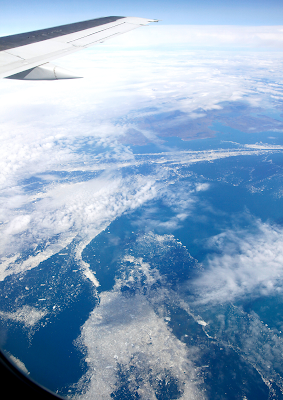 |
| Aerial View of Ellesmere Island |
The generic name,
Qikiqtania (pronounced kick-kick-TAN-ee-ya), is derived from the Inuktitut words
Qikiqtaaluk and
Qikiqtani which are the traditional place name of the region where the fossil was discovered.
The specific name, wakei, is in memory of the evolutionary biologist David Wake — colleague, mentor and friend.
He was a professor of integrative biology and Director and curator of herpetology at the Museum of Vertebrate Zoology at the University of California, Berkeley who passed away in April 2021.
Wake is known for his work on the biology and evolution of salamanders and vertebrate evolutionary biology.
If you look at the photo on the left you can imagine visiting these fossil localities in Canada's far north.
Qikiqtania was found on Inuit land and belongs to the community. Thomas Stewart and his colleagues were able to conduct this research because of the generosity and support of individuals in the hamlets of Resolute Bay and Grise Fiord, the Iviq Hunters and Trappers of Grise Fiord, and the Department of Heritage and Culture, Nunavut.
To them, on behalf of the larger scientific community — Nakurmiik. Thank you!
Here is the link to Tom Stewart's article in The Conversation & paper in Nature that dropped yesterday:
- Stewart, Thomas A.; Lemberg, Justin B.; Daly, Ailis; Daeschler, Edward B.; Shubin, Neil H. (2022-07-20). "A new elpistostegalian from the Late Devonian of the Canadian Arctic". Nature. doi:10.1038/s41586-022-04990-w. ISSN 0028-0836.
- Stewart, Thomas. "Meet Qikiqtania, a fossil fish with the good sense to stay in the water while others ventured onto land" The Conversation. Retrieved 2022-07-20.
Image One: An artist’s vision of Qikiqtania enjoying its fully aquatic, free-swimming lifestyle. Alex Boersma, CC BY-ND
Image Two: A new elpistostegalian from the Late Devonian of the Canadian Arctic, T. A. Stewart, J. B. Lemberg, A. Daly, E. B. Daeschler, & N. H. Shubin.
A huge shout out to the deeply awesome Neil Shubin who shared that the paper had been published and offered his insights on what played out behind the scenes!


%20Fram%20Formation%20of%20Nunavut,%20Canada.%20The%20genus%20contains%20a%20single%20species,%20Q.%20wakei,%20known%20from%20a%20partial%20skele.png)
