Showing posts with label turtle. Show all posts

Monday, April 15, 2024

TURTLE SHELLS: HOME SWEET ARMOUR

Turtle shells are different from the body armour or armoured shells we see adorning dinosaurs like the ankylosaurs. 

Ankylosaurs were blessed with huge plates of bone embedded into their skin that acted as a natural shield against predators. Crocodilians have these same bony plates, or osteoderms, embedded in their skin to give them extra protection. 

We find similar body armour on armadillos. Yet, armadillos, crocodiles and ankylosaurs each evolved body armour that differs significantly from that found in turtles. 

Remarkably, the carapace we see in fully grown turtles is formed from different parts of their skeletons. And, once fully formed, turtle shell fully integrates with the backbone and ribs, growing over the animal in a domed carapace — both protection and home sweet home. 

When we look to the oldest known members of the turtle lineage, Proterochersis and Proganochelys, found as fossils in 210 million-year-old outcrops in present-day Germany and Poland. Like the turtles we find today, these stem-turtles already had fully formed shells — special bony or cartilaginous shell that originates in their ribs. It is a useful adaptation to help deter predators as their soft interior makes for a tasty snack. 

Though I have never eaten turtle (and never will), it was a common and sought after meat for turtle soup. Years ago, I read of Charles Darwin craving it after trying it for the first time on his trip in 1831 aboard the HMS Beagle. It seems Charlie like to taste every exotic new species he had the opportunity to try.

Turtle armour is made of dermal bone and endochondral bones from their vertebrae and rib cage. It is fundamentally different from the armour seen on our other vertebrate friends and the design creates some unique features in turtles. 

Because turtle ribs fuse together with some of their vertebrae, they have to pump air in and out of the lungs with their leg muscles. 

Another unusual feature in turtles is their limb girdles, pectoral and pelvic, which have come to lie within their rib cage, a feature that allows some turtles to pull their limbs inside the shell for protection. 

Sea turtles didn't develop this behaviour or ability and do not retract into their shells like other turtles.

Armadillos have armour formed by plates of dermal bone covered in relatively small, overlapping epidermal scales called scutes, composed of bone with a covering of horn. In crocodiles, their exoskeletons form their armour, similar to ankylosaurs. A bit of genius design, really. It is made of protective dermal and epidermal components that begin as rete Malpighii: a single layer of short, cylindrical cells that lose their nuclei over time as they transform into a horny layer.

Depending on the species and age of the turtle, turtles eat all kinds of food including seagrass, seaweed, crabs, jellyfish, and shrimp,. That tasty diet shows up in the composition of their armour as they have oodles of great nutrients to work with. The lovely example you see here is from the Oxford Museum collections.

Sunday, March 24, 2024

STUPENDEMYS GEOGRAPHICUS: A COLOSSAL TURTLE

Freshwater turtles come in all shapes and sizes but one of the most interesting and massive of these is the now-extinct freshwater turtle Stupendemys geographicus.

These aquatic beasties had shells almost three metres long (up to 9.5 feet) making it about a 100 times larger and sharing mixed traits with some of it's nearest living relatives — the giant South American River Turtle, Podocnemis expansa and Yellow-Spotted Amazon River Turtle, Podocnemis unifilis, the Amazon river turtle, Peltocephalus dumerilianus, and twice that of the largest marine turtle, the leatherback, Dermochelys coriacea.

It was also larger than those huge Archelon turtles that lumbered along during the Late Cretaceous at a whopping 15 feet, just over 4.5 metres. Stupendemys geographicus lived during the Miocene in Venezuela and Columbia. South America is a treasure trove of unique fossil fauna.

Throughout its history, the region has been home to giant rodents and an amazing assortment of crocodylians. It was also home to one of the largest turtles that ever lived. But for many years, the biology and systematics of Stupendemys geographicus remained largely unknown. When we found them in the fossil record it is usually as bits and pieces of shell and bone; exciting finds but not enough for us to see the big picture.
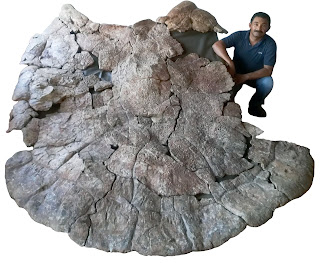
Palaeontologist Rodolfo Sánchez with Stupendemys geographicus
Back in 1994, several new shells and the first lower jaws of Stupendemys were found in the Urumaco region near Falcón State, Venezuela. The area is known to palaeontologists as a hotbed rich in well-preserved fossils. Fossil specimens of Stupendemys geographicus were first found here back in the 1970s by Harvard University researchers.

But for almost four decades, very few complete carapaces or other telltale fossils of Stupendemys were found in the region.

This excited Edwin Cadena, Paleontologist at the Universidad del Rosario in Colombia and researchers of the University of Zurich (UZH) and fellow researchers from Colombia, Venezuela, and Brazil. They had very good reason to believe that it was just a matter of time before more complete specimens were to be found. The area is a wonderful place to do fieldwork. It's an arid, desert locality without plant or forest coverage we see at other sites. Fossils weather out but do not wash away like they do at other sites.

Their efforts paid off and the fossils are marvellous. Shown here is Venezuelan Palaeontologist Rodolfo Sánchez with a male carapace (showing the horns) of Stupendemys geographical. This is one of the 8 million-year-old specimens from Venezuela.

Rodolfo Sánchez with Stupendemys geographicus
The team collected the most recent finds from Urumaco and added them fossil specimens from La Tatacoa Desert in Colombia.

Together, they paint a much clearer picture of a large terrestrial turtle that varied its diet and had distinct differences between the males and females in their morphology. Cadena published in February of this year with his colleagues in the journal Science Advances.

The researchers grouped together from multiple sites to help create a better understanding of the biology, lifestyle and phylogenetic position of these gigantic neotropical turtles.

Their paper includes the reporting of the largest carapace ever recovered and argues for a sole giant erymnochelyin taxon, S. geographicus, with extensive geographical distribution in what was the Pebas and Acre systems — pan-Amazonia during the middle Miocene to late Miocene in northern South America).

This turtle was quite the beast with two lance-like horns and battle scars to show it could hold its own with the apex predators of the day.

They also hypothesize that S. geographicus exhibited sexual dimorphism in shell morphology, with horns in males and hornless females. From the carapace length of 2.40 metres, they estimate to total mass of these turtles to be up to 1.145 kg, almost 100 times the size of its closest living relative. The newly found fossil specimens greatly expand the size of these fellows and our understanding of their biology and place in the geologic record.

Their conclusions paint a picture of a single giant turtle species across the northern Neotropics, but with two shell morphotypes, further evidence of sexual dimorphism. These were tuff turtles to prey upon. Bite marks and punctured bones tell us that they faired well from what must have been frequent predatory interactions with large, 30 foot long (over 9 metres) Caimans — big, burly alligatorid crocodilians — that also inhabited the northern Neotropics and shared their roaming grounds. Even with their large size, they were a very tempting snack for these brutes but unrequited as it appears Stupendemys fought, won and lumbered away.

Image Two: Venezuelan Palaeontologist Rodolfo Sánchez and a male carapace of Stupendemys geographicus, from Venezuela, found in 8 million years old deposits. Photo credit: Jorge Carrillo

Image Three: Venezuelan Palaeontologist Rodolfo Sánchez and a male carapace of Stupendemys geographicus, from Venezuela, found in 8 million years old deposits. Photo credit: Edwin Cadena

Reference: E-A. Cadena, T. M. Scheyer, J. D. Carrillo-Briceño, R. Sánchez, O. A Aguilera-Socorro, A. Vanegas, M. Pardo, D. M. Hansen, M. R. Sánchez-Villagra. The anatomy, paleobiology and evolutionary relationships of the largest side-necked extinct turtle. Science Advances. 12 February 2020. DOI: 10.1126/sciadv.aay4593

Saturday, March 23, 2024

TEMPERATURE, SAND AND SEX: GREEN SEA TURTLES

What do temperature, sand and sex have in common?

Well, for the Green Sea Turtle—everything. When these cuties are still in their shells incubating, the temperature of the sand surrounding them determines their sex. 

Boy or girl? 

Warm sand produces females and cooler sand hatches out male Green Sea Turtles.

The Green Sea Turtle, Chelonia mydas, also known as the Green Turtle, Black Sea Turtle or Pacific Green Turtle is a species in the family Cheloniidae.

It is the only species in the genus Chelonia. Its range extends throughout tropical and subtropical seas around the world, with two distinct populations in the Atlantic and Pacific Oceans, but it is also found in the Indian Ocean. 

The common name refers to the usually green fat found beneath its carapace, not to the colour of its carapace, which is olive to black.

This sea turtle's dorsoventrally flattened body is covered by a large, teardrop-shaped carapace; it has a pair of large, paddle-like flippers. It is usually lightly coloured, although in the eastern Pacific populations' parts of the carapace can be almost black. Unlike other members of its family, such as the hawksbill sea turtle, C. mydas is mostly herbivorous. The adults usually inhabit shallow lagoons, feeding mostly on various species of seagrasses. The turtles bite off the tips of the blades of seagrass, which keeps the grass healthy and these aquatic vegans in top shape..

Like other sea turtles, green sea turtles migrate long distances between feeding grounds and hatching beaches. Many islands worldwide are known as Turtle Island due to green sea turtles nesting on their beaches. Females crawl out on beaches, dig nests and lay eggs during the night. Later, hatchlings emerge and scramble into the water. Those that reach maturity may live to 80 years in the wild.

Researchers at the Senckenberg Research Institute in Frankfurt, Germany discovered the remains of the oldest fossilized sea turtle known to date. Remains from a new species, Desmatochelys padillai sp, including fossilized shell and bones have been found at two outcrops near Villa de Leyva, Colombia. 

The find was published in the journal PaleoBios, dates the reptile at 120 million years old – 25 million years older than any previously known specimen of this beautiful and long-lived turtle.

Wednesday, February 7, 2024

VANCOUVER ISLAND'S TRENT RIVER PALAEONTOLOGY

Dan Bowen, Chair, VIPS, Trent River
The rocks that make up the Trent River on Vancouver Island are on the move. They were laid down near of the equator as small, tropical islands. They rode across the Pacific heading north and slightly east over the past 85 million years to where we find them today.

The Pacific Plate is an oceanic tectonic plate that lies beneath the Pacific Ocean. And it is massive. At 103 million km2 (40 million sq mi), it is the largest tectonic plate and continues to grow fed by volcanic eruptions that piggyback onto its trailing edge.

This relentless expansion pushes the Pacific Plate into the North American Plate. The pressure subducts it beneath our continent where it then melts back into the earth. Plate tectonics are slow but powerful forces. 

The island chains that rode the plates across the Pacific smashed into our coastline and slowly built the province of British Columbia. And because each of those islands had a different origin, they create pockets of interesting and diverse geology.

It is these islands that make up the Insular Belt — a physio-geological region on the northwestern North American coast. It consists of three major island groups — and many smaller islands — that stretches from southern British Columbia up into Alaska and the Yukon. These bits of islands on the move arrived from the Late Cretaceous through the Eocene — and continues to this day.

The rocks that form the Insular Superterrane are allochthonous, meaning they are not related to the rest of the North American continent. The rocks we walk over along the Trent River are distinct from those we find throughout the rest of Vancouver Island, Haida Gwaii, the rest of the province of British Columbia and completely foreign to those we find next door in Alberta.

To discover what we do find on the Trent takes only a wee stroll, a bit of digging and time to put all the pieces of the puzzle together. The first geological forays to Vancouver Island were to look for coal deposits, the profitable remains of ancient forests that could be burned to the power industry.

Jim Monger and Charlie Ross of the Geological Survey of Canada both worked to further our knowledge of the complex geology of the Comox Basin. They were at the cutting edge of west coast geology in the 1970s. It was their work that helped tease out how and where the rocks we see along the Trent today were formed and made their way north.

We know from their work that by 85 million years ago, the Insular Superterrane had made its way to what is now British Columbia. 

The lands were forested much as they are now but by extinct genera and families. The fossil remains of trees similar to oak, poplar, maple and ash can be found along the Trent and Vancouver Island. We also see the lovely remains of flowering plants such as Cupanities crenularis, figs and breadfruit.

Heading up the river, you come to a delineation zone that clearly marks the contact between the dark grey marine shales and mudstones of the Haslam Formation where they meet the sandstones of the Comox Formation. Fossilized material is less abundant in the Comox sandstones but still contains some interesting specimens. Here you begin to see fossilized wood and identifiable fossil plant material.

Further upstream, there is a small tributary, Idle Creek, where you can find more of this terrestrial material in the sandy shales. As you walk up, you see identifiable fossil plants beneath your feet and jungle-like, overgrown moss-covered, snarly trees all around you.

Walking west from the Trent River Falls at the bottom, you pass the infamous Ammonite Alley, where you can find Mesopuzosia sp. and Kitchinites sp. of the Upper Cretaceous (Santonian), Haslam Formation. Minding the slippery green algae covering some of the river rocks, you can see the first of the Polytychoceras vancouverense zone.

Continuing west, you reach the first of two fossil turtle sites on the river — amazingly, one terrestrial and one marine. If you continue, you come to the Inland Island Highway.

The Trent River has yielded some very interesting marine specimens, and significant terrestrial finds. We have found a wonderful terrestrial helochelydrid turtle, Naomichelys speciosa, and the caudal vertebrae of a Hadrosauroid dinosaur. Walking down from the Hadrosaur site you come to the site of the fossil ratfish find — one of the ocean's oddest fish.

Ratfish, Hydrolagus Collie, are chimaera found in the north-eastern Pacific Ocean today. The fossil specimen from the Trent would be considered large by modern standards as it is a bruiser in comparison to his modern counterparts. 

This robust fellow had exceptionally large eyes and sex organs that dangled enticingly between them. You mock, but there are many ratfish who would differ. While inherently sexy by ratfish standards, this fellow was not particularly tasty to their ancient marine brethren (or humans today) — so not hugely sought after as a food source or prey.

A little further again from the ratfish site we reach the contact of the two Formations. The rocks here have travelled a long way to their current location. With them, we peel away the layers of the geologic history of both the Comox Valley and the province of British Columbia.

The Trent River is not far from the Puntledge, a river whose banks have also revealed many wonderful fossil specimens. The Puntledge is also the name used by the K'ómoks First Nation to describe themselves. They have lived here since time immemorial. Along with Puntledge, they refer to themselves as Sahtloot, Sasitla and Ieeksun.

References: Note on the occurrence of the marine turtle Desmatochelys (Reptilia: Chelonioidea) from the Upper Cretaceous of Vancouver Island Elizabeth L. Nicholls Canadian Journal of Earth Sciences (1992) 29 (2): 377–380. https://doi.org/10.1139/e92-033; References: Chimaeras - The Neglected Chondrichthyans". Elasmo-research.org. Retrieved 2017-07-01.

Directions: If you're keen to explore the area, park on the side of Highway 19 about three kilometres south of Courtenay and hike up to the Trent River. Begin to look for parking about three kilometres south of the Cumberland Interchange. There is a trail that leads from the highway down beneath the bridge which will bring you to the Trent River's north side.

Thursday, June 8, 2023

VANCOUVER ISLAND'S FABULOUS FOSSILS: TRENT RIVER PALAEONTOLOGY

Dan Bowen, Chair, VIPS, Trent River
The rocks that make up the Trent River on Vancouver Island are on the move. They were laid down near of the equator as small, tropical islands. They rode across the Pacific heading north and slightly east over the past 85 million years to where we find them today.

The Pacific Plate is an oceanic tectonic plate that lies beneath the Pacific Ocean. And it is massive. At 103 million km2 (40 million sq mi), it is the largest tectonic plate and continues to grow fed by volcanic eruptions that piggyback onto its trailing edge.

This relentless expansion pushes the Pacific Plate into the North American Plate. The pressure subducts it beneath our continent where it then melts back into the earth. Plate tectonics are slow but powerful forces. 

The island chains that rode the plates across the Pacific smashed into our coastline and slowly built the province of British Columbia. And because each of those islands had a different origin, they create pockets of interesting and diverse geology.

It is these islands that make up the Insular Belt — a physio-geological region on the northwestern North American coast. It consists of three major island groups — and many smaller islands — that stretches from southern British Columbia up into Alaska and the Yukon. These bits of islands on the move arrived from the Late Cretaceous through the Eocene — and continues to this day.

The rocks that form the Insular Superterrane are allochthonous, meaning they are not related to the rest of the North American continent. The rocks we walk over along the Trent River are distinct from those we find throughout the rest of Vancouver Island, Haida Gwaii, the rest of the province of British Columbia and completely foreign to those we find next door in Alberta.

To discover what we do find on the Trent takes only a wee stroll, a bit of digging and time to put all the pieces of the puzzle together. The first geological forays to Vancouver Island were to look for coal deposits, the profitable remains of ancient forests that could be burned to the power industry.

Jim Monger and Charlie Ross of the Geological Survey of Canada both worked to further our knowledge of the complex geology of the Comox Basin. They were at the cutting edge of west coast geology in the 1970s. It was their work that helped tease out how and where the rocks we see along the Trent today were formed and made their way north.

We know from their work that by 85 million years ago, the Insular Superterrane had made its way to what is now British Columbia. 

The lands were forested much as they are now but by extinct genera and families. The fossil remains of trees similar to oak, poplar, maple and ash can be found along the Trent and Vancouver Island. We also see the lovely remains of flowering plants such as Cupanities crenularis, figs and breadfruit.

Heading up the river, you come to a delineation zone that clearly marks the contact between the dark grey marine shales and mudstones of the Haslam Formation where they meet the sandstones of the Comox Formation. Fossilized material is less abundant in the Comox sandstones but still contains some interesting specimens. Here you begin to see fossilized wood and identifiable fossil plant material.

Further upstream, there is a small tributary, Idle Creek, where you can find more of this terrestrial material in the sandy shales. As you walk up, you see identifiable fossil plants beneath your feet and jungle-like, overgrown moss-covered, snarly trees all around you.

Walking west from the Trent River Falls at the bottom, you pass the infamous Ammonite Alley, where you can find Mesopuzosia sp. and Kitchinites sp. of the Upper Cretaceous (Santonian), Haslam Formation. Minding the slippery green algae covering some of the river rocks, you can see the first of the Polytychoceras vancouverense zone.

Continuing west, you reach the first of two fossil turtle sites on the river — amazingly, one terrestrial and one marine. If you continue, you come to the Inland Island Highway.

The Trent River has yielded some very interesting marine specimens, and significant terrestrial finds. We have found a wonderful terrestrial helochelydrid turtle, Naomichelys speciosa, and the caudal vertebrae of a Hadrosauroid dinosaur. Walking down from the Hadrosaur site you come to the site of the fossil ratfish find — one of the ocean's oddest fish.

Ratfish, Hydrolagus Collie, are chimaera found in the north-eastern Pacific Ocean today. The fossil specimen from the Trent would be considered large by modern standards as it is a bruiser in comparison to his modern counterparts. 

This robust fellow had exceptionally large eyes and sex organs that dangled enticingly between them. You mock, but there are many ratfish who would differ. While inherently sexy by ratfish standards, this fellow was not particularly tasty to their ancient marine brethren (or humans today) — so not hugely sought after as a food source or prey.

A little further again from the ratfish site we reach the contact of the two Formations. The rocks here have travelled a long way to their current location. With them, we peel away the layers of the geologic history of both the Comox Valley and the province of British Columbia.

The Trent River is not far from the Puntledge, a river whose banks have also revealed many wonderful fossil specimens. The Puntledge is also the name used by the K'ómoks First Nation to describe themselves. They have lived here since time immemorial. Along with Puntledge, they refer to themselves as Sahtloot, Sasitla and Ieeksun.

References: Note on the occurrence of the marine turtle Desmatochelys (Reptilia: Chelonioidea) from the Upper Cretaceous of Vancouver Island Elizabeth L. Nicholls Canadian Journal of Earth Sciences (1992) 29 (2): 377–380. https://doi.org/10.1139/e92-033; References: Chimaeras - The Neglected Chondrichthyans". Elasmo-research.org. Retrieved 2017-07-01.

Directions: If you're keen to explore the area, park on the side of Highway 19 about three kilometres south of Courtenay and hike up to the Trent River. Begin to look for parking about three kilometres south of the Cumberland Interchange. There is a trail that leads from the highway down beneath the bridge which will bring you to the Trent River's north side.

Monday, February 6, 2023

FOSSILS OF NOVA SCOTIA

Dendrerpeton acadianum, an extinct amphibian
One of the best Canadian fossil finds stems from a random boulder picked up on the beach near the town of Joggins, Nova Scotia. Inside were the bones of a fully articulated skeleton of Dendrerpeton acadianum, a Temnospondyli from the Lower Pennsylvanian. 

These little cuties belong to an extinct genus of amphibians who loved wet, swampy wetlands similar to those we find in the bayous of Mississippi today.   

Dendrerpeton is the primitive sister-group to a clade of Temnospondyls that includes Trimerorhachoids, the Eryopoids — Ervops, Parioxys, & Sclerocephalus — Zatracheids & Dissorophoids. 

This little guy along with finding the first true reptile, Hylonomus lyelli, ancestor of all dinosaurs that would rule the Earth 100 million years later serve as the reference point where animals finally broke free of the water to live on land. This evolutionary milestone recorded at Joggins remains pivotal to understanding the origins of all vertebrate life on land, including our own species. 

Joggins records life in a once a wet, swampy wetland
Sir Charles Lyell, the author of Principles of Geology, first noted the exceptional natural heritage value of the Joggins Fossil Cliffs. He described them as: 

“...the finest example in the world of a natural exposure in a continuous section ten miles long, occurs in the sea cliffs bordering a branch of the Bay of Fundy in Nova Scotia.” 

Indeed, the world-famous Bay of Fundy with its impressive tides, the highest in the world, and stormy nature exposed much of this outcrop. 

Thursday, November 17, 2022

FOSSIL AMPHIBIANS OF NOVA SCOTIA

Dendrerpeton acadianum, an extinct amphibian
One of the best Canadian fossil finds stems from a random boulder picked up on the beach near the town of Joggins, Nova Scotia. Inside were the bones of a fully articulated skeleton of Dendrerpeton acadianum, a Temnospondyli from the Lower Pennsylvanian. 

These little cuties belong to an extinct genus of amphibians who loved wet, swampy wetlands similar to those we find in the bayous of Mississippi today.   

Dendrerpeton is the primitive sister-group to a clade of Temnospondyls that includes Trimerorhachoids, the Eryopoids — Ervops, Parioxys, & Sclerocephalus — Zatracheids & Dissorophoids. 

This little guy along with finding the first true reptile, Hylonomus lyelli, ancestor of all dinosaurs that would rule the Earth 100 million years later serve as the reference point where animals finally broke free of the water to live on land. This evolutionary milestone recorded at Joggins remains pivotal to understanding the origins of all vertebrate life on land, including our own species. 

Joggins records life in a once a wet, swampy wetland
Sir Charles Lyell, the author of Principles of Geology, first noted the exceptional natural heritage value of the Joggins Fossil Cliffs. He described them as: 

“...the finest example in the world of a natural exposure in a continuous section ten miles long, occurs in the sea cliffs bordering a branch of the Bay of Fundy in Nova Scotia.” 

Indeed, the world-famous Bay of Fundy with its impressive tides, the highest in the world, and stormy nature exposed much of this outcrop. 

Wednesday, January 26, 2022

TRENT RIVER FOSSIL TURTLE

The Trent River near Courtenay, British Columbia is a hotbed of 85-million-year-old fossil fauna immortalized in stone. 

The bedrock of the Trent River has yielded both marine and terrestrial fossils. 

While you might just gloss over that tidbit of information with a casual nod, consider how unlikely this particular fossil site is. We find fossils of species that lived on the land just metres from those who lived in our ancient oceans — remarkable!

We have found a nearly complete terrestrial helochelydrid turtle, the bones of a juvenile elasmosaur marine reptile and the caudal vertebrae of a Hadrosauroid dinosaur who munched on plants, all within spitting distance of one another.

If you stroll along the Trent solo or as part of a guided tour through the Courtenay Museum, you can walk right up to the Hadrosaur site. It was here many years ago that Mike Trask (whose name may ring a bell as he found the first elasmosaur on the Puntledge River) found bones from a duck-bill dinosaur. Now in Alberta, the province just east of British Columbia, there are areas where if you throw a rock, you'll hit a duck-bill bone, but in British Columbia, they were unheard of. This was not just the first duck-billed dinosaur, it was also the first dinosaur found on Vancouver Island — ever.   

Let's park that little bit of goodness for now and hold your awe and applause for the bounty of the Trent and walk just a wee bit down from the hadrosaur site where you come to the greyish bedrock that looks so plain it seems hardly worth noting, but it was once the resting place of a fossil ratfish, one of the ocean's oddest fish.  

If you head a wee bit upriver, you come to the delineation zone marking the contact between the dark grey marine shales and mudstones of the Haslam Formation where they meet the sandstones of the Comox Formation. 

Fossilized material in the Comox sandstones is less abundant but still well worth a look. If you look closely you begin to see fossilized wood and identifiable fossil plant material. So, hadrosaur, terrestrial, ratfish, marine, then terrestrial plant material. This river just keeps on giving.

Further upstream, there is a small tributary, Idle Creek, where you can find more of this terrestrial material in the sandy shales. A little further up the river, you see more identifiable fossil plants beneath your feet and jungle-like, overgrown snarly trees all around you.

Mesopuzosia sp.; Collection of Rick Ross
If you started your journey at the Trent River Falls and walked west, you pass the infamous Ammonite Alley, where you can find Mesopuzosia sp. and Kitchinites sp. of the Upper Cretaceous (Santonian), Haslam Formation. 

I have included one of the yummy, chocolate coloured Mesopuzosia sp. ammonite found, prepped and photographed by the deeply awesome Rick Ross of the Vancouver Island Palaeontological Society for you to enjoy. 

You are now in the Polytychoceras vancouverense zone. Continuing west, we reach the first of two fossil turtle sites on the river — one terrestrial and one marine. I thought I would share a bit about the terrestrial turtle found here as it is one of my favourite discoveries — after the excitement of the elasmosaur excavated last summer.   

Helochelydrids are a group of poorly known turtles from Late Jurassic to Late Cretaceous deposits in North America and Europe. It is the only known North American member of Helochelydridae.

Naomichelys is known from numerous specimens throughout western North America, most notably the holotype partial shell from the Early Cretaceous Cloverly Formation of Montana and a complete skeleton from the Antlers Formation of Texas. The Cloverly Formation includes a number of vertebrate fossils including a diverse assemblage of dinosaur fossils. the site was designated as a National Natural Landmark by the National Park Service in 1973.

Naomichelys is a member of the family Helochelydridae. We find their fossilized remains in Late Jurassic to Late Cretaceous deposits in North America and Europe. Within North America, only the species Naomichelys speciosa is known from relatively complete material which makes comparisons between specimens from other localities challenging. The delightful Phil Currie along with co-authors Matthew J. Vavrek, Derek W. Larson, Donald B. Brinkman and Courtenay's own Joe Morin described the new species of Helochelydrid terrestrial turtle and put the Trent River near Courtenay, British Columbia on the palaeontological map once again.

The new genus and species of helochelydrid turtle were based on the relatively complete shell from the bedrock of the Trent. This area is a section of the marine Haslam Formation (Santonian) of Vancouver Island, British Columbia, Canada.

The new species is characterized by several distinctive shell features, notably a forward curving process on the anterior portion of the hyoplastra, strongly distinguishing it from N. speciosa

The shell is relatively small — and much smaller than one might expect — but does appear to be from a fully grown individual and not a juvenile, suggesting that the species was generally much smaller than other known helochelydrids.

Previously most records of helochelydrids in North America had been assigned to N. speciosa, regardless of actual diagnosable characters. 

The presence of an additional species of helochelydrid from North America tells us that a greater diversity of the taxon was present than was previously recognized. While the interspecific relationships of helochelydrids remain difficult to fully assess, due to the lack of well-preserved specimens, this new species provides additional geographic and phylogenetic data that aids our understanding of this enigmatic group.

As the rock of the Trent River slowly erodes away, it will be interesting to see what it reveals next. We have now found both marine and terrestrial reptiles along with plants, ammonites and other fossil goodies. Tis a story — and river — to keep an eye on!

What to Know Before You Go — Trent River Walk

The full Trent River Walk is 14.8 kilometres of moderate hiking on a well-maintained trail. You may choose to enjoy the wide, flat beginning section of the loop and leave off the narrower sections of the trail where you need to navigate roots and rock. Dogs on leash are welcome. 

You can do this as a family year-round. The trail provides access to the many collecting areas of the river. Be mindful of slippery rocks and keep your eyes peeled for fossils. To enter the trail and find parking, set 375 Hatton Road, Courtenay, British Columbia, into your GPS. Enjoy!   

Wednesday, July 7, 2021

TREASURES OF CANADA: TRENT RIVER PALAEONTOLOGY

Dan Bowen, Chair, VIPS, Trent River
The rocks that make up the Trent River on Vancouver Island were laid down south of the equator as small, tropical islands. They rode across the Pacific heading north and slightly east over the past 85 million years to where we find them today.

The Pacific Plate is an oceanic tectonic plate that lies beneath the Pacific Ocean. And it is massive. At 103 million km2 (40 million sq mi), it is the largest tectonic plate and continues to grow fed by volcanic eruptions that piggyback onto its trailing edge.

This relentless expansion pushes the Pacific Plate into the North American Plate. The pressure subducts it beneath our continent where it then melts back into the earth. Plate tectonics are slow but powerful forces. 

The island chains that rode the plates across the Pacific smashed into our coastline and slowly built the province of British Columbia. And because each of those islands had a different origin, they create pockets of interesting and diverse geology.

It is these islands that make up the Insular Belt — a physio-geological region on the northwestern North American coast. It consists of three major island groups — and many smaller islands — that stretches from southern British Columbia up into Alaska and the Yukon. These bits of islands on the move arrived from the Late Cretaceous through the Eocene — and continues to this day.

The rocks that form the Insular Superterrane are allochthonous, meaning they are not related to the rest of the North American continent. The rocks we walk over along the Trent River are distinct from those we find throughout the rest of Vancouver Island, Haida Gwaii, the rest of the province of British Columbia and completely foreign to those we find next door in Alberta.

To discover what we do find on the Trent takes only a wee stroll, a bit of digging and time to put all the pieces of the puzzle together. The first geological forays to Vancouver Island were to look for coal deposits, the profitable remains of ancient forests that could be burned to the power industry.

Jim Monger and Charlie Ross of the Geological Survey of Canada both worked to further our knowledge of the complex geology of the Comox Basin. They were at the cutting edge of west coast geology in the 1970s. It was their work that helped tease out how and where the rocks we see along the Trent today were formed and made their way north.

We know from their work that by 85 million years ago, the Insular Superterrane had made its way to what is now British Columbia. 

The lands were forested much as they are now but by extinct genera and families. The fossil remains of trees similar to oak, poplar, maple and ash can be found along the Trent and Vancouver Island. We also see the lovely remains of flowering plants such as Cupanities crenularis, figs and breadfruit.

Heading up the river, you come to a delineation zone that clearly marks the contact between the dark grey marine shales and mudstones of the Haslam Formation where they meet the sandstones of the Comox Formation. Fossilized material is less abundant in the Comox sandstones but still contains some interesting specimens. Here you begin to see fossilized wood and identifiable fossil plant material.

Further upstream, there is a small tributary, Idle Creek, where you can find more of this terrestrial material in the sandy shales. As you walk up, you see identifiable fossil plants beneath your feet and jungle-like, overgrown moss-covered, snarly trees all around you.

Walking west from the Trent River Falls at the bottom, you pass the infamous Ammonite Alley, where you can find Mesopuzosia sp. and Kitchinites sp. of the Upper Cretaceous (Santonian), Haslam Formation. Minding the slippery green algae covering some of the river rocks, you can see the first of the Polytychoceras vancouverense zone.

Continuing west, you reach the first of two fossil turtle sites on the river — amazingly, one terrestrial and one marine. If you continue, you come to the Inland Island Highway.

The Trent River has yielded some very interesting marine specimens, and significant terrestrial finds. We have found a wonderful terrestrial helochelydrid turtle, Naomichelys speciosa, and the caudal vertebrae of a Hadrosauroid dinosaur. Walking down from the Hadrosaur site you come to the site of the fossil ratfish find — one of the ocean's oddest fish.

Ratfish, Hydrolagus Collie, are chimaera found in the north-eastern Pacific Ocean today. The fossil specimen from the Trent would be considered large by modern standards as it is a bruiser in comparison to his modern counterparts. 

This robust fellow had exceptionally large eyes and sex organs that dangled enticingly between them. You mock, but there are many ratfish who would differ. While inherently sexy by ratfish standards, this fellow was not particularly tasty to their ancient marine brethren (or humans today) — so not hugely sought after as a food source or prey.

A little further again from the ratfish site we reach the contact of the two Formations. The rocks here have travelled a long way to their current location. With them, we peel away the layers of the geologic history of both the Comox Valley and the province of British Columbia.

The Trent River is not far from the Puntledge, a river whose banks have also revealed many wonderful fossil specimens. The Puntledge is also the name used by the K'ómoks First Nation to describe themselves. They have lived here since time immemorial. Along with Puntledge, they refer to themselves as Sahtloot, Sasitla and Ieeksun.

References: Note on the occurrence of the marine turtle Desmatochelys (Reptilia: Chelonioidea) from the Upper Cretaceous of Vancouver Island Elizabeth L. Nicholls Canadian Journal of Earth Sciences (1992) 29 (2): 377–380. https://doi.org/10.1139/e92-033; References: Chimaeras - The Neglected Chondrichthyans". Elasmo-research.org. Retrieved 2017-07-01.

Directions: If you're keen to explore the area, park on the side of Highway 19 about three kilometres south of Courtenay and hike up to the Trent River. Begin to look for parking about three kilometres south of the Cumberland Interchange. There is a trail that leads from the highway down beneath the bridge which will bring you to the Trent River's north side.