Showing posts with label writing. Show all posts

Saturday, March 16, 2024

DRIFTWOOD CANYON FOSSIL BEDS / KUNGAX

Puffbird similar to Fossil Birds found at Driftwood Canyon 
Driftwood Canyon Provincial Park 

Driftwood Canyon Provincial Park covers 23 hectares of the Bulkley River Valley, on the east side of Driftwood Creek, a tributary of the Bulkley River, 10 km northeast of the town of Smithers in northern British Columbia. 

Wet'suwet'en First Nation

The parklands are part of the asserted traditional territory of the Wet'suwet'en First Nation which includes lands around the Bulkley River, Burns Lake, Broman Lake, and François Lake in the northwestern Central Interior of British Columbia. 

The Wetʼsuwetʼen are part of the Dakelh or Carrier First Nation, and in combination with the Babine First Nation are referred to as the Western Carrier. They speak Witsuwitʼen, a dialect of the Babine-Witsuwitʼen language which, like its sister language Carrier, is a member of the Athabaskan family.

Their oral history or kungax recounts a time when their ancestral village, Dizkle or Dzilke, once stood upstream from the Bulkley Canyon. This cluster of cedar houses on both sides of the river was said to be abandoned because of an omen of impending disaster. The exact location of the village has been lost but their stories live on. 

The neighbouring Gitxsan, collectively the People of Smooth Waters—the Gilseyhu Big Frog Clan, the Laksilyu Small Frog Clan, the Tsayu Beaver Clan, the Gitdumden Wolf and Bear Clan and the Laksamshu Fireweed and Owl Clan—each phratry or kinship group calling the Lax Yip home—33,000 km2 of land and water in northwestern ​British Columbia along the waters of the Skeena River and its tributaries—have a similar tale—though the village in their versions is referred to as Dimlahamid or Temlahan depending on which house group or wilp is sharing the tale—as well as where they are located as dialects differ. 

Gitksan speak Sim'algaxthe real or true language. Within the Gitxsan communities there are two slightly different dialects. The Gyeets (Downriver) dialect spoken in Gijigyukwhla (Gitsegukla), Gitwangax, and Gitanyow—and the Gigeenix (Upriver) dialect is spoken in Ansbayaxw (Kispiox), Sik-E-Dakh and Gitanmaax.

Driftwood Canyon Fossil Beds

Driftwood Canyon's Fossil Beds record life in the earlier portion of the Eocene when British Columbia — and indeed our world — was much warmer than it is today. This site was discovered in the beginning of the 20th century and is now recognized as containing significant fossil material. 

The fossils found here—and their superb preservation—provide a fascinating opportunity to understand the area’s evolutionary processes of both geology and biology over the past fifty million years or so. The fossils themselves are 51.7 million years old and look remarkably like many of the species we recognize today. 

The park that contains these beautiful fossils is fifty-seven years old. It was created in 1967 by the generosity of the late Gordon Harvey (1913–1976). He donated the land to protect fossil resources that he truly loved and wanted to see preserved. The fossil beds are on the east side of Driftwood Creek. 

Metasequoia, the Dawn Redwood
Exploring the region today, we see a landscape dominated by conifers blanketing the area. 

Forests teem with the aromatic Western Red Cedar, Pacific Silver Fir with its many medicinal properties, the tall and lanky Subalpine Fir with its soft, brittle and quickly decaying wood, the slender scaly Lodgepole Pine, the graceful and slightly forlorn looking Western Hemlock. Across the landscape you see several species of Spruce, including the impressive Sitka. 

Some of the tallest on view would have been mere seedlings, colonizing the glacial moraines centuries ago when the glaciers retreated. Collectively, these conifers tell the tale of the region's cool climate today. 

The Gitsan territory boasts seven of the 14 biogeoclimatic zones of the province—the Alpine Tundra, Spruce-Willow-Birch, Boreal White and Black Spruce, Sub-Boreal Pine-Spruce, Sub-Boreal Spruce, Engelmann Spruce-Subalpine Fir and Interior Cedar-Hemlock. 

The fossil material we find here speaks to a warmer climate in this region's past. We find fossil plants, fish—including specimens of salmon, suckerfish and bowfin, a type of air breathing fish—and insect fossil here—wasps and water striders—fossil plants including Metasequoia, the Dawn Redwood, alder—and interesting vertebrate material. Bird feathers are infrequently collected from the shales; however, two bird body fossils have been found here.

In 1968, a bird body fossil was collected in the Eocene shales of the Ootsa Lake Group in Driftwood Canyon Provincial Park by Pat Petley of Kamloops. 

Pat donated the specimen in 2000 to the Thompson Rivers University (TRU) palaeontology collections. This fossil bird specimen is tentatively identified as the puffbird, Piciformes bucconidae, of the genus Primobucco.

Primobucco is an extinct genus of bird placed in its own family, Primobucconidae. The type species, Primobucco mcgrewi, lived during the Lower Eocene of North America. It was initially described by American paleo-ornithologist Pierce Brodkorb in 1970, from a fossil right-wing, and thought to be an early puffbird. However, the discovery of a further 12 fossils in 2010 indicate that it is instead an early type of roller.

Related fossils from the European Messel deposits have been assigned to the two species P. perneri and P. frugilegus. Two specimens of P. frugilegus have been found with seeds in the area of their digestive tract, which suggests that these birds were more omnivorous than the exclusively predaceous modern rollers. The Driftwood specimen has never been thoroughly studied. If there is a grad student out there looking for a worthy thesis, head on down to the Thompson Rivers University where you'll find the specimen on display.

Another fossil bird, complete with feathers, was collected at Driftwood Canyon in 1970, This one was found by Margret and Albrecht Klöckner who were travelling from Germany. Theirs is a well-travelled specimen, having visited many sites in BC as they toured around, then to Germany and finally back to British Columbia when it was repatriated and donated to the Royal British Columbia Museum in Victoria. 

I am not sure if it is still on display or back in collections, but it was lovingly displayed back in 2008. There is a new grad student, Alexis, looking at Eocene bird feathers down at the RBCM, so perhaps it is once again doing the rounds. 

This second bird fossil is of a long-legged water bird and has been tentatively identified by Dr. Gareth Dyke of the University of Southampton as possibly from the order Charadriiformes, a diverse order of small to medium-ish water birds that include 350 species of gulls, plovers, sandpipers, terns, snipes, and waders. Hopefully, we'll hear more on this find in the future.

A Tapir showing off his prehensile nose trunk
Tapirs and Tiny Hedgehogs

The outcrops at Driftwood Canyon are also special because they record a record of some of the first fossil mammals ever to be found in British Columbia at this pivotal point in time. 

Wee proto-hedgehogs smaller than your thumb lived in the undergrowth of that fossil flora. They shared the forest floor with an extinct tapir-like herbivore in the genus Heptodon that looked remarkably similar to his modern, extant cousins (there is a rather cheeky fellow shown here so you get the idea) but lacked their pronounced snout (proboscis). I am guessing that omission made him the more fetching of his lineage.

In both cases, it was a fossilized jaw bone that was recovered from the mud, silt and volcanic ash outcrops in this ancient lakebed site. And these two cuties are significant— they are the very first fossil mammals we've ever found from the early Eocene south of the Arctic.

How can we be sure of the timing? The fossil outcrops here are found within an ancient lakebed. Volcanic eruptions 51 million years ago put loads of fine dust into the air that settled then sank to the bottom of the lake, preserving the specimens that found their way here — leaves, insects, birds, mammals.

 As well as turning the lake into a fossil making machine—water, ash, loads of steady sediment to cover specimens and stave off predation—the volcanic ash contains the very chemically inert—resistant to mechanical weathering—mineral zircon which we can date with uranium/lead (U/Pb). 

The U/Pb isotopic dating technique is wonderfully accurate and mighty helpful in dating geologic events from volcanic eruptions, continental movements to mass extinctions. This means we know exactly when these lovelies were fossilized and, in turn, their significance.

Know Before You Go

If you fancy a visit to Driftwood Canyon Park, the park is accessible from Driftwood Road from Provincial Highway 16. You are welcome to view and photograph the fossils found here but collecting is strictly forbidden. 

Driftwood Canyon is recognized as one of the world’s most significant fossil beds. It provides park users with a fascinating opportunity to understand the area’s evolutionary processes of both geology and biology. The day-use area is open from May 15 to September 2. There is a short, wheelchair-accessible interpretative trail that leads from the parking are to the fossil beds. Pets are welcome on leash. Signs along the trail provide information on fossils and local history. 

Below a cliff face at the end of the trail is a viewing area that has interpretive information and viewing area overlooking Driftwood Creek.

This park proudly operated by Mark and Anais Drydyk
Email: kermodeparks@gmail.com / Tel: 1 250 877-1482 or 1 250 877-1782

Palaeo Coordinates: Latitude: 50° 51' 59" N / Longitude: 116° 27' 37" W
Lat/Long (dec): 50.86665,-116.46042 / GUID: d3a6bd3e-68d6-42cf-9b2c-d20a30576988

Driftwood Canyon Provincial Park Brochure: 
https://bcparks.ca/explore/parkpgs/driftwood_cyn/driftwood-canyon-brochure.pdf?v=1638723136455


Tuesday, January 30, 2024

BUMBLEBEES: FOSSILS AND FIRST NATIONS

This fuzzy yellow and black striped fellow is a bumblebee in the genus Bombus sp., family Apidae. We know him from our gardens where we see them busily lapping up nectar and pollen from flowers with their long hairy tongues.

My Norwegian cousins on my mother's side call them humle. Norway is a wonderful place to be something wild as the wild places have not been disturbed by our hands. 

There are an impressive thirty-five species of bumblebee species that call Norway hjem (home), and one, Bombus consobrinus, boasts the longest tongue that they use to feast solely on Monkshood, genus Aconitum, you may know by the name Wolf's-bane.

In the Kwak̓wala language of the Kwakwaka'wakw, speakers of Kwak'wala, and my family in the Pacific Northwest, bumblebees are known as ha̱mdzalat̕si — though I wonder if this is actually the word for a honey bee, Apis mellifera, as ha̱mdzat̕si is the word for a beehive.

I have a special fondness for all bees and look for them both in the garden and in First Nation art.

Bumblebees' habit of rolling around in flowers gives us a sense that these industrious insects are also playful. In First Nation art they provide levity — comic relief along with their cousins the mosquitoes and wasps — as First Nation dancers wear masks made to mimic their round faces, big round eyes and pointy stingers. A bit of artistic license is taken with their forms as each mask may have up to six stingers. The dancers weave amongst the watchful audience and swoop down to playfully give many of the guests a good, albeit gentle, poke. 

Honey bees actually do a little dance when they get back to the nest with news of an exciting new place to forage — truly they do. Bumblebees do not do a wee bee dance when they come home pleased with themselves from a successful foraging mission, but they do rush around excitedly, running to and fro to share their excitement. They are social learners, so this behaviour can signal those heading out to join them as they return to the perfect patch of wildflowers. 

Bumblebees are quite passive and usually sting in defence of their nest or if they feel threatened. Female bumblebees can sting several times and live on afterwards — unlike honeybees who hold back on their single sting as its barbs hook in once used and their exit shears it off, marking their demise.

They are important buzz pollinators both for our food crops and our wildflowers. Their wings beat at 130 times or more per second, literally shaking the pollen off the flowers with their vibration. 

And they truly are busy bees, spending their days fully focused on their work. Bumblebees collect and carry pollen and nectar back to the nest which may be as much as 25% to 75% of their body weight. 

And they are courteous — as they harvest each flower, they mark them with a particular scent to help others in their group know that the nectar is gone. 

The food they bring back to the nest is eaten to keep the hive healthy but is not used to make honey as each new season's queen bees hibernate over the winter and emerge reinvigorated to seek a new hive each Spring. She will choose a new site, primarily underground depending on the bumblebee species, and then set to work building wax cells for each of her fertilised eggs. 

Bumblebees are quite hardy. The plentiful hairs on their bodies are coated in oils that provide them with natural waterproofing. They can also generate more heat than their smaller, slender honey bee cousins, so they remain productive workers in cooler weather.    

We see the first bumblebees arise in the fossil record 100 million years ago and diversify alongside the earliest flowering plants. Their evolution is an entangled dance with the pollen and varied array of flowers that colour our world. 

We have found many wonderful examples within the fossil record, including a rather famous Eocene fossil bee found by a dear friend and naturalist who has left this Earth, Rene Savenye.

His namesake, H. Savenyei, is a lovely fossil halictine bee from Early Eocene deposits near Quilchena, British Columbia — and the first bee body-fossil known from the Okanagan Highlands — and indeed from Canada. 

It is a fitting homage, as bees symbolize honesty, playfulness and willingness to serve the community in our local First Nation lore and around the world — something Rene did his whole life.

Monday, January 15, 2024

JELLYFISH: DANCERS OF THE DEEP

This lovely ocean dancer with her long delicate tentacles or lappets and thicker rouched oral arms is a jellyfish. 

Her brethren are playing in the waters of the deep all over the world, from surface waters to our deepest seas — and they are old. They are some of the oldest animals in the fossil record.

Jellyfish and sea jellies are the informal common names given to the medusa-phase or adult phase of certain gelatinous members of the subphylum Medusozoa, a major part of the phylum Cnidaria — more closely related to anemones and corals.

Jellyfish are not fish at all. They evolved millions of years before true fish. The oldest conulariid scyphozoans appeared between 635 and 577 million years ago in the Neoproterozoic of the Lantian Formation, a 150-meter-thick sequence of rocks deposited in southern China. 

Others are found in the youngest Ediacaran rocks of the Tamengo Formation of Brazil, c. 505 mya, through to the Triassic. Cubozoans and hydrozoans appeared in the Cambrian of the Marjum Formation in Utah, USA, c. 540 million years ago.

I have seen all sorts of their brethren growing up on the west coast of Canada. I have seen them in tide pools, washed up on the beach and swam amongst thousands of Moon Jellyfish while scuba diving in the Salish Sea. Their movement in the water is marvellous.  

In the Kwak̓wala language of the Kwakiutl or Kwakwaka'wakw, speakers of Kwak'wala, of the Pacific Northwest, jellyfish are known as ǥaǥisama.

The watercolour ǥaǥisama you see here in dreamy pink and white is but one colour variation. They come in blue, purple, orange, yellow and clear — and are often luminescent. They produce light by the oxidation of a substrate molecule, luciferin, in a reaction catalyzed by a protein, luciferase.

Wednesday, August 10, 2022

FRAGILE BEAUTY: RUGOSE AND TABULATE CORALS

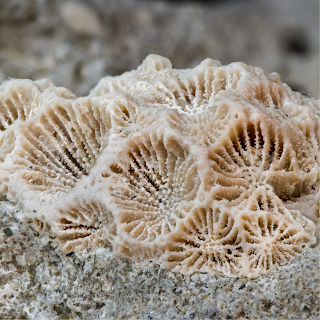
Scleractinian Fossil Coral, Florida
The delicate wintery beauty you see here is a Scleractinian coral we find first in the fossil record in the Mesozoic. 

Corals first appeared in the Cambrian about 535 million years ago. Fossils are extremely rare until the Ordovician period, 100 million years later, when rugose and tabulate corals became widespread. 

Palaeozoic corals seem to make friends wherever they live and often contain numerous endobiotic symbionts.

Tabulate corals occur in limestones and calcareous shales of the Ordovician and Silurian periods, and often form low cushions or branching masses of calcite alongside rugose corals. 

Their numbers began to decline during the middle of the Silurian period, and they became extinct at the end of the Permian period, 250 million years ago.

Rugose or horn corals became dominant by the middle of the Silurian and became extinct early in the Triassic period. The rugose corals existed in solitary and colonial forms and were also composed of calcite.

The famous Great Barrier Reef is thought to have been laid down about two million years ago. If you have had the pleasure of scuba diving near it to take in its modern wonders, perhaps you will be interested to learn how it was formed. Over long expanses of time, the corals here have broken up, fragmented and died. Sand and rubble accumulate between the corals, and the shells of clams and other molluscs decay to form a gradually evolving calcium carbonate structure to what you view today. 

Coral reefs are extremely diverse marine ecosystems hosting over 4,000 species of fish, massive numbers of cnidarians, molluscs, crustaceans, and many other animals.

Monday, June 20, 2022

APODOCERAS: SEXUAL DIMORPHISM

Apodoceras / Stonebarrow Fossils
Apoderoceras is a wonderful example of sexual dimorphism within ammonites as the macroconch (female) shell grew to diameters in excess of 40 cm – many times larger than the diameters of the microconch (male) shell.

Apoderoceras has been found in the Lower Jurassic of Argentina, Hungary, Italy, Portugal, and most of North-West and central Europe, including as this one is, the United Kingdom. This specimen was found on the beaches of Charmouth in West Dorset.

Neither Apoderoceras nor Bifericeras donovani are strictly index fossils for the Taylori subzone, the index being Phricodoceras taylori. Note that Bifericeras is typical of the earlier Oxynotum Zone, and ‘Bifericerasdonovani is doubtfully attributable to the genus. The International Commission on Stratigraphy (ICS) has assigned the First Appearance Datum of genus Apoderoceras and of Bifericeras donovani the defining biological marker for the start of the Pliensbachian Stage of the Jurassic, 190.8 ± 1.0 million years ago.

Apoderoceras, Family Coeloceratidae, appears out of nowhere in the basal Pliensbachian and dominates the ammonite faunas of NW Europe. It is superficially similar to the earlier Eteoderoceras, Family Eoderoceratidae, of the Raricostatum Zone, but on close inspection can be seen to be quite different. It is therefore an ‘invader’ and its ancestry is cryptic.

The Pacific ammonite Andicoeloceras, known from Chile, appears quite closely related and may be ancestral, but the time correlation of Pacific and NW European ammonite faunas is challenging. Even if Andicoeloceras is ancestral to Apoderoceras, no other preceding ammonites attributable to Coeloceratidae are known. We may yet find clues in the Lias of Canada. Apoderoceras remains present in NW Europe throughout the Taylori Subzone, showing endemic evolution. It becomes progressively more inflated during this interval of time, the adult ribs more distant, and there is evidence that the diameter of the macroconch evolved to become larger. At the end of the Taylori Subzone, Apoderoceras disappeared as suddenly as it appeared in the region, and ammonite faunas of the remaining Jamesoni Zone are dominated by the Platypleuroceras–Uptonia lineage, generally assigned (though erroneously) to the Family Polymorphitidae.

In the NW European Taylori Subzone, Apoderoceras is accompanied (as well as by the Eoderoceratid, B. donovani, which is only documented from the Yorkshire coast, although there are known examples from Northern Ireland) by the oxycones Radstockiceras (quite common) and Oxynoticeras (very rare), the late Schlotheimid, Phricoderoceras (uncommon) Note: P. taylori is a microconch, and P. lamellosum, the macroconch), and the Eoderoceratid, Tetraspidoceras (very rare). The lovely large specimen (macroconch) of Apoderoceras pictured here is likely a female. Her larger body perfected for egg production.

Wednesday, October 27, 2021

ETHELDRED'S HOPLITES

Hoplites (Hoplites) bennettiana (Sowerby, 1826)
A beautiful example of the ammonite, Hoplites (Hoplites) bennettiana (Sowerby, 1826), from Early Albian localities in the Carrière de Courcelles Villemoyenne, Région de Troyes, near Champagne in northeastern France.

The species name is a homage to Etheldred Benett, an early English geologist often credited with being the first female geologist — a fossil collector par excellence.

She was also credited with being a man  —  the Natural History Society of Moscow awarding her membership as Master Etheldredus Benett in 1836. The confusion over her name — it did sound masculine — came again with the bestowing of a Doctorate of Civil Law from Tsar Nicholas I.

The Tsar had read Sowerby's Mineral Conchology, a major fossil reference work that contained the second-highest number of contributed fossils of the day, many of the best quality available at the time. Forty-one of those specimens were credited to Benett. Between her name and this wonderous contribution to a growing science, the Russian Tsar awarded the Doctorate to what he believed was a young male scientist on the rise. He believed in education, founding Kyiv University in 1834, just not for women. He was an autocratic military man frozen in time — the thought that this work could have been done by a female unthinkable. Doubly charming is that the honour from the University of St Petersburg was granted at a time when women were not allowed to attend St. Pete's or any higher institutions. That privilege arrived in 1878, twenty years after Nicholas I's death.

Benett took these honours (and social blunders) with grace. She devoted her life to collecting and studying fossils from the southwest of England, amassing an impressive personal collection she openly shared with geologist friends, colleagues and visitors to her home. Her speciality was fossils from the Middle Cretaceous, Upper Greensand in the Vale of Wardour — a valley in the county of Wiltshire near the River Nadder.

Etheldred Benett was born on 22 July 1775 at Pyt House, Tisbury, Wiltshire, the eldest daughter of the local squire Thomas Benett.

Etheldred's interest was cultivated by the botanist Aylmer Bourke Lambert (1761-1842), a founding member of the Linnean Society. Benett's brother had married Lucy Lambert, Aylmer's half-sister. Aylmer was a Fellow of the Royal Society and the Society of the Arts. He was also an avid fossil collector and member of the Geological Society of London. The two met and got on famously.

Aylmer kindled an interest in natural history in both of Benett's daughters. Etheldred had a great fondness for geology, stratigraphy and all things paleo, whilst her sister concentrated on botany. Etheldred had a distinct advantage over her near contemporary, the working-class Mary Anning (1799-1847), in that Benett was a woman of independent wealth who never married — and didn't need to — who could pursue the acquisition and study of fossils for her own interest.

While Anning was the marine reptile darling of the age, she was also greatly hindered by her finances. "She sells, seashells by the seashore..." while chanted in a playful spirit today, was not meant kindly at the time.

Aylmer's encouragement emboldened Etheldred to go into the field to collect for herself — and collect she did. Profusely.

Benett’s contribution to the early history of Wiltshire geology is significant. She corresponded extensively with the coterie of gentlemen scientists of the day —  Gideon Mantell, William Buckland, James Sowerby, George Bellas Greenough and, Samuel Woodward. She also consorted with the lay folk and had an ongoing correspondence with William Smith, whose stratigraphy work had made a favourable impression on her brother-in-law, Aylmer.

Her collections and collaboration with geologists of the day were instrumental in helping to form the field of geology as a science. One colleague and friend, Gideon Mantell, British physician, geologist and palaeontologist, who discovered four of the five genera of dinosaurs and Iguanadon, was so inspired by Benett's work he named this Cretaceous ammonite after her — Hoplites bennettiana.

Benett's fossil assemblage was a valuable resource for her contemporaries and remains so today. It contains thousands of Jurassic and Cretaceous fossil specimens from the Wiltshire area and the Dorset Coast, including a myriad of first recorded finds. The scientific name of every taxon is usually based on one particular specimen, or in some cases multiple specimens. Many of the specimens she collected serve as the Type Specimen for new species.

Fossil Sponge, Polypothecia quadriloba, Warminster, Wiltshire
Her particular interest was the collection and study of fossil sponges. Alcyonia caught her eye early on. She collected and recorded her findings with the hope that one of her colleagues might share her enthusiasm and publish her work as a contribution to their own. Alas, no one took up the helm — those interested were busy with other pursuits (or passed away) and others were less than enthusiastic or never seemed to get around to it.

To ensure the knowledge was shared in a timely fashion, she finally wrote them up and published them herself. You can read her findings in her publication, ‘A Catalogue of Organic Remains of the County of Wiltshire’ (1831), where she shares observations on the fossil sponge specimens and other invert goodies from the outcrops west of town.

She shared her ideas freely and donated many specimens to local museums. It was through her exchange of observations, new ideas and open sharing of fossils with Gideon Mantell and others that we gained a clearer understanding of the Lower Cretaceous sedimentary rocks of Southern England.

In many ways, Mantell was drawn to Benett as his ideas went against majority opinion. At a time when marine reptiles were dominating scientific discoveries and discussions, he pushed the view that dinosaurs were terrestrial, not amphibious, and sometimes bipedal. Mantell's life's work established the now-familiar idea that the Age of Reptiles preceded the Age of Mammals. Mantell kept a journal from 1819-1852, that remained unpublished until 1940 when E. Cecil Curwen published an abridged version. (Oxford University Press 1940). John A. Cooper, Royal Pavilion and Museums, Brighton and Hove, published the work in its entirety in 2010.

I was elated to get a copy, both to untangle the history of the time and to better learn about the relationship between Mantell and Benett. So much of our geologic past has been revealed since Mantell's first entry two hundred years ago. The first encounter we share with the two of them is a short note from March 8, 1819. "This morning I received a letter from Miss Bennett of Norton House near Warminster Wilts, informing me of her having sent a packet of fossils for me, to the Waggon Office..." The diary records his life and the social interactions of the small connected community of the scientific social elite — pure delight.

Though a woman in a newly evolving field, her work, dedication and ideas were recognized and appreciated by her colleagues. Gideon Mantell described her as, "a lady of great talent and indefatigable research," whilst the Sowerbys noted her, "labours in the pursuit of geological information have been as useful as they have been incessant."

Benett produced the first measured sections of the Upper Chicksgrove quarry near Tisbury in 1819, published and shared with local colleagues as, "the measure of different beds of stone in Chicksgrove Quarry in the Parish of Tisbury.” The stratigraphic section was later published by naturalist James Sowerby without her knowledge. Her research contradicted many of Sowerby’s conclusions.

She wrote and privately published a monograph in 1831, containing many of her drawings and sketches of molluscs and sponges. Her work included sketches of fossil Alcyonia (1816) from the Green Sand Formation at Warminster Common and the immediate vicinity of Warminster in Wiltshire.

Echinoids and Bivalves. Collection of Etheldred Benett (1775-1845)
The Society holds two copies, one was given to George Bellas Greenough, and another copy was given to her friend Gideon Mantell. This work established her as a true, pioneering biostratigrapher following but not always agreeing with the work of William Smith.

If you'd like to read a lovely tale on William's work, check out the Map that Changed the World: William Smith and the Birth of Modern Geology by Simon Winchester. It narrates the intellectual context of the time, the development of Smith's ideas and how they contributed to the theory of evolution and more generally to a dawning realization of the true age of the earth.

The book describes the social, economic or industrial context for Smith's insights and work, such as the importance of coal mining and the transport of coal by means of canals, both of which were a stimulus to the study of geology and the means whereby Smith supported his research. Benett debated many of the ideas Smith put forward. She was luckier than Smith financially, coming from a wealthy family, a financial perk that allowed her the freedom to add fossils to her curiosity cabinet at will.

Most of her impressive collection was assumed lost in the early 20th century. It was later found and purchased by an American, Thomas Bellerby Wilson, who donated it to the Academy of Natural Sciences of Philadelphia. Bits of her collection made their way into British museums. Leeds City Museum, the British Museum in London, Bristol Museum and the University of St. Petersburg all house her specimens. These collections contain many of the first fossils found of their kind — some with the soft tissues preserved. When Benett died in 1845, it was Mantell who penned her obituary for the London Geological Journal.

Etheldred Benett (1776-1845)
In 1989, almost a hundred and fifty years after her death, a review of her collection had Arthur Bogen and Hugh Torrens remark that her work has significantly impacted our modern understanding of Porifera, Coelenterata, Echinodermata, and the molluscan classes, Cephalopoda, Gastropoda, and Bivalvia. A worthy legacy, indeed.

Her renown lives on through her collections, her collaborations and through the beautiful 110 million-year-old ammonite you see here, Hoplites bennettiana. The lovely example you see here is in the collection of the deeply awesome Christophe Marot.

Spamer, Earle E.; Bogan, Arthur E.; Torrens, Hugh S. (1989). "Recovery of the Etheldred Benett Collection of fossils mostly from Jurassic-Cretaceous strata of Wiltshire, England, analysis of the taxonomic nomenclature of Benett (1831), and notes and figures of type specimens contained in the collection". Proceedings of the Academy of Natural Sciences of Philadelphia. 141. pp. 115–180. JSTOR 4064955.

Torrens, H. S.; Benamy, Elana; Daeschler, E.; Spamer, E.; Bogan, A. (2000). "Etheldred Benett of Wiltshire, England, the First Lady Geologist: Her Fossil Collection in the Academy of Natural Sciences of Philadelphia, and the Rediscovery of "Lost" Specimens of Jurassic Trigoniidae (Mollusca: Bivalvia) with Their Soft Anatomy Preserved.". Proceedings of the Academy of Natural Sciences of Philadelphia. 150. pp. 59–123. JSTOR 4064955.

Photo credit: Fossils from Wiltshire.  In the foreground are three examples of the echinoid, Cidaris crenularis, from Calne, a town in Wiltshire, southwestern England, with bivalves behind. Caroline Lam, Archivist at the Geological Society, London, UK. http://britgeodata.blogspot.com/2016/03/etheldred-benett-first-female-geologist_30.html

Photo credit: Fossil sponges Polypothecia quadriloba, from Warminster, Wiltshire. The genus labels are Benett’s, as is the handwriting indicating the species. The small number, 20812, is the Society’s original accession label from which we can tell that the specimen was received in April 1824. The tablet onto which the fossils were glued is from the Society’s old Museum.

https://www.strangescience.net/ebenett.htm

Monday, July 5, 2021

PTEROSAURS OF HORNBY ISLAND

If you could travel through time and go back to observe our ancient skies, you would see massive pterosaurs — huge, winged flying reptiles of the extinct order Pterosauria — cruising along with you. They soared our skies during most of the Mesozoic — from the late Triassic to the end of the Cretaceous (228 to 66 million years ago). 

By the end of the Cretaceous, they had grown to giants and one of their brethren, Quetzalcoatlus, a member of the family Azhdarchidae, boasts being the largest known flying animal that ever lived. They were the earliest vertebrates known to have evolved powered flight. Their wings were formed by a membrane of skin, muscle, and other tissues stretching from the ankles to a dramatically lengthened fourth finger.

We divide their lineage into two major types: basal pterosaurs and pterodactyloids. Basal pterosaurs (also called 'non-pterodactyloid pterosaurs' or ‘rhamphorhynchoids’) were smaller animals with fully toothed jaws and long tails. Their wide wing membranes connected to their hind legs. This would have allowed them some manoeuvrability on the ground, but with an awkward sprawling posture. They were better climbers with flexible joint anatomy and strong claws. Basal pterosaurs preferred to dine on insects and small vertebrates.

Later pterosaurs (pterodactyloids) evolved many sizes, shapes, and lifestyles. Pterodactlyoids had narrower wings with free hind limbs, highly reduced tails, and long necks with large heads. On the ground, pterodactyloids walked better than their earlier counterparts, manoeuvring all four limbs smoothly with an upright posture. They walked standing plantigrade on the hind feet and folding the wing finger upward to walk on the three-fingered "hand." These later pterosaurs were more nimble. They could take off from the ground, run and wade and swim. Their jaws had horny beaks and some of these later groups lacked the teeth of earlier lineages. Some groups developed elaborate head crests that were likely used to attract mates' sexy-pterosaur style.

So can we or have we found pterosaurs on Hornby Island? The short answer is yes.

Collishaw Point, known locally as Boulder Point, Hornby Island
Hornby Island is a lovely lush, island in British Columbia's northern Gulf Islands. It was formed from sediments of the upper Nanaimo Group which are also widely exposed on adjacent Denman Island and the southern Gulf Islands.

Peter Mustard, a geologist from the Geologic Survey of Canada, did considerable work on the geology of the island. It has a total stratigraphic thickness of 1350 m of upper Nanaimo Group marine sandstone, conglomerate and shale. 

These are partially exposed in the Campanian to the lower Maastrichtian outcrops at Collishaw Point on the northwest side of Hornby Island. Four formations underlie the island from oldest to youngest, and from west to east: the Northumberland, Geoffrey, Spray and Gabriola.

During the upper Cretaceous, between ~90 to 65 Ma, sediments derived from the Coast Belt to the east and the Cascades to the southeast poured seaward to the west and northwest into what was the large ancestral Georgia Basin. This major forearc basin was situated between Vancouver Island and the mainland of British Columbia. The rocks you find here originated far to the south in Baja California and are the right age and type of sediment for a pterosaur find. But are we California dreaming?

Upper Cretaceous Nanaimo Group Fossil Concretion
Well, truth be told, we were with one of the potential pterosaur finds from Hornby. It wasn't just hopeful thinking that had the west coast in a paleo uproar many ago when Sharon Hubbard of the Vancouver Island Palaeontological Society found what looked very much like a pterosaur.

Right time period. Right location. And, we have found them here in the past.

Sandy McLachlan found the first definitive pterosaur, an azhdarchid, back in 2008.

But was Sharon's find a pterosaur?

Victoria Arbour, a Canadian evolutionary biologist and palaeontologist working as a Natural Sciences and Engineering Research Council of Canada postdoctoral fellow at the University of Toronto and Royal Ontario Museum, certainly thought so. 

While Arbour is an expert on ankylosaurs, our lumbering armoured dinosaurs friends, she has studied pterosaurs and participated in the naming of Gwawinapterus from Hornby Island. 

But here's the thing — bony material encased in stone and let to cement for millions of years can be tricky.

While this fossil find was initially described as a very late-surviving member of the pterosaur group Istiodactylidae, further examination cast doubt on the identification. Once more detail was revealed the remains were published as being those of a saurodontid fish, an ambush predator with very sharp serrated teeth and elongate, torpedo-like bodies that grew up to two meters. Not a pterosaur but still a massively exciting find. Arbour was very gracious at the renaming, taking it in stride. She has since gone on to name a partial ornithischian dinosaur from Sustut Basin, as well as the ankylosaurs Zuul, Zaraapelta, Crichtonpelta, and Ziapelta. But she may have another shot at a pterosaur.

Dan Bowen, Chair, VIPS. Photo: Deanna Steptoe Graham
In 2019, Dan Bowen, Chair of the Vancouver Island Palaeontological Society and a truly awesome possum, found some very interesting bones in concretion on Hornby. 

The concretion was nestled amongst the 72 million-year-old grey shales of the Northumberland Formation, Campanian to the lower Maastrichtian, part of the Cretaceous Nanaimo Group from Collishaw Point.

The site is known as Boulder Point to the locals and it has been a popular fossil destination for many years. It is the same site where Sharon made her find years earlier.

The concretion contains four articulated vertebrae that looked to be fish at first glance. Jay Hawley, a local fossil enthusiast was asked to prep the block to reveal more details. Once the matrix was largely removed the vertebrae inside were revealed to be bird bones, not fish and not another saurodontid as originally thought. Palaeontologist Victoria Arbour was called back in to put her keen lens on the discovery. 

You will appreciate that she took a good long look at the specimen and confirmed it to be a bird or a pterosaur. We still do not have confirmation on which it is as yet. The delicate bony material is very flattened with a very shallow u-shape on the bottom but will need additional study to confirm if the skies above California were once home to a great pterosaur who died, was fossilized then rode our tectonic plates to now call Hornby home. It is a great story and one that I am keen to follow.

References: To learn more about the azhdarchid remains found by Sandy McLachlan, check out the paper by Martin-Silverston et al. 2016.