Showing posts with label telus. Show all posts

Thursday, December 1, 2022

BC'S FOSSIL BOUNTY: BEHIND THE SCENES WITH JOHN FAM

Meet John Fam, Vice Chair of the Vancouver Paleontological Society. 

The awesome folk in the Vancouver Paleontological Society and Vancouver Island Palaeontological Society have been collecting with John for many years, some exciting local trips — and some epic trips of a lifetime. 

Visiting the fossil outcrops at Tyaughton in the Taseko Lakes area of British Columbia takes months of planning. Remote, dangerous and difficult to reach, these sites are epic and each of those field trips definitely count as trips of a lifetime.

John shares Tales of Tyaughton in his episode of BC's Fossil Bounty.

"For the longest time, a handful of BCPA members have known about the wonderful Triassic-Jurassic fossils of the Tyaughton Creek area. Some of us had been even fortunate to see the spectacular collection of Jurassic ammonites stored in the basement of the Geological Survey of Canada.

I still remember purchasing a copy of Hettangian Ammonoid Faunas of the Taseko Lakes Area by Hans Frebold and wondering if I would even get a chance to visit such a remote locality. If you picture a squid living inside a sea shell floating and hunting in the ocean, these were the ancient creatures we’d be looking for.

As Karen Lund, one of the Directors of the Vancouver Paleontological Society (VanPS), told me, "Tyaughton is kind of like the Eldorado for the VanPS.”

We had heard so many stories that this site was becoming somewhat legendary in our minds. Thus, I made it a personal goal of mine to visit the remote fossil beds.

I began researching all possible sources related to Tyaughton Creek. I dug up many old GSC reports by Hans Frebold, Howard Tipper and George Jeletzky along with more recent material by Paul-Smith and his grad students.

All this literature was very helpful in understanding not only the fossil localities but also the complex geology of the region. I also paid a couple of visits to Dr. Howard Tipper of Geological Survey of Canada. 

Dr. Tipper was very supportive and helpful in providing valuable information regarding the fossil sites. He also shared with me his extensive knowledge of Jurassic palaeontology.

Armed with this information, I met up with Heidi Henderson, then Chair of the Vancouver Palaeontological Society, who you’ll know as the Fossil Huntress, to plan the first of four expeditions.

We had to figure out how to access such a rugged and remote locality. The fossil beds are 16 km from the nearest logging road, several hundred kilometres from Vancouver and 7,500 feet above sea level.

We would be sharing territory with a healthy Grizzly bear population and likely be a food source for the not as large but equally daunting horsefly population. 

We were keen to access this elusive site, but hiking in 16 km and gaining about a thousand feet or more of elevation would be a challenge. Hiking back out with 50 kg of rock would be impossible. 

We finally decided that it would be best that we fly in by helicopter. That, too, provided its own challenges. In the end, we did four trips over many field seasons. 

We met many Grizzly bears, horseflies, we were snowed in but came away with many wonderful fossils including new species. The undergrad we brought on the first trip did her PhD over that time and now teaches at the University of British Columbia."

Here's John Fam Behind the Scene prepping for that episode and Eva Svobodova doing her magic with Hair and Makeup on the set at Shoreline Studios in Vancouver. 


Wednesday, November 30, 2022

BC'S FOSSIL BOUNTY: BEHIND THE SCENES

Eugene, Gavin, Julius & Eva BTS on BC's Fossil Bounty — Season Two
We have started filming Season Two of BC's Fossil Bounty. Here is a sneak peek of Eva Svobodova doing her last bit of hair & makeup magic to prep Dr. Julius Csotonyi for his interview for BC's Fossil Bounty.

What you are seeing here is Studio One at Shoreline Studios in Vancouver with some of the cast and crew. 

To the left are the profiles of Gavin Hamilton, Production and Camera Assistant along with Eugene Ko, our awesome Location Sound Mixer for both Season One and Two. 

We had three cameras in place to capture the best of Julius and the glorious painting he brought to life. Just to the right outside of this photograph, we have D'Arcy Hamilton, Cinematographer and Andrew de Villiers, Director from Film Vancouver Productions. 

We did a deep dive in Season One of the career of Dr. Julius Csotonyi, a Vancouver-based scientific illustrator and natural history fine artist. We wanted to have him back (you asked and we answered) to share a particular story of how he fills the walls of museums with murals and what goes into that process. 

Julius has a scientific background in ecology (MSc) and microbiology (PhD) which has taken him to study sensitive ecosystems, from sand dunes in the Rocky Mountain parks to hydrothermal vents at the bottom of the Pacific Ocean.

Eugene Ko, Location Sound Mixer, BC's Fossil Bounty
These experiences have fuelled his strong resolve to work toward preserving our Earth’s biota. Painting biological subjects is one means that he uses to both enhance public awareness of biological diversity and to motivate concern for its welfare. 

For Season Two, along with the tale of how the Smithsonian's Deep Time Exhibit unfolded, we also show you how he creates art — live!

We chose a particular arthropod that is long extinct. You'll learn which palaeo creature he chose and see it come to life when his episode airs in 2023. 

To see his episode in Season One, you can watch it on TELUS Optik TV or visit the STORYHIVE YouTube link here: https://www.youtube.com/channel/UCUerL9urNX8fHb6nHc_vrBQ

Thank you to all the awesome possums who made this production possible — cast, crew and sponsors. You truly delivered something amazing in Season One and we are tracking to do the same in Season Two. Funding is supported by TELUS STORYHIVE, DINO LAB INC. & DINOSTY FOSSILS. 

BC'S FOSSIL BOUNTY — SEASON TWO airs on TELUS Optik TV and the ARCHEA & TELUS YouTube Channels Summer 2023. 

Monday, November 28, 2022

BC'S FOSSIL BOUNTY ON TELUS OPTIK TV

Melissa Kay, Fossil Restoration Technician, Dino Lab Inc.
Cue the confetti! BC's Fossil Bounty begins filming Season Two today. For those of you waiting on Season One, it was released this past week. Each of our interviewees are wonderfully engaging and share their stories to much delight.

A huge thank you to everyone for participating and making this show possible. You can look for Season One on TELUS Optik TV or on YouTube. You can also find links to the series on the BC's Fossil Bounty page on Facebook.

Join the Fossil Huntress as we explore the rich fossil bounty of fossil plants, dinosaurs to mighty marine reptiles and the people who unearth them.

Discover British Columbia's violent past — how plate tectonics, volcanoes and glaciers shaped the land and why we find plant fossils along the Kitsilano foreshore and marine fossils beneath False Creek.

Did you know that some female dinosaurs have distinctive bone material that tells us they are just about to give birth or just became new mammas? What are some of the fossils you can find in the Vancouver area and around British Columbia? What makes for environmentally and socially responsible mining? Where IS Waldo?

Dr. Catherine Hickson & Dr. John Clague
Did you know there is a place you can visit where they encourage you to touch the fossils? Yep, Dino Lab is your go-to for the full touch-and-feel dino experience!

How do you get a job prepping dinosaurs or creating larger-than-life murals for museums of our ancient world? You will love this show if you are thinking of becoming a palaeontologist or working with fossils.

​Hear from palaeontologists, geologists, geochemists, science organizations, dinosaur docents, palaeoartists and fossil preparators whose work brings our ancient world to life.

View Season One on TELUS Optik TV or the STORYHIVE and ARCHEA YouTube Channels: https://www.youtube.com/channel/UCUerL9urNX8fHb6nHc_vrBQ

Tuesday, October 11, 2022

CRANBROOK EAGER FORMATION: TUZOIA

This specimen of the arthropod Tuzoia sp. is from the Lower Cambrian Eager Formation of British Columbia. 

Tuzoia is an extinct genus of large bivalved arthropod known from Early to Middle Cambrian marine environments in what is now the Burgess Shale, Emu Bay Shale, Kaili, the Rockslide Formation, the Spence Shale, Wheeler Formation, and Marjum Formation, and the Kinzers Formation. 

As you can see here, they are also found in the Lower Cambrian Eager Formation near Cranbrook British Columbia. 

This particular specimen is from the Rifle Range outcrop near Cranbrook where you can also find numerous fragments and complete specimens of the olenellid trilobites Ollenellus sp. and the larger, more robust Wanneria dunnae, along with Mesonacis eagerensis (Best, 1952).

The site outcrops at a few locations as you head east out of Cranbrook towards Fort Steele. The first trilobites were discovered with the building of the Kootenay Highway connecting Cranbrook to Fort Steele and beyond. Several other localities, including the outcrops at the Silhouette Rife Range — which is literally on a Rifle Range where folks go to shoot at things — is a shade older than the Middle Cambrian Burgess Shale but the fauna here is much less varied. 

The site has been known and collected since the 1920s. Back in the day, fossil collecting was a family affair with folks heading out in their lightly coloured finery to picnic and surface collect the eroding exposures. Cranbrook local, Clement Hungerford Pollen was an engineer and avocational palaeontologist. He promoted collecting the exposures of the Eager Formation around 1921. As a pedigreed Englishman of considerable means, he had invested in the Kootenay Central Railway, revitalizing the town by opening up railway access within the region.

Tuesday, September 27, 2022

BC'S FOSSIL BOUNTY RETURNS FOR SEASON TWO

BC's Fossil Bounty Greenlit for Season Two
We live in a diverse province edged by mountains, ocean, forests and streams. While our lens is often on the rugged beauty all around us, beneath our feet is yet another world.

Layers of rock hold fossils, each an interface to our deep past. 

Within each fragment, these ancient beings whisper their secrets, share their life experiences, tell us tales of community, how they made a living, who they rubbed shoulders with (or fins, or seedlings...) and convey the essence of a world long embedded in stone.

We are excited to share that BC's Fossil Bounty has been greenlit for Season Two by STORYHIVE Voices 2.0.  Join me as we explore the rich fossil bounty of fossil plants, dinosaurs to mighty marine reptiles and the people who unearth them. 

Discover British Columbia's violent past — how plate tectonics, volcanoes and glaciers shaped the land and why we find plant fossils along the Kitsilano foreshore and marine fossils beneath False Creek. Learn about the science of geochemistry from a palaeontologist who uses fossil teeth to reconstruct ancient environments.

Meet those who call Vancouver home and use this beautiful base for their mining explorations — opening up BC and communities through partnerships that honour First Nations wisdom, show a commitment to social responsibility & sound environmental practices.

​Hear from palaeontologists, geologists, geochemists, science organizations, dinosaur docents, palaeoartists and fossil preparators whose work brings our ancient world to life.

All this goodness is coming to you on TELUS Optik TV in a few short weeks. We had a great time filming BC's Fossil Bounty with some of the loveliest human beings on the planet. 

Funding is supported by TELUS STORYHIVE & DINO LAB INC. BC'S FOSSIL BOUNTY — SEASON ONE airs on TELUS Optik TV and the TELUS YouTube Channel to millions of viewers beginning Autumn 2022. SEASON TWO will be shooting in November and air in 2023. 

Visit www.fossilhuntress.com to learn more and to hear updates on the project.

Saturday, September 10, 2022

BC'S FOSSIL BOUNTY ON TELUS OPTIK TV

We live in a diverse province edged by mountains, ocean, forests and streams. While our lens is often on the rugged beauty all around us, beneath our feet is yet another world.

Layers of rock hold fossils, each an interface to our deep past. 

Within each fragment, these ancient beings whisper their secrets, share their life experiences, tell us tales of community, how they made a living, who they rubbed shoulders with (or fins, or seedlings...) and convey the essence of a world long embedded in stone.

Join me as we explore the rich fossil bounty of fossil plants, dinosaurs to mighty marine reptiles and the people who unearth them. Discover British Columbia's violent past — how plate tectonics, volcanoes and glaciers shaped the land and why we find plant fossils along the Kitsilano foreshore and marine fossils beneath False Creek. Learn about the science of geochemistry from a palaeontologist who uses fossil teeth to reconstruct ancient environments.

Meet those who call Vancouver home and use this beautiful base for their mining explorations — opening up BC and communities through partnerships that honour First Nations wisdom, show a commitment to social responsibility & sound environmental practices.

​Hear from palaeontologists, geologists, geochemists, science organizations, dinosaur docents, palaeoartists and fossil preparators whose work brings our ancient world to life.

Funding is supported by TELUS STORYHIVE & DINO LAB INC. BC'S FOSSIL BOUNTY — SEASON ONE airs on TELUS Optik TV and the TELUS YouTube Channel to millions of viewers beginning Autumn 2022. Plans for SEASON TWO are in the works. 

Visit www.fossilhuntress.com to learn more and to hear updates on the project.

Saturday, September 3, 2022

FOSSIL COLLECTING AT THE MYSTERIOUS CREEK FORMATION

Located three hours east of Vancouver, most folks head to Harrison Lake to enjoy its crisp waters, soak in the hot springs, camp or four-wheel-drive immersed in rugged scenery, or look for the elusive Sasquatch reported to live in the area. 

But some come to Harrison Lake and miss the town entirely. Instead, they favour the upper west side of the lake and the fossiliferous bounty found here.

Indeed, this is the perfect location for local citizen scientists to strut their stuff. Harrison is a perfect family day trip, where you can discover wonderful marine fossil specimens as complete or partially crushed fossilized shells embedded in rock. 

Amazingly, we can find them at all. These beauties range in age from Jurassic to Cretaceous, with most being Lower Callovian, meaning the ammonites here swam our ancient oceans more than 160 million years ago. 

The area around Harrison Lake has been home to the Sts’ailes, a sovereign Coast Salish First Nation for thousands of years. Sts’ailes’ means, “the beating heart,” and it sums up this glorious wilderness perfectly. They describe their ancient home as Xa’xa Temexw or Sacred Earth. 

With the settling of Canada, Geologists began exploring the area in the 1880s, calling upon the Sts’ailes to help them look for coal and a route for the Canadian Pacific Railway. Coal was the aim, but happily, they also found fossils. Sacred Earth, indeed.  

Belemnite Fossils
In my favourite outcrops, you can find large, smooth inflated Jurassic ammonites along with their small grey and brown cousins. 

Further up the road, you will see Cretaceous cigar-shaped squid-like cephalopods called Belemnites, and the bivalve (clam) Buchia — gifts deposited by glaciers. Here are the most common.

Ammonites

Almost all of the ammonite specimens found near Harrison Lake are the toonie sized Cadoceras (Paracadoceras) tonniense with well-preserved outer whorls but flattened inner whorls. We find semi-squished elliptical specimens here, too. If you see a large, smooth, inflated grapefruit-sized ammonite, you are holding a rare prize — a Cadoceras comma ammonite, the macroconch or female of the species.  

Ammonites were predatory, squid-like creatures that lived inside coil-shaped shells. Like other cephalopods, ammonites had sharp, beak-like jaws inside a ring of squid-like tentacles that extended from their shells. They used these tentacles to snare prey — plankton, vegetation, fish and crustaceans — similar to the way a squid or octopus hunts today.

Within their shells, ammonites had a number of chambers called septa filled with gas or fluid, and they were interconnected through a wee air tube. By pushing air in or out, they were able to control their buoyancy. 

These small but mighty marine predators lived in the last chamber of their shell and continuously built new shell material as they grew. As they added each new chamber, they would move their squid-like body down to occupy the final outside chamber.

Interestingly, ammonites from Harrison Lake are quite similar to the ones found within the lower part of the Chinitna Formation near Cook Inlet, Alaska, and Jurassic Point, Kyuquot, on the west coast of Vancouver Island — some of the most beautiful places on Earth. 

Buchia (bivalve) Clams

The bivalve or clam Buchia are commonly found at Harrison Lake. You will see them cemented together en masse. . They populated Upper Jurassic–Lower Cretaceous waters like a team sport. When they thrived, they really thrived, building up large coquinas of material. Large boulders of Buchia cemented together en masse hitched a ride with the glaciers and were deposited around Harrison Lake. Some kept going and we find similar erratics or glacier-deposited boulders as far south as Washington state. 

Buchia is used as Index Fossils. Index fossils help us to figure out the age of the rock we are looking at because they are abundant, populate an area en masse, and then die out quickly. In other words, they make it easy to identify a geologic time span.

So what does this mean to you? Now, when you are out and about with friends and discover rocks with Buchia, or made entirely of Buchia, you can say, “Oh, this looks to be Upper Jurassic or Lower Cretaceous. Come take a look! We're likely the first to lay eyes on this little clam since dinosaurs roamed the Earth.” 

Fossil Collecting at Harrison Lake Fossil Field Trip — Getting there

This Harrison Lake site is a great day trip from Vancouver or the Fraser Valley. You will need a vehicle with good tires for travel on gravel roads. Search out the route ahead of time and share your trip plan with someone you trust. If you can pre-load the Google Earth map of the area, you will thank yourself. 

Heading east on from Vancouver, it will take you 1.5-2 hours to reach Harrison Mills. 

Access Forestry Road #17 at the northeast end of the parking lot from the Sasquatch Inn at 46001 Lougheed Hwy, Harrison Mills. From there, it will take about an hour to get to the site. Look for signs for the Chehalis River Fish Hatchery to get you started. 

Drive 30 km up Forestry Road #1, and stop just past Hale Creek at 49.5° N, 121.9° W (paleo-coordinates 42.5° N, 63.4° W) on the west side of Harrison Lake. You will see Long Island to your right. 

The first of the yummy fossil exposures are just north of Hale Creek on the west side of the road. Keep in mind that this is an active logging road, so watch your kids and pets carefully. Everyone should be wearing something bright so they can be easily spotted.

How to Spot the Fossils

The fossils here are easily collected—look in the bedrock and in the loose material that gathers in the ditches. Specimens will show up as either dark grey, grey-brown or black. Look for the large, dark-grey boulders the size of smart cars packed with Buchia. 

And while you are at it, be on the lookout for anything that looks like bone. This site is also ripe for marine reptiles—think plesiosaur, mosasaur and elasmosaur. As a citizen scientist and budding palaeontologist, you might just find something new!

What to Know Before You Go

Fill your gas tank and pack a tasty lunch. As with all trips into British Columbia's wild places, dress for the weather. You will need hiking boots, rain gear, gloves, eye protection, and a good geologic hammer and rock (cold) chisel. 

Wear bright clothing and keep your head covered. Slides are common, and you may start a few if you hike the cliffs. If you are with a group, those collecting below may want to consider hardhats in case of rockfall — chunks of rock the size of your fist up to the size of a grapefruit. They pack a punch. 

Bring a colourful towel or something to put your keepers on. Once you set rock down, it can be hard to find again given the terrain. I take the extra precaution of spraying the ends of my hammers and chisels with yellow fluorescent paint, as I have lost too many in the field. You will also want to bring a camera for the blocks of Buchia that are too big to carry home. 

Identifying Your Treasures

When you have finished for the day, compare your treasures to see which ones you would like to keep. In British Columbia, you are a steward of the fossil, which means they belong to the province, but you can keep them safe. You are not allowed to sell or ship them outside British Columbia without a permit. 

Once you get home, wash and identify your finds. Harrison Lake does not have a large variety of fossil fauna, so this should not be difficult. If your find is coiled and round, it is an ammonite. If it is long and straight, it is a belemnite. And if it looks like a wee fat baby oyster, it is Buchia. This is not always true, but mostly true.

What about collecting fossils in all seasons?. Everyone has a preference. I prefer not to collect in the snow, but I have done it. While sunny days are lovely, it can also be easier to see the specimens when the rock is wet. So, do we do this in the rain? Heck, yeah! 

In torrential rain? 

Yes — once you are hooked, but for your casual friends or the kiddos, the answer is likely no. Choose your battles. They may come with you, but a cold day getting soaked is no fun. 

In time, you will find your inner fossil geek — probably with your first find. And that's just the tip of the iceberg. First, it will be you, then your kids, your friends and then your neighbour. Once you start, it is easy to get hooked. Fossil addiction is real, and the only cure is to get out there and do it some more. You've got this!

References and further information:

A. J. Arthur, P. L. Smith, J. W. H. Monger and H. W. Tipper. 1993. Mesozoic stratigraphy and Jurassic palaeontology west of Harrison Lake, southwestern British Columbia. Geological Survey of Canada Bulletin 441:1-62

R. W. Imlay. 1953. Callovian (Jurassic) ammonites from the United States and Alaska Part 2. The Alaska Peninsula and Cook Inlet regions. United States Geological Survey Professional Paper 249-B:41-108

An overview of the tectonic history of the southern Coast Mountains, British Columbia; Monger, J W H; in, Field trips to Harrison Lake and Vancouver Island, British Columbia; Haggart, J W (ed.); Smith, P L (ed.). Canadian Paleontology Conference, Field Trip Guidebook 16, 2011 p. 1-11 (ESS Cont.# 20110248).


Wednesday, August 10, 2022

FRAGILE BEAUTY: RUGOSE AND TABULATE CORALS

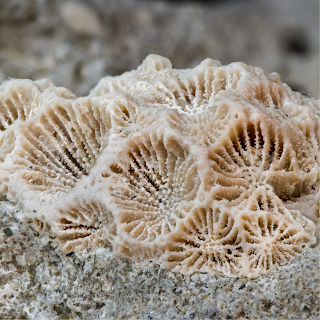
Scleractinian Fossil Coral, Florida
The delicate wintery beauty you see here is a Scleractinian coral we find first in the fossil record in the Mesozoic. 

Corals first appeared in the Cambrian about 535 million years ago. Fossils are extremely rare until the Ordovician period, 100 million years later, when rugose and tabulate corals became widespread. 

Palaeozoic corals seem to make friends wherever they live and often contain numerous endobiotic symbionts.

Tabulate corals occur in limestones and calcareous shales of the Ordovician and Silurian periods, and often form low cushions or branching masses of calcite alongside rugose corals. 

Their numbers began to decline during the middle of the Silurian period, and they became extinct at the end of the Permian period, 250 million years ago.

Rugose or horn corals became dominant by the middle of the Silurian and became extinct early in the Triassic period. The rugose corals existed in solitary and colonial forms and were also composed of calcite.

The famous Great Barrier Reef is thought to have been laid down about two million years ago. If you have had the pleasure of scuba diving near it to take in its modern wonders, perhaps you will be interested to learn how it was formed. Over long expanses of time, the corals here have broken up, fragmented and died. Sand and rubble accumulate between the corals, and the shells of clams and other molluscs decay to form a gradually evolving calcium carbonate structure to what you view today. 

Coral reefs are extremely diverse marine ecosystems hosting over 4,000 species of fish, massive numbers of cnidarians, molluscs, crustaceans, and many other animals.

Friday, August 5, 2022

THAT'S A WRAP: BC'S FOSSIL BOUNTY COMING AUTUMN 2022

We live in a diverse province edged by mountains, ocean, forests and streams. While our lens is often on the rugged beauty all around us, beneath our feet is yet another world.

Layers of rock hold fossils, each an interface to our deep past. 

Within each fragment, these ancient beings whisper their secrets, share their life experiences, tell us tales of community, how they made a living, who they rubbed shoulders with (or fins, or seedlings...) and convey the essence of a world long embedded in stone.

Join me as we explore the rich fossil bounty of fossil plants, dinosaurs to mighty marine reptiles and the people who unearth them.

Discover British Columbia's violent past — how plate tectonics, volcanoes and glaciers shaped the land and why we find plant fossils along the Kitsilano foreshore and marine fossils beneath False Creek. Learn about the science of geochemistry from a palaeontologist who uses fossil teeth to reconstruct ancient environments.

Meet those who call Vancouver home and use this beautiful base for their mining explorations — opening up BC and communities through partnerships that honour First Nations wisdom, show a commitment to social responsibility & sound environmental practices.

​Hear from palaeontologists, geologists, geochemists, science organizations, dinosaur docents, palaeoartists and fossil preparators whose work brings our ancient world to life.

All this goodness is coming to you on TELUS Optik TV in a few short weeks. We had a great time filming BC's Fossil Bounty with some of the loveliest human beings on the planet. 

Funding is supported by TELUS STORYHIVE & DINO LAB INC. BC'S FOSSIL BOUNTY — SEASON ONE airs on TELUS Optik TV and the TELUS YouTube Channel to millions of viewers beginning Autumn 2022. Plans for SEASON TWO & SEASON THREE are in the works. 

Visit www.fossilhuntress.com to learn more and to hear updates on the project.

Tuesday, July 26, 2022

KHATSAHLANO: A FOREST FIRE IN STONE

In the Field with Vancouverite Geoscientist Andy Randell — We were super excited to spend a day with the awesome possum that is Andy Randell filming fossils in the field.

We braved the wet and cold on this fine day to head out in search of fossil plants along the Kitsilano foreshore.

And find them we did! 40 million-year-old pretty as you please plant fossils

The Kitsilano fossil plant sites are intriguing as they hold a mystery... why ONLY plants and NO animal fossils? Nary an insect, mammal or reptile to be found. 

We did find some truly lovely plant fossils that speak to a warmer, wetter environment than the Kitsilano we know today. 

Andy shared that the sediments that lay on the foreshore along Kitsilano Beach are thought to be from the Upper Eocene / Early Oligocene in age (38 to 28 million years old), although opinion varies on the exact age with some folk thinking they may be as much as 40 million-years-old. 

The rocks here are layered in stacks of sand, silt and mudstones associated with a lowland estuarine or deltaic environment. If you look closely, you can see signs of the water meandering into channels and ponds of still water. 

The area would have formed a basin, surrounded by mountains that were drained by rivers into this area. It seems that there are no indications of any marine incursions in the sediment pile, and so the area is assumed to have remained stable for some time.

Plant fossils are common in these beds and are often well preserved. The most common are broadleaved deciduous species such as beech, oak, chestnut and hazel, although several coniferous species are known including redwoods (Sequoia), larch, pine and spruce. The deciduous trees like low, moist landscapes which fit with the basin model. The coniferous species likely lived on the surrounding hills where the ground was somewhat drier and their remains transported by rivers into the depositional basin.

There are also regular signs of burning in the fossils – indicating some kind of forest fire events that must have occurred with some frequency.

You will want to catch his wonderfully engaging interviews. Andy is a professional geologist living in Vancouver who is tailoring his career to bring change to the minerals exploration industry. 

Since 2014, he has established his consulting business, SGDS Hive, which takes on graduate geoscientists and mentors them through a variety of exploration projects to help engage and educate the next generation of geologists. 

Andy is the engine behind Below BC, a non-profit society that provides outreach to the public around Earth Science topics, which now serves several thousand people in British Columbia each year. 

His love of geology and palaeontology started early. Andy is a wealth of knowledge on fossil plants. Growing up on the Isle of Wight, he studied plants that are remarkably similar to those we looked at today—and he is a natural behind the lens!

We were joined by my good friend Lauren, the deeply awesome John Fam, Vice-Chair of the Vancouver Paleontological Society & his two boys, Oliver & Liam. 

It was Liam's first fossil field trip & my 7-month old Flat Coat Retriever's first foray into the field. Both Liam and Coco had a grand time! He found fossils that she inspected and on occasion took a wee bite of to see what all the fuss was about.

We were blessed to have David, Andy's partner, teacher & botany buff, along with their two palaeo puppers — Daisy & Dobby — to complete our escort.

With Andy's guidance, everyone found fossil material and learned a lot about how these fossils were originally laid down in a river system.

A huge thank you to Gabriel Mesquita our talented cinematographer! It was a cold, wet day and the entire crew were troopers. If you are planning to visit the Kitsilano foreshore to look for fossils, know that the stairwell access at the base of Dunbar/Alma Street has been washed away. 

You'll want to head to Waterloo Street and make your way to the beach on the rather steep stairwell found there. Surface collecting is fine at this site. Wear rubber boots and know that the rock is very slippery.

Sunday, July 24, 2022

OH, WHAT WE DO FOR FOSSILS

Coroniceras sp. from Sayward, British Columbia
This yummy Lower Jurassic ammonite with the creamy dark chocolate colouring is from an all but inaccessible outcrop of the Upper Sinemurian, Bonanza Group,  Harbledownense Zone, Memekay River area, near Sayward, Vancouver Island, British Columbia, Canada. 

This area is home to the We Wai Kai and Wei Wai Kum First Nations and lands of the K'omoks whose culture thrives and reflects the natural rugged beauty of the central island region.

I passed through Sayward earlier this month on the way to northern Vancouver Island. 

It is rugged, remote and beautiful. Think trees and valleys for as far as the eye can see. Some of those hillsides on the horizon contain wonderful fossils, including this Coroniceras sp. with the truly marvellous keel.

By the time these ammonites were being buried in sediment, Wrangellia, the predominately volcanic terrane that now forms Vancouver Island and Haida Gwaii, had made its way to the northern mid-latitudes.

Within the basal part of the sequence, sedimentary beds are found interbedded with lapilli and crystal tuffs. Here you'll see maroon tuffaceous sandstone, orange-grey sandstone, granule sandstone and conglomerate. Within them we find ammonites nestled in with gastropods and pelecypods. 

While the fossiliferous outcrop is quite small, the Bonanza group is much larger, estimated to be at least 1000 metres thick. The site is quite small and in an active logging area, so the window to collect was limited. The drive up the mountain was thrilling as there had just been heavy rains and the road was washed out and narrowed until it was barely the width of our wheelbase and very, very steep. Closer to the top it narrowed to be just shy of the width of the vehicle — thrilling, to say the least. 

So scary that my passengers all got out as there was a high probability of going head-first over the edge. I was navigating by some handwritten field notes and a wee map on a paper napkin that should have read, "park at the bottom and hike up." 

Did we park at the bottom and hike up? No, we did not. 

The torrential rains of the Pacific Northwest had been working their magic on the hillside and slowly washing out the road until it slowly became more of a trail.

At the base of the hillside all looked well. Giddy for the fossils to come, we ventured off with a truck full of enthusiasm. Within 15 minutes of steep elevation gain, we had a wonderful view of the valley below. We were halfway up the mountain before I realized the error of my ways. The road twisted and turned then slowly narrowed to the width of my tires. Too narrow to turn around, so the only way was up. 

Graham Beard from Qualicum Beach was the fellow who showed me the site and drew the wee map for me. I cannot recall everyone on the trip, but Perry Poon was there — he shot a video of the drive up that he described as thrilling. I have never seen it but would like to one day — and so was Patricia Coutts with her lovely Doberman. 

She and I had just done a trip up to Goldbridge where the cliff we were on had turned into a landslide into a ravine so she was feeling understandably cautious about the power of Mother Nature. 

Picture the angle, the hood of my jeep riding high and hiding what remained of the road beneath and a lovely stick shift that made you roll backwards a wee bit with every move to put it into gear. So, without being able to see the very narrow path beneath, I had to just keep going. 

Both Perry and Patricia helped with filling in the potholes so my tires would have something to grip. 

I bent the frame on the jeep heading up and had some explaining to do when I returned it to the car rental place. 

As I recall, I wasn't in my ordinary vehicle but a rental because my car had been stolen the weekend before when I was away with John Fam and Dan Bowen collecting at Jurassic Point, an epic fossil site accessible only by boat on our wild west coast.

Fortuitous timing really, as they stole my car but I had unloaded my precious fossil collecting gear out of the trunk just days before.  

In the end, we found what we were looking for. Memekay yields a mix of ammonites, gastropods and bivalves. 

Many of them are poorly preserved. It was a hell of a ride but well worth the effort as we found some great fossils and with them more information on the palaeontology and geology of Vancouver Island. Just look at the keel on this beauty.

I would share the site information but it is now covered over with debris and inaccessible. One day, this whole region will be developed and the site will be opened up again. Until then, we'll have to enjoy what has been unearthed.

Tuesday, July 19, 2022

STORYHIVE VOICES: MEET JULIUS CSOTONYI

Julius Csotonyi BTS on BC'S FOSSIL BOUNTY
Meet Julius Csotonyi — scientist, natural history illustrator, conservationist and biological sciences graduate with a passion for drawing dinosaurs. 

He got hooked on the palaeontology bug early and has been doodling dinosaurs since childhood. 

Over the years, he has expanded his portfolio to include all branches of scientifically inspired artwork — each of them beautifully rendered. 

He has collaborated on projects with several major museums and book publishers from around the globe, including the National Geographic Society and the Royal Tyrrell Museum, working closely with scientists and drawing from his scientific background. 

An MSc graduate of Ecology and Environmental Biology (University of Alberta), and a PhD graduate in microbiology (University of Manitoba), he has published scientific papers on mutualisms in Utah and some very cool and unusual alien-looking bacteria from deep ocean hydrothermal volcanic vents. 

His scientific background fuels his passion to strive to restore as realistically as possible the curiously alien environments that earth has hosted in its deep past. 

His style spans the gamut from pencil and ink line drawings to watercolour, pastel, 2-dimensional digital illustrations and 3-dimensional digital models. His superbly detailed work encompasses dinosaurs and other prehistoric life, sharks and other living animals, as well as space art, fantasy and science fiction themes.

Julius Csotonyi's Hell Creek Raptor
His paleoart career began with work on two dinosaur encyclopedias with UK author Dougal Dixon. 

His largest projects to date have been a panoramic 75-foot-long mural commissioned for the Houston Museum of Natural Science (HMNS), depicting a Late Cretaceous Montana ecosystem along with a mummified Brachylophosaurus —  Dinosaur Mummy CSI: Cretaceous Science Investigation, 2008. 

He has illustrated many life-sized dinosaur murals — some up to 45 metres or 150 feet long — for the Royal Ontario Museum's 2012 exhibit, Ultimate Dinosaurs; Giants from Gondwana. 

Julius illustrated the 25th anniversary exhibit ('Alberta Unearthed') for the Royal Tyrrell Museum of Paleontology (Drumheller, Alberta, 2010) and most of the new Hall of Paleontology at the HMNS. 

Some of his other projects have included the ceratopsian exhibit for the Royal Tyrrell Museum (2007), a mummified Edmontosaurus for Phillip Manning's 'Grave Secrets of Dinosaurs' (National Geographic Books, 2007) and an African Massospondylus nesting site (Royal Ontario Museum, Toronto, 2010). In addition to books and museum projects, 

Csotonyi accepts private commissions of artwork in a wide range of digital and traditional media. His website, http://csotonyi.com, features a growing portfolio of his work, and some of it is also featured on his science blog, 'Evolutionary Routes'. 

He is appearing in BC'S FOSSIL BOUNTY — airing on TELUS Optik TV & the TELUS YouTube Channel beginning Autumn 2022.

Wednesday, July 13, 2022

JOGGINS FOSSIL CLIFFS

Hylonomus lyelli, Ancestor of all dinosaurs
The fossil cliffs at Joggins are one of Canada's gems, now a UNESCO World Heritage Site, you can visit to see our ancient world frozen in time. 

Preserved in situ is a snapshot of an entire food chain of a terrestrial Pennsylvanian Coal Age wetland.

The outcrop holds fossil plant life — including impressive standing lycopsid trees that formed the framework of these wetlands — decomposing detritivores in the invertebrates and tetrapods, the predatory carnivores of the day.

The Coal Age trees were fossilized where they stood 300-million-years ago with the remains of the earliest reptiles entombed within. The preservation is quite marvellous with the footprints of creatures who once lived in these wetlands are frozen where they once walked and the dens of amphibians are preserved with remnants of their last meal. 

Nowhere is a record of plant, invertebrate and vertebrate life within now fossilized forests rendered more evocatively. The fossil record at Joggins contains 195+ species of plants, invertebrates and vertebrates. The fossil plant life became the vast coal deposits for which this period of Earth's history is named. 

Recorded in the rock are vertebrate and invertebrate fauna both aquatic and terrestrial. This broad mix of specimens gives us a view into life back in the Pennsylvanian and sets us up to understand their ecological context.
Pennsylvanian Coal Age Ecosystem, 300-Million-Years-Old
The fossil record includes species first defined at Joggins, some of which are found nowhere else on Earth. 

It was here that Sir Charles Lyell, with Sir William Dawson, founder of modern geology, discovered tetrapods — amphibians and reptiles — entombed in the upright fossil trees. 

Later work by Dawson would reveal the first true reptile, Hylonomus lyelli, ancestor of all dinosaurs that would rule the Earth 100 million years later. 

This tiny reptile serves as the reference point where animals finally broke free of the water to live on land. This evolutionary milestone recorded at Joggins remains pivotal to understanding the origins of all vertebrate life on land, including our own species. 

Sir Charles Lyell, author of Principles of Geology, first noted the exceptional natural heritage value of the Joggins Fossil Cliffs, calling them “...the finest example in the world of a natural exposure in a continuous section ten miles long, occurs in the sea cliffs bordering a branch of the Bay of Fundy in Nova Scotia.” Indeed, the world-famous Bay of Fundy with its impressive tides, the highest in the world, and stormy nature exposed much of this outcrop. 

Geological accounts of the celebrated coastal section at Joggins first appear in the published literature in 1828–1829, by Americans C.T. Jackson and F. Alger, and by R. Brown and R. Smith, managers for the General Mining Association in the Sydney and Pictou coal fields. Brown and Smith’s account is the first to document the standing fossil trees.

Joggins Fossil Cliffs Map (Click to Enlarge)
Plan Your Joggins Fossil Cliffs Staycation

Joggins Fossil Cliffs is a Canadian gem — and they welcome visitors. They offer hands-on learning and discovery microscope activities in their Fossil Lab.

You can explore interpretive displays in the Joggins Fossil Centre before heading out to the beach and cliffs with an interpreter.

Their guided tours of the fossil site include an educational component that tells you about the geology, ecology, palaeontology and conservation of this very special site. 

Joggins / Chegoggin / Mi'kmaq L'nu

We know this area as Joggins today. In Mi'kmaw, the language spoken in Mi'kma'ki, the territory of the Mi'kmaq L'nu, the area bears another name, Chegoggin, place of fishing weirs.

Booking Your Class Field Trip

If you are a teacher and would like to book a class field trip, contact the Director of Operations via the contact information listed below. They will walk you through Covid safety and discuss how to make your visit educational, memorable and fun.

Know Before You Go

The Bay of Fundy has the highest tides in the world. Beach walks are scheduled according to the tides and run regardless of the weather. Good low tides but raining, the beach walk goes on. Lovely and sunny but with a high tide, the beach walk must wait. So, you will want to dress for it as they will not be cancelled in the event of rain. Should severe weather be a factor, bookings may need to be rescheduled at the discretion of the Joggins staff.

Any questions about booking your school field trip? Feel free to email:  operations@jogginsfossilcliffs.net or call: 1 (902) 251-2727 EXT 222.

References & further reading:

Joggins Fossil Cliffs: https://jogginsfossilcliffs.net/cliffs/history/

Image: Hylonomus lyelli, Una ricostruzione di ilonomo by Matteo De Stefano/MUSEThis file was uploaded by MUSE - Science Museum of Trento in cooperation with Wikimedia Italia., CC BY-SA 3.0, https://commons.wikimedia.org/w/index.php?curid=48143186

Image: Arthropleura: Par Tim Bertelink — Travail personnel, CC BY-SA 4.0, https://commons.wikimedia.org/w/index.php?curid=48915156

Joggins Map: Joggins Fossil Cliffs: https://jogginsfossilcliffs.net/cliffs/history/

Tuesday, July 5, 2022

SUPERNATURAL BRITISH COLUMBIA

Our province is known as Supernatural BC — and for good reason. British Columbia on Canada's far western shores boasts a rich and diverse geography. We are home to some of the most impressive fauna and flora on the planet — both living and fossilized. 

The province is home to more than a hundred native species including a few only known from British Columbia. Birds, bees, bats and insects soar, buzz & flutter on our coastal winds. Our nutrient rich coastal waters are home to diverse marine life from jellyfish, salmon to our coastal whales.

From great bears to wee mice, the Pacific Northwest is a paradise with abundant food resources. Here's a partial list for you to look for as you explore the province: Moose, Black and Brown Bear, Boreal Woodland Caribou, Black-tailed & Mule Deer, British Columbia Wolf, Roosevelt Elk, Eagles, Owls, Hawks, Steller's Jay, American Bison, Humpback, Orca and Blue whales, California Sea Lions, Canada Lynx, Collared Pika, Cougar, Dall sheep, Northern Elephant Seal, Northern Right-whale Dolphin, Wolverine, Yellow-Bellied & Vancouver Island Marmots, Vancouver Island water shrew, Queen Charlotte Hairy Woodpecker, Pine Grosbeak and Townsend Voles.   

The land they inhabit and you and I stroll upon was built by great tectonic forces that pushed and pulled large sections of the Earth's crust to the shape of the landmasses we see today. 

Our province is a crazy quilt of bits and pieces made up from the accretion of exotic terranes that have been added bit by bit lengthening our province from where it meets Alberta then west to were it meets the Pacific — the ocean we can thank for our mild climate.  

For those who live in Vancouver, we live upon the North American Plate which sits near the boundary of a major fault. The Juan de Fuca plate is slowly pushing against the edge of our province and slowly sliding underneath. 

That process of relentless pushing against the outer edge of British Columbia is what helped to form our mountains. Picture slowly pressing and sliding a table cloth along a table. As you press, the material bunches up, folds and builds small ridges. 

That faulting and folding mimics what we see across our world as the tectonic plates play the same role as your hand, pressing and pushing large sections of land. The movement and pressure is released as earthquakes and the eruption of volcanoes which have also shaped our province. 

Our climate has also changed over time. We can see this in the smooth mountains and deep valleys that were gouged or polished by massive glaciers. There was a time when the city I live in and much of our coast was covered in 2 kilometres of ice. It began to melt and recede from our Interior about 18,000 years ago and our coast around 13,000 years ago

Along that journey of province-building forces, the rocks we find here today record the life history of our province — and indeed that of the Earth — for over 600 million years of Earth's 4.543 billion year history. British Columbia's fossil bounty includes dinosaurs, marine reptiles, plants, insects, fish, sharks, bison, musk ox, mammoth, birds, pterosaurs, ammonites and trilobites!

British Columbia's Provincial Symbols:

Every province has their official list of provincial birds, gemstones and fossils. Here's the hit list for British Columbia:

  • Provincial Fossil: Elasmosaur
  • Provincial Gemstone: Jade
  • Provincial Fish: Pacific Salmon, Oncorhynchus (all seven species)
  • Provincial Flower: Pacific Dogwood, Cornus nuttallii
  • Provincial Bird: Steller's Jay, Cyanacitta stelleri
  • Provincial Tree: Western Red Cedar (and we boast some more than 2,000 years old!)
  • Provincial Mammal: Spirit Bear, Ursus americanus kermodei
British Columbia's Fossils — Honorable Mentions:
  • Lace Crab, Marrella splendens, Burgess Shale, Stephen Formation, Cambrian, 508 mya 
  • Ammonite, Canadoceras yokoyamai, Haslam Formation, Cretaceous, 80-84 mya
  • Fusulinid Foraminifera (one-celled animal), Yabeina columbiana, Marble Canyon, 260-268 mya
  • Ichthyosaur, Shonisaurus sikanniensis, Pardonet Formation, 210-220 mya
  • Salmon, Eosalmo driftwoodensis, Tranquille Formation, 52-53 mya
  • Trilobite, Olenoides serratus, Burgess Shale, Cambrian, 508 mya

Additional Reading:

If you are interested in reading more on the forming of British Columbia, I highly recommend Dr. John Clague's book: Vancouver — City on the Edge. It is very approachable and beautifully done. Dr. Clague is also Episode One of Season One on BC's Fossil Bounty coming to TELUS Optik TV Autumn 2022. I'll also put a copy of his audio on the Fossil Huntress Podcast once the episode airs in a few months.

To get to know your neighbours in British Columbia, you are welcome to visit www.speciesofthepacificnorthwest.com which shares many of our furry, feathery and fishy friends along with their names in Kwak'wala spoken by the Kwakwaka'wakw First Nations along British Columbia's coast.

Saturday, June 25, 2022

BC'S FOSSIL BOUNTY: KAY LILLICO, DINOSAUR DOCENT

Behind the Scenes on BC'S FOSSIL BOUNTY
A Sneak Peak Behind the Scenes on BC'S FOSSIL BOUNTY. Meet Kay Lillico — Dinosaur Docent at Dino Lab Inc. 

We caught a sneak peek as our talented Hair & Make Up artist, Kalinda Nelson, preps Kay for the cameras on set @shorelinestudios.

Kay delivered pure gold on her work sharing the science of palaeontology. 

We learned how Kay’s passion for dinosaurs (sexy little raptors) & invertebrates including the arthropod Anomalocaris led her to become a Science Communicator & pursue her dreams at Dino Lab Inc. — and how you can, too!

Kay encourages everyone who is excited by the prospect of palaeontology to keep pursuing knowledge and go after their dreams! Seek out opportunities, really don’t be afraid to get outside of your comfort zone. Her path led her to work at Dino Lab Inc. — an awesome hand's on museum that does educational tours, fossil prep and has real fossils you can visit in person. 

Ever pet a Triceratops? You can at Dino Lab! They are the originators of the hands on dinosaur experience. If you head on over for a tour be sure to check out their Fossil Restoration Lab, Fossil Gallery and palaeontology themed gift shop.

Behind the Scenes on BC'S FOSSIL BOUNTY
Are you interested in learning more about the show? We are very excited to be telling the tale of Vancouver, British Columbia through the lens of palaeontology, geology and artistry!

Vancouver is a magical place. We live in a diverse province edged by mountains, ocean, forests and streams. While our lens is often on the rugged beauty all around us, beneath our feet is yet another world.

Layers of rock hold fossils, each an interface to our deep past. Within each fragment, these ancient beings whisper their secrets, share their life experiences, tell us tales of community, how they made a living, who they rubbed shoulders with (or fins, or seedlings...) and convey the essence of a world long embedded in stone.

Join me as we explore the rich fossil bounty of fossil plants, dinosaurs to mighty marine reptiles and the people who unearth them.

Discover British Columbia's violent past — how plate tectonics, volcanoes and glaciers shaped the land and why we find plant fossils along the Kitsilano foreshore and marine fossils beneath False Creek. Did you know that some female dinosaurs have distinctive bone material that tells us they are just about to give birth or just became new mammas? You will once you see Kay Lillico's episode on Season One of BC's Fossil Bounty.

​Hear from palaeontologists, geologists, geochemists, science organizations, dinosaur docents, palaeoartists and fossil preparators whose work brings our ancient world to life.

Do you love Kay as much as I do? Give her a follow on Instagram @klilly_13 — she’s awesome! Want to learn more about Dino Lab? They are on Instagram at @dino_lab.inc and www.dinolabinc.ca.

Funding is supported by TELUS STORYHIVE & DINO LAB INC. BC'S FOSSIL BOUNTY — SEASON ONE airs on TELUS Optik TV and the TELUS YouTube Channel Autumn 2022.

Thursday, June 23, 2022

STANLEY PARK: LIVED HISTORY

Totem, Welcome & Mortuary Poles at Stanley Park
If you visit Brockton Point in Stanley Park, there are many carved red cedar First Nation poles for you to admire.  

What you are viewing are replicas of First Nation welcome and totem poles that once stood in the park but have been returned to their homes within the province's diverse First Nation communities — or held within museum collections. 

Some of the original totems came from Alert Bay on Cormorant Island, near the Port McNeill on the north coast of Vancouver Island. 

Others came from communities in Haida Gwaii — and still more from the Wuikinuxv First Nations at Rivers Inlet on British Columbia's central west coast — home of the Great Bear Rainforest with her Spirit Bears.

The exception is the most recent addition carved by Robert Yelton in 2009. Robert is a First Nation carver from the Squamish Nation and his original welcome pole graces Brockton Point, the original settlement site of a group of Squamish-Portuguese settlers.  

If you look at the photo above, the lovely chocolate, red and turquoise pole on the right is a replica of the mortuary pole raised to honour the Raven Chief of Skedans or Gida'nsta, the Haida phrase for from his daughter, the title of respect used when addressing a person of high rank. Early fur traders often took the name of the local Chief and used it synonymously as the place names for the sites they visited — hence Skedans from Gida'nsta.

Chief Skedans Mortuary Pole
Chief Skedans, or Qa'gials qe'gawa-i, to his children, lived in Ḵ’uuna Llnagaay, or village at the edge, in Xaayda Kil — a village on the exposed coast of Louise Island — now a Haida Heritage Site.  

There are some paintings you may have seen by Emily Carr of her visits to the site in 1912, She used the phonetic Q'una from Q:o'na to describe both the place name and title of her work. 

Carr's paintings of the totems have always looked to me to be a mash-up — imagine if painter Tamara de Lempicka and photographer Edward Curtis had a baby — not pretty, but interesting.

Some called this area, Huadju-lanas or Xu'adji la'nas, which means Grizzly-Bear-Town, in reference to resident grizzly bear population and their adornment of many totems and artwork by the local artists.

Upon Chief Skedan's death, the mortuary pole was carved both to honour him and provide his final resting place. Dates are a bit fuzzy, but local accounts have this as sometime between 1870-1878 — and at a cost of 290 blankets or roughly $600 in today's currency. 

The great artistry of the pole was much admired by those in the community and those organizing the celebrations for the 1936 Vancouver Golden Jubilee — witnessed by  350,000 newly arrived residents.

Negotiations were pursued and the pole made its way down from Haida Gwaii to Stanley Park in time for the celebrations. The original totem graced Stanley Park for a little over twenty years before eventually making its way back to Haida Gwaii. It was returned to the community with bits of plaster and shoddy paint marring the original. These bits were scraped off and the pole welcomed back with due ceremony. 

In 1964, respected and renowned Northwest Coast master carver, Bill Reid, from the Kaadaas gaah Kiiguwaay, Raven/Wolf Clan of T'anuu, Haida Gwaii and Scottish-German descent, was asked to carve this colourful replica. 

Mountain Goat Detail, Skedans Mortuary Pole
Reid carved the totem onsite in Stanley Park with the help of German carver Werner True. Interestingly, though I looked at length for information on Werner True, all I can find is that he aided Bill Reid on the carving for a payment of $1000.

Don Yeomans, Haida master carver, meticulously recarved the moon crest in 1998. If you have admired the totem pole in the Vancouver Airport, you will have seen some of Yeoman's incredible work. 

The crest is Moon with the face, wings, legs and claws of a mighty and proud Thunderbird with a fairly smallish hooked beak in a split design. We have Moon to thank for the tides and illuminating our darkest nights. As a crest, Moon is associated with transformation and acting as both guardian and protector.

The original pole had a mortuary box that held the Chief's remains. The crest sits atop a very charming mountain goat. I have included a nice close-up here of the replica for you to enjoy. 

Mountain Goats live in the high peaks of British Columbia and being so close to the sky, they have the supernatural ability to cross over to the sky world. They are also credited as being spirit guardians and guides to First Nation shamans.

I love his horns and tucked in cloven hooves. There is another pole being carved on Vancouver Island that I hope to see during its creation that also depicts a Mountain Goat. With permission and in time, I hope to share some of those photos with you. 

Mountain Goat is sitting atop Grizzly Bear or Huaji or Xhuwaji’ with little human figures placed in his ears to represent the Chief's daughter and son-in-law, who raised the pole and held a potlatch in his honour. 

Beneath the great bear is Seal or Killer Whale in his grasp. The inscription in the park says it is a Killer Whale but I am not sure about that interpretation — both the look and lore make Seal more likely. Perhaps if Killer Whale were within Thunderbird's grasp — maybe

Though it is always a pleasure to see Killer Whale carved in red cedar, as the first whales came into being when they were carved in wood by a human — or by Raven — then magically infused with the gift of life. We think of totem pole as being part of the material culture of all Indigenous cultures across Canada when, indeed, they are carved by only a few and not always in the ways that you expect. 

Some are welcome poles, others record the loss of a loved one in a mortuary pole, some have spread wings like those carved by the Kwakwaka'wakw. 

Some are house fronts or house posts, others are shaped like an entryway versus the tall thin poles you might expect. 

We can thank the talented artists of the Haida, Nuxalk, Kwakwaka'wakw, Tlingit, Tsimshian and Coast Salish for the poles we enjoy in the Pacific Northwest. 

It is their storytelling and clan crests that we are enjoying when we look upon these carvings. These are the stories of their ancestors, their heroics, challenges, titles, deeds and sorrow. Each a masterpiece as a visual that supports an oral tradition—stories told and reinforced year-upon-year at Winter ceremonies.

Siwash Rock on the northern end of Third Beach, Stanley Park
The ground these totems sit upon is composed of plutonic, volcanic and sedimentary layers of rock and exhibits the profound influences of glaciation and glacial retreat from the last ice age. 

Glacial deposits sit atop as a mix of clay, sand, cobbles and larger boulders of glacial till. 

There are a few areas of exposed volcanics within the park that speak to the scraping of the glaciers as they retreated about 12,500 years ago. 

The iconic moss and lichen coated Siwash Rock on the northern end of Third Beach is one of the more picturesque of these. It is a basaltic and andesitic volcanic rock — a blend of black phenocrysts of augite cemented together with plagioclase, hornblende and volcanic glass.

Images not shown: 

Do check out the work of Emily Carr and her paintings of Q:o'na from the 1940s. I'll share a link here but do not have permission to post her work. http://www.emilycarr.org/totems/exhibit/haida/ssintro.htm

Thursday, June 9, 2022

BC'S FOSSIL BOUNTY — COMING THIS AUTUMN 2022

We live in a diverse province edged by mountains, ocean, forests and streams. While our lens is often on the rugged beauty all around us, beneath our feet is yet another world.

Layers of rock hold fossils, each an interface to our deep past. 

Within each fragment, these ancient beings whisper their secrets, share their life experiences, tell us tales of community, how they made a living, who they rubbed shoulders with (or fins, or seedlings...) and convey the essence of a world long embedded in stone.

Join me as we explore the rich fossil bounty of fossil plants, dinosaurs to mighty marine reptiles and the people who unearth them.

Discover British Columbia's violent past — how plate tectonics, volcanoes and glaciers shaped the land and why we find plant fossils along the Kitsilano foreshore and marine fossils beneath False Creek. Learn about the science of geochemistry from a palaeontologist who uses fossil teeth to reconstruct ancient environments.

Meet those who call Vancouver home and use this beautiful base for their mining explorations — opening up BC and communities through partnerships that honour First Nations wisdom, show a commitment to social responsibility & sound environmental practices.

​Hear from palaeontologists, geologists, geochemists, science organizations, dinosaur docents, palaeoartists and fossil preparators whose work brings our ancient world to life.

Funding is supported by TELUS STORYHIVE & DINO LAB INC. BC'S FOSSIL BOUNTY — SEASON ONE airs on TELUS Optik TV and the TELUS YouTube Channel to millions of viewers beginning Autumn 2022. Plans for SEASON TWO & SEASON THREE are in the works. 

Visit www.fossilhuntress.com to learn more and to hear updates on the project.

Thursday, June 2, 2022

HISTORIC STANLEY PARK: TOTEM POLES & FIRST NATION HISTORY

Totem, Welcome & Mortuary Poles at Stanley Park
If you visit Brockton Point in Stanley Park, there are many carved red cedar First Nation poles for you to admire.  

What you are viewing are replicas of First Nation welcome and totem poles that once stood in the park but have been returned to their homes within the province's diverse First Nation communities — or held within museum collections. 

Some of the original totems came from Alert Bay on Cormorant Island, near the Port McNeill on the north coast of Vancouver Island. 

Others came from communities in Haida Gwaii — and still more from the Wuikinuxv First Nations at Rivers Inlet on British Columbia's central west coast — home of the Great Bear Rainforest with her Spirit Bears.

The exception is the most recent addition carved by Robert Yelton in 2009. Robert is a First Nation carver from the Squamish Nation and his original welcome pole graces Brockton Point, the original settlement site of a group of Squamish-Portuguese settlers.  

If you look at the photo above, the lovely chocolate, red and turquoise pole on the right is a replica of the mortuary pole raised to honour the Raven Chief of Skedans or Gida'nsta, the Haida phrase for from his daughter, the title of respect used when addressing a person of high rank. Early fur traders often took the name of the local Chief and used it synonymously as the place names for the sites they visited — hence Skedans from Gida'nsta.

Chief Skedans Mortuary Pole
Chief Skedans, or Qa'gials qe'gawa-i, to his children, lived in Ḵ’uuna Llnagaay, or village at the edge, in Xaayda Kil — a village on the exposed coast of Louise Island — now a Haida Heritage Site.  

There are some paintings you may have seen by Emily Carr of her visits to the site in 1912, She used the phonetic Q'una from Q:o'na to describe both the place name and title of her work. 

Carr's paintings of the totems have always looked to me to be a mash-up — imagine if painter Tamara de Lempicka and photographer Edward Curtis had a baby — not pretty, but interesting.

Some called this area, Huadju-lanas or Xu'adji la'nas, which means Grizzly-Bear-Town, in reference to resident grizzly bear population and their adornment of many totems and artwork by the local artists.

Upon Chief Skedan's death, the mortuary pole was carved both to honour him and provide his final resting place. Dates are a bit fuzzy, but local accounts have this as sometime between 1870-1878 — and at a cost of 290 blankets or roughly $600 in today's currency. 

The great artistry of the pole was much admired by those in the community and those organizing the celebrations for the 1936 Vancouver Golden Jubilee — witnessed by  350,000 newly arrived residents.

Negotiations were pursued and the pole made its way down from Haida Gwaii to Stanley Park in time for the celebrations. The original totem graced Stanley Park for a little over twenty years before eventually making its way back to Haida Gwaii. It was returned to the community with bits of plaster and shoddy paint marring the original. These bits were scraped off and the pole welcomed back with due ceremony. 

In 1964, respected and renowned Northwest Coast master carver, Bill Reid, from the Kaadaas gaah Kiiguwaay, Raven/Wolf Clan of T'anuu, Haida Gwaii and Scottish-German descent, was asked to carve this colourful replica. 

Mountain Goat Detail, Skedans Mortuary Pole
Reid carved the totem onsite in Stanley Park with the help of German carver Werner True. Interestingly, though I looked at length for information on Werner True, all I can find is that he aided Bill Reid on the carving for a payment of $1000.

Don Yeomans, Haida master carver, meticulously recarved the moon crest in 1998. If you have admired the totem pole in the Vancouver Airport, you will have seen some of Yeoman's incredible work. 

The crest is Moon with the face, wings, legs and claws of a mighty and proud Thunderbird with a fairly smallish hooked beak in a split design. We have Moon to thank for the tides and illuminating our darkest nights. As a crest, Moon is associated with transformation and acting as both guardian and protector.

The original pole had a mortuary box that held the Chief's remains. The crest sits atop a very charming mountain goat. I have included a nice close-up here of the replica for you to enjoy. 

Mountain Goats live in the high peaks of British Columbia and being so close to the sky, they have the supernatural ability to cross over to the sky world. They are also credited as being spirit guardians and guides to First Nation shamans.

I love his horns and tucked in cloven hooves. There is another pole being carved on Vancouver Island that I hope to see during its creation that also depicts a Mountain Goat. With permission and in time, I hope to share some of those photos with you. 

Mountain Goat is sitting atop Grizzly Bear or Huaji or Xhuwaji’ with little human figures placed in his ears to represent the Chief's daughter and son-in-law, who raised the pole and held a potlatch in his honour. 

Beneath the great bear is Seal or Killer Whale in his grasp. The inscription in the park says it is a Killer Whale but I am not sure about that interpretation — both the look and lore make Seal more likely. Perhaps if Killer Whale were within Thunderbird's grasp — maybe

Though it is always a pleasure to see Killer Whale carved in red cedar, as the first whales came into being when they were carved in wood by a human — or by Raven — then magically infused with the gift of life.

Siwash Rock on the northern end of Third Beach, Stanley Park
The ground these totems sit upon is composed of plutonic, volcanic and sedimentary layers of rock and exhibits the profound influences of glaciation and glacial retreat from the last ice age. 

Glacial deposits sit atop as a mix of clay, sand, cobbles and larger boulders of glacial till. 

There are a few areas of exposed volcanics within the park that speak to the scraping of the glaciers as they retreated about 12,500 years ago. 

The iconic moss and lichen coated Siwash Rock on the northern end of Third Beach is one of the more picturesque of these. It is a basaltic and andesitic volcanic rock — a blend of black phenocrysts of augite cemented together with plagioclase, hornblende and volcanic glass.

Images not shown: 

Do check out the work of Emily Carr and her paintings of Q:o'na from the 1940s. I'll share a link here but do not have permission to post her works. http://www.emilycarr.org/totems/exhibit/haida/ssintro.htm