Showing posts with label show. Show all posts

Saturday, January 28, 2023

HARRISON LAKE: FOSSILS AND THE BEATING HEART

Located three hours east of Vancouver, most folks head to Harrison Lake to enjoy its crisp waters, soak in the hot springs, camp or four-wheel-drive immersed in rugged scenery, or look for the elusive Sasquatch reported to live in the area. 

But there are some who come to Harrison Lake and miss the town entirely. Instead, they favour the upper west side of the lake and the fossiliferous bounty found here.

Indeed, this is the perfect location for local citizen scientists to strut their stuff. Harrison is a perfect family day trip, where you can discover wonderful marine fossil specimens as complete or partially crushed fossilized shells embedded in rock. 

It is truly amazing that we can find them at all. These beauties range in age from Jurassic to Cretaceous, with most being Lower Callovian, meaning the ammonites here swam our ancient oceans more than 160 million years ago. 

The area around Harrison Lake has been home to the Sts’ailes, a sovereign Coast Salish First Nation for thousands of years. Sts’ailes’ means, “the beating heart,” and it sums up this glorious wilderness perfectly. They describe their ancient home as Xa’xa Temexw or Sacred Earth. 

With the settling of Canada, Geologists began exploring the area in the 1880s, calling upon the Sts’ailes to help them look for coal and a route for the Canadian Pacific Railway. Coal was the aim, but happily, they also found fossils. Sacred Earth, indeed.  

Belemnite Fossils
In my favourite outcrops, you can find large, smooth inflated Jurassic ammonites along with their small grey and brown cousins. 

Further up the road, you will see Cretaceous cigar-shaped squid-like cephalopods called Belemnites, and the bivalve (clam) Buchia — gifts deposited by glaciers. Here are the most common.

Ammonites

Almost all of the ammonite specimens found near Harrison Lake are the toonie sized Cadoceras (Paracadoceras) tonniense with well-preserved outer whorls but flattened inner whorls. We find semi-squished elliptical specimens here, too. If you see a large, smooth, inflated grapefruit-sized ammonite, you are holding a rare prize — a Cadoceras comma ammonite, the macroconch or female of the species.  

Ammonites were predatory, squid-like creatures that lived inside coil-shaped shells. Like other cephalopods, ammonites had sharp, beak-like jaws inside a ring of squid-like tentacles that extended from their shells. They used these tentacles to snare prey — plankton, vegetation, fish and crustaceans — similar to the way a squid or octopus hunts today.

Within their shells, ammonites had a number of chambers called septa filled with gas or fluid, and they were interconnected through a wee air tube. By pushing air in or out, they were able to control their buoyancy. 

These small but mighty marine predators lived in the last chamber of their shell and continuously built new shell material as they grew. As they added each new chamber, they would move their squid-like body down to occupy the final outside chamber.

Interestingly, ammonites from Harrison Lake are quite similar to the ones found within the lower part of the Chinitna Formation near Cook Inlet, Alaska, and Jurassic Point, Kyuquot, on the west coast of Vancouver Island — some of the most beautiful places on Earth. 

Buchia (bivalve) Clams

The bivalve or clam Buchia are commonly found at Harrison Lake. You will see them cemented together en masse. . They populated Upper Jurassic–Lower Cretaceous waters like a team sport. When they thrived, they really thrived, building up large coquinas of material. Large boulders of Buchia cemented together en masse hitched a ride with the glaciers and were deposited around Harrison Lake. Some kept going and we find similar erratics or glacier-deposited boulders as far south as Washington state. 

Buchia is used as Index Fossils. Index fossils help us to figure out the age of the rock we are looking at because they are abundant, populate an area en masse, and then die out quickly. In other words, they make it easy to identify a geologic time span.

So what does this mean to you? Now, when you are out and about with friends and discover rocks with Buchia, or made entirely of Buchia, you can say, “Oh, this looks to be Upper Jurassic or Lower Cretaceous. Come take a look! We're likely the first to lay eyes on this little clam since dinosaurs roamed the Earth.” 

Fossil Collecting at Harrison Lake Fossil Field Trip — Getting there

This Harrison Lake site is a great day trip from Vancouver or the Fraser Valley. You will need a vehicle with good tires for travel on gravel roads. Search out the route ahead of time and share your trip plan with someone you trust. If you can pre-load the Google Earth map of the area, you will thank yourself. 

Heading east on from Vancouver, it will take you 1.5-2 hours to reach Harrison Mills. 

Access Forestry Road #17 at the northeast end of the parking lot from the Sasquatch Inn at 46001 Lougheed Hwy, Harrison Mills. From there, it will take about an hour to get to the site. Look for signs for the Chehalis River Fish Hatchery to get you started. 

Drive 30 km up Forestry Road #1, and stop just past Hale Creek at 49.5° N, 121.9° W (paleo-coordinates 42.5° N, 63.4° W) on the west side of Harrison Lake. You will see Long Island to your right. 

The first of the yummy fossil exposures are just north of Hale Creek on the west side of the road. Keep in mind that this is an active logging road, so watch your kids and pets carefully. Everyone should be wearing something bright so they can be easily spotted.

How to Spot the Fossils

The fossils here are easily collected—look in the bedrock and in the loose material that gathers in the ditches. Specimens will show up as either dark grey, grey-brown or black. Look for the large, dark-grey boulders the size of smart cars packed with Buchia. 

And while you are at it, be on the lookout for anything that looks like bone. This site is also ripe for marine reptiles—think plesiosaur, mosasaur and elasmosaur. As a citizen scientist and budding palaeontologist, you might just find something new!

What to Know Before You Go

Fill your gas tank and pack a tasty lunch. As with all trips into British Columbia's wild places, dress for the weather. You will need hiking boots, rain gear, gloves, eye protection, and a good geologic hammer and rock (cold) chisel. 

Wear bright clothing and keep your head covered. Slides are common, and you may start a few if you hike the cliffs. If you are with a group, those collecting below may want to consider hardhats in case of rockfall — chunks of rock the size of your fist up to the size of a grapefruit. They pack a punch. 

Bring a colourful towel or something to put your keepers on. Once you set rock down, it can be hard to find again given the terrain. I take the extra precaution of spraying the ends of my hammers and chisels with yellow fluorescent paint, as I have lost too many in the field. You will also want to bring a camera for the blocks of Buchia that are too big to carry home. 

Identifying Your Treasures

When you have finished for the day, compare your treasures to see which ones you would like to keep. In British Columbia, you are a steward of the fossil, which means they belong to the province, but you can keep them safe. You are not allowed to sell or ship them outside British Columbia without a permit. 

Once you get home, wash and identify your finds. Harrison Lake does not have a large variety of fossil fauna, so this should not be difficult. If your find is coiled and round, it is an ammonite. If it is long and straight, it is a belemnite. And if it looks like a wee fat baby oyster, it is Buchia. This is not always true, but mostly true.

What about collecting fossils in all seasons?. Everyone has a preference. I prefer not to collect in the snow, but I have done it. While sunny days are lovely, it can also be easier to see the specimens when the rock is wet. So, do we do this in the rain? Heck, yeah! 

In torrential rain? 

Yes — once you are hooked, but for your casual friends or the kiddos, the answer is likely no. Choose your battles. They may come with you, but a cold day getting soaked is no fun. 

In time, you will find your inner fossil geek — probably with your first find. And that's just the tip of the iceberg. First, it will be you, then your kids, your friends and then your neighbour. Once you start, it is easy to get hooked. Fossil addiction is real, and the only cure is to get out there and do it some more. You've got this!

References and further information:

A. J. Arthur, P. L. Smith, J. W. H. Monger and H. W. Tipper. 1993. Mesozoic stratigraphy and Jurassic palaeontology west of Harrison Lake, southwestern British Columbia. Geological Survey of Canada Bulletin 441:1-62

R. W. Imlay. 1953. Callovian (Jurassic) ammonites from the United States and Alaska Part 2. The Alaska Peninsula and Cook Inlet regions. United States Geological Survey Professional Paper 249-B:41-108

An overview of the tectonic history of the southern Coast Mountains, British Columbia; Monger, J W H; in, Field trips to Harrison Lake and Vancouver Island, British Columbia; Haggart, J W (ed.); Smith, P L (ed.). Canadian Paleontology Conference, Field Trip Guidebook 16, 2011 p. 1-11 (ESS Cont.# 20110248).


Thursday, December 1, 2022

BC'S FOSSIL BOUNTY: BEHIND THE SCENES WITH JOHN FAM

Meet John Fam, Vice Chair of the Vancouver Paleontological Society. 

The awesome folk in the Vancouver Paleontological Society and Vancouver Island Palaeontological Society have been collecting with John for many years, some exciting local trips — and some epic trips of a lifetime. 

Visiting the fossil outcrops at Tyaughton in the Taseko Lakes area of British Columbia takes months of planning. Remote, dangerous and difficult to reach, these sites are epic and each of those field trips definitely count as trips of a lifetime.

John shares Tales of Tyaughton in his episode of BC's Fossil Bounty.

"For the longest time, a handful of BCPA members have known about the wonderful Triassic-Jurassic fossils of the Tyaughton Creek area. Some of us had been even fortunate to see the spectacular collection of Jurassic ammonites stored in the basement of the Geological Survey of Canada.

I still remember purchasing a copy of Hettangian Ammonoid Faunas of the Taseko Lakes Area by Hans Frebold and wondering if I would even get a chance to visit such a remote locality. If you picture a squid living inside a sea shell floating and hunting in the ocean, these were the ancient creatures we’d be looking for.

As Karen Lund, one of the Directors of the Vancouver Paleontological Society (VanPS), told me, "Tyaughton is kind of like the Eldorado for the VanPS.”

We had heard so many stories that this site was becoming somewhat legendary in our minds. Thus, I made it a personal goal of mine to visit the remote fossil beds.

I began researching all possible sources related to Tyaughton Creek. I dug up many old GSC reports by Hans Frebold, Howard Tipper and George Jeletzky along with more recent material by Paul-Smith and his grad students.

All this literature was very helpful in understanding not only the fossil localities but also the complex geology of the region. I also paid a couple of visits to Dr. Howard Tipper of Geological Survey of Canada. 

Dr. Tipper was very supportive and helpful in providing valuable information regarding the fossil sites. He also shared with me his extensive knowledge of Jurassic palaeontology.

Armed with this information, I met up with Heidi Henderson, then Chair of the Vancouver Palaeontological Society, who you’ll know as the Fossil Huntress, to plan the first of four expeditions.

We had to figure out how to access such a rugged and remote locality. The fossil beds are 16 km from the nearest logging road, several hundred kilometres from Vancouver and 7,500 feet above sea level.

We would be sharing territory with a healthy Grizzly bear population and likely be a food source for the not as large but equally daunting horsefly population. 

We were keen to access this elusive site, but hiking in 16 km and gaining about a thousand feet or more of elevation would be a challenge. Hiking back out with 50 kg of rock would be impossible. 

We finally decided that it would be best that we fly in by helicopter. That, too, provided its own challenges. In the end, we did four trips over many field seasons. 

We met many Grizzly bears, horseflies, we were snowed in but came away with many wonderful fossils including new species. The undergrad we brought on the first trip did her PhD over that time and now teaches at the University of British Columbia."

Here's John Fam Behind the Scene prepping for that episode and Eva Svobodova doing her magic with Hair and Makeup on the set at Shoreline Studios in Vancouver. 


Wednesday, November 30, 2022

BC'S FOSSIL BOUNTY: BEHIND THE SCENES

Eugene, Gavin, Julius & Eva BTS on BC's Fossil Bounty — Season Two
We have started filming Season Two of BC's Fossil Bounty. Here is a sneak peek of Eva Svobodova doing her last bit of hair & makeup magic to prep Dr. Julius Csotonyi for his interview for BC's Fossil Bounty.

What you are seeing here is Studio One at Shoreline Studios in Vancouver with some of the cast and crew. 

To the left are the profiles of Gavin Hamilton, Production and Camera Assistant along with Eugene Ko, our awesome Location Sound Mixer for both Season One and Two. 

We had three cameras in place to capture the best of Julius and the glorious painting he brought to life. Just to the right outside of this photograph, we have D'Arcy Hamilton, Cinematographer and Andrew de Villiers, Director from Film Vancouver Productions. 

We did a deep dive in Season One of the career of Dr. Julius Csotonyi, a Vancouver-based scientific illustrator and natural history fine artist. We wanted to have him back (you asked and we answered) to share a particular story of how he fills the walls of museums with murals and what goes into that process. 

Julius has a scientific background in ecology (MSc) and microbiology (PhD) which has taken him to study sensitive ecosystems, from sand dunes in the Rocky Mountain parks to hydrothermal vents at the bottom of the Pacific Ocean.

Eugene Ko, Location Sound Mixer, BC's Fossil Bounty
These experiences have fuelled his strong resolve to work toward preserving our Earth’s biota. Painting biological subjects is one means that he uses to both enhance public awareness of biological diversity and to motivate concern for its welfare. 

For Season Two, along with the tale of how the Smithsonian's Deep Time Exhibit unfolded, we also show you how he creates art — live!

We chose a particular arthropod that is long extinct. You'll learn which palaeo creature he chose and see it come to life when his episode airs in 2023. 

To see his episode in Season One, you can watch it on TELUS Optik TV or visit the STORYHIVE YouTube link here: https://www.youtube.com/channel/UCUerL9urNX8fHb6nHc_vrBQ

Thank you to all the awesome possums who made this production possible — cast, crew and sponsors. You truly delivered something amazing in Season One and we are tracking to do the same in Season Two. Funding is supported by TELUS STORYHIVE, DINO LAB INC. & DINOSTY FOSSILS. 

BC'S FOSSIL BOUNTY — SEASON TWO airs on TELUS Optik TV and the ARCHEA & TELUS YouTube Channels Summer 2023. 

Saturday, November 12, 2022

FOSSILS OF THE LONDON CLAY

Birds, Snakes & Mammals, London Clay
Birds, mammals, snakes and crocodiles — these do not immediately spring to mind when you think of marine deposits — but these are some of the wonderful fossil specimens that make the London Clay so interesting to collect from.

The London Clay Formation is a marine geological formation of Ypresian (early Eocene Epoch, c. 56–49 Ma) age which outcrops in the southeast of England. 

The exposures are well-known for their variety of fossil fauna. The fossils from the lower Eocene sections tell us about a moderately warm, tropical to subtropical climate.

It was with the greatest pleasure that I came across some of the wonderful fossil specimens found by Martin Rayner and his father over the better part of 40-years worth of dedicated collecting. These excellent examples of the London Clay fauna hail from Sheppey, Seasalter and Tankerton. 

You may recall that Martin is a co-author of London Clay Fossils of Kent and Essex.  The book is a collectors' guide to the fossil animals and plants of the London Clay from river and coastal exposures in Kent and Essex. It is known locally as the Fossil Bible.

This superb book is published by the Medway Fossil and Mineral Society and was written by four of the Society members, David Rayner, Tony Mitchell, Martin Rayner and Fred Clouter. 

It the essential field guide for use by both beginners and the more experienced — and likely the definitive work on the subject for many years to come. 

The book includes when to collect, equipment, cleaning, preparation and preservation of specimens, sieving, storage and cataloguing, geology and a list of fourteen collecting sites  — six with site location maps, access details and collecting techniques.

There is a hugely useful identification section and comprehensive terminology for the invertebrates, vertebrates and plants of the London Clay. Here you'll find all of the yummy foraminifera, bryozoa, worms, trace fossils, corals, barnacles, lobsters, stomatopods, crabs, insects, brachiopods, bivalves, scaphopods, gastropods, nautili, coleoids, crinoids, echinoids and starfish. Also included are the sharks, rays, chimaera, bony fish, otoliths, turtles, snakes, crocodiles, birds, mammals and plant material.

If you fancy picking up a copy, here is the UKGE link: https://www.ukge.com/en-ie/London-Clay-Fossils-of-Kent-and-Essex__p-3291.aspx

Photo One: Martin Rayner: Snake, Bird and Mammal finds from the London Clay, mostly from Sheppey and Seasalter, UK

Photo Two: Martin Rayner: A rare skull from the remains of the sea snake Palaeophis toliapicus.  

Tuesday, October 11, 2022

CRANBROOK EAGER FORMATION: TUZOIA

This specimen of the arthropod Tuzoia sp. is from the Lower Cambrian Eager Formation of British Columbia. 

Tuzoia is an extinct genus of large bivalved arthropod known from Early to Middle Cambrian marine environments in what is now the Burgess Shale, Emu Bay Shale, Kaili, the Rockslide Formation, the Spence Shale, Wheeler Formation, and Marjum Formation, and the Kinzers Formation. 

As you can see here, they are also found in the Lower Cambrian Eager Formation near Cranbrook British Columbia. 

This particular specimen is from the Rifle Range outcrop near Cranbrook where you can also find numerous fragments and complete specimens of the olenellid trilobites Ollenellus sp. and the larger, more robust Wanneria dunnae, along with Mesonacis eagerensis (Best, 1952).

The site outcrops at a few locations as you head east out of Cranbrook towards Fort Steele. The first trilobites were discovered with the building of the Kootenay Highway connecting Cranbrook to Fort Steele and beyond. Several other localities, including the outcrops at the Silhouette Rife Range — which is literally on a Rifle Range where folks go to shoot at things — is a shade older than the Middle Cambrian Burgess Shale but the fauna here is much less varied. 

The site has been known and collected since the 1920s. Back in the day, fossil collecting was a family affair with folks heading out in their lightly coloured finery to picnic and surface collect the eroding exposures. Cranbrook local, Clement Hungerford Pollen was an engineer and avocational palaeontologist. He promoted collecting the exposures of the Eager Formation around 1921. As a pedigreed Englishman of considerable means, he had invested in the Kootenay Central Railway, revitalizing the town by opening up railway access within the region.

Tuesday, September 27, 2022

BC'S FOSSIL BOUNTY RETURNS FOR SEASON TWO

BC's Fossil Bounty Greenlit for Season Two
We live in a diverse province edged by mountains, ocean, forests and streams. While our lens is often on the rugged beauty all around us, beneath our feet is yet another world.

Layers of rock hold fossils, each an interface to our deep past. 

Within each fragment, these ancient beings whisper their secrets, share their life experiences, tell us tales of community, how they made a living, who they rubbed shoulders with (or fins, or seedlings...) and convey the essence of a world long embedded in stone.

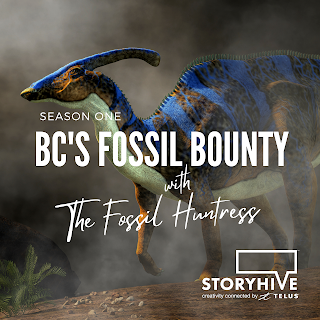
We are excited to share that BC's Fossil Bounty has been greenlit for Season Two by STORYHIVE Voices 2.0.  Join me as we explore the rich fossil bounty of fossil plants, dinosaurs to mighty marine reptiles and the people who unearth them. 

Discover British Columbia's violent past — how plate tectonics, volcanoes and glaciers shaped the land and why we find plant fossils along the Kitsilano foreshore and marine fossils beneath False Creek. Learn about the science of geochemistry from a palaeontologist who uses fossil teeth to reconstruct ancient environments.

Meet those who call Vancouver home and use this beautiful base for their mining explorations — opening up BC and communities through partnerships that honour First Nations wisdom, show a commitment to social responsibility & sound environmental practices.

​Hear from palaeontologists, geologists, geochemists, science organizations, dinosaur docents, palaeoartists and fossil preparators whose work brings our ancient world to life.

All this goodness is coming to you on TELUS Optik TV in a few short weeks. We had a great time filming BC's Fossil Bounty with some of the loveliest human beings on the planet. 

Funding is supported by TELUS STORYHIVE & DINO LAB INC. BC'S FOSSIL BOUNTY — SEASON ONE airs on TELUS Optik TV and the TELUS YouTube Channel to millions of viewers beginning Autumn 2022. SEASON TWO will be shooting in November and air in 2023. 

Visit www.fossilhuntress.com to learn more and to hear updates on the project.

Saturday, September 3, 2022

FOSSIL COLLECTING AT THE MYSTERIOUS CREEK FORMATION

Located three hours east of Vancouver, most folks head to Harrison Lake to enjoy its crisp waters, soak in the hot springs, camp or four-wheel-drive immersed in rugged scenery, or look for the elusive Sasquatch reported to live in the area. 

But some come to Harrison Lake and miss the town entirely. Instead, they favour the upper west side of the lake and the fossiliferous bounty found here.

Indeed, this is the perfect location for local citizen scientists to strut their stuff. Harrison is a perfect family day trip, where you can discover wonderful marine fossil specimens as complete or partially crushed fossilized shells embedded in rock. 

Amazingly, we can find them at all. These beauties range in age from Jurassic to Cretaceous, with most being Lower Callovian, meaning the ammonites here swam our ancient oceans more than 160 million years ago. 

The area around Harrison Lake has been home to the Sts’ailes, a sovereign Coast Salish First Nation for thousands of years. Sts’ailes’ means, “the beating heart,” and it sums up this glorious wilderness perfectly. They describe their ancient home as Xa’xa Temexw or Sacred Earth. 

With the settling of Canada, Geologists began exploring the area in the 1880s, calling upon the Sts’ailes to help them look for coal and a route for the Canadian Pacific Railway. Coal was the aim, but happily, they also found fossils. Sacred Earth, indeed.  

Belemnite Fossils
In my favourite outcrops, you can find large, smooth inflated Jurassic ammonites along with their small grey and brown cousins. 

Further up the road, you will see Cretaceous cigar-shaped squid-like cephalopods called Belemnites, and the bivalve (clam) Buchia — gifts deposited by glaciers. Here are the most common.

Ammonites

Almost all of the ammonite specimens found near Harrison Lake are the toonie sized Cadoceras (Paracadoceras) tonniense with well-preserved outer whorls but flattened inner whorls. We find semi-squished elliptical specimens here, too. If you see a large, smooth, inflated grapefruit-sized ammonite, you are holding a rare prize — a Cadoceras comma ammonite, the macroconch or female of the species.  

Ammonites were predatory, squid-like creatures that lived inside coil-shaped shells. Like other cephalopods, ammonites had sharp, beak-like jaws inside a ring of squid-like tentacles that extended from their shells. They used these tentacles to snare prey — plankton, vegetation, fish and crustaceans — similar to the way a squid or octopus hunts today.

Within their shells, ammonites had a number of chambers called septa filled with gas or fluid, and they were interconnected through a wee air tube. By pushing air in or out, they were able to control their buoyancy. 

These small but mighty marine predators lived in the last chamber of their shell and continuously built new shell material as they grew. As they added each new chamber, they would move their squid-like body down to occupy the final outside chamber.

Interestingly, ammonites from Harrison Lake are quite similar to the ones found within the lower part of the Chinitna Formation near Cook Inlet, Alaska, and Jurassic Point, Kyuquot, on the west coast of Vancouver Island — some of the most beautiful places on Earth. 

Buchia (bivalve) Clams

The bivalve or clam Buchia are commonly found at Harrison Lake. You will see them cemented together en masse. . They populated Upper Jurassic–Lower Cretaceous waters like a team sport. When they thrived, they really thrived, building up large coquinas of material. Large boulders of Buchia cemented together en masse hitched a ride with the glaciers and were deposited around Harrison Lake. Some kept going and we find similar erratics or glacier-deposited boulders as far south as Washington state. 

Buchia is used as Index Fossils. Index fossils help us to figure out the age of the rock we are looking at because they are abundant, populate an area en masse, and then die out quickly. In other words, they make it easy to identify a geologic time span.

So what does this mean to you? Now, when you are out and about with friends and discover rocks with Buchia, or made entirely of Buchia, you can say, “Oh, this looks to be Upper Jurassic or Lower Cretaceous. Come take a look! We're likely the first to lay eyes on this little clam since dinosaurs roamed the Earth.” 

Fossil Collecting at Harrison Lake Fossil Field Trip — Getting there

This Harrison Lake site is a great day trip from Vancouver or the Fraser Valley. You will need a vehicle with good tires for travel on gravel roads. Search out the route ahead of time and share your trip plan with someone you trust. If you can pre-load the Google Earth map of the area, you will thank yourself. 

Heading east on from Vancouver, it will take you 1.5-2 hours to reach Harrison Mills. 

Access Forestry Road #17 at the northeast end of the parking lot from the Sasquatch Inn at 46001 Lougheed Hwy, Harrison Mills. From there, it will take about an hour to get to the site. Look for signs for the Chehalis River Fish Hatchery to get you started. 

Drive 30 km up Forestry Road #1, and stop just past Hale Creek at 49.5° N, 121.9° W (paleo-coordinates 42.5° N, 63.4° W) on the west side of Harrison Lake. You will see Long Island to your right. 

The first of the yummy fossil exposures are just north of Hale Creek on the west side of the road. Keep in mind that this is an active logging road, so watch your kids and pets carefully. Everyone should be wearing something bright so they can be easily spotted.

How to Spot the Fossils

The fossils here are easily collected—look in the bedrock and in the loose material that gathers in the ditches. Specimens will show up as either dark grey, grey-brown or black. Look for the large, dark-grey boulders the size of smart cars packed with Buchia. 

And while you are at it, be on the lookout for anything that looks like bone. This site is also ripe for marine reptiles—think plesiosaur, mosasaur and elasmosaur. As a citizen scientist and budding palaeontologist, you might just find something new!

What to Know Before You Go

Fill your gas tank and pack a tasty lunch. As with all trips into British Columbia's wild places, dress for the weather. You will need hiking boots, rain gear, gloves, eye protection, and a good geologic hammer and rock (cold) chisel. 

Wear bright clothing and keep your head covered. Slides are common, and you may start a few if you hike the cliffs. If you are with a group, those collecting below may want to consider hardhats in case of rockfall — chunks of rock the size of your fist up to the size of a grapefruit. They pack a punch. 

Bring a colourful towel or something to put your keepers on. Once you set rock down, it can be hard to find again given the terrain. I take the extra precaution of spraying the ends of my hammers and chisels with yellow fluorescent paint, as I have lost too many in the field. You will also want to bring a camera for the blocks of Buchia that are too big to carry home. 

Identifying Your Treasures

When you have finished for the day, compare your treasures to see which ones you would like to keep. In British Columbia, you are a steward of the fossil, which means they belong to the province, but you can keep them safe. You are not allowed to sell or ship them outside British Columbia without a permit. 

Once you get home, wash and identify your finds. Harrison Lake does not have a large variety of fossil fauna, so this should not be difficult. If your find is coiled and round, it is an ammonite. If it is long and straight, it is a belemnite. And if it looks like a wee fat baby oyster, it is Buchia. This is not always true, but mostly true.

What about collecting fossils in all seasons?. Everyone has a preference. I prefer not to collect in the snow, but I have done it. While sunny days are lovely, it can also be easier to see the specimens when the rock is wet. So, do we do this in the rain? Heck, yeah! 

In torrential rain? 

Yes — once you are hooked, but for your casual friends or the kiddos, the answer is likely no. Choose your battles. They may come with you, but a cold day getting soaked is no fun. 

In time, you will find your inner fossil geek — probably with your first find. And that's just the tip of the iceberg. First, it will be you, then your kids, your friends and then your neighbour. Once you start, it is easy to get hooked. Fossil addiction is real, and the only cure is to get out there and do it some more. You've got this!

References and further information:

A. J. Arthur, P. L. Smith, J. W. H. Monger and H. W. Tipper. 1993. Mesozoic stratigraphy and Jurassic palaeontology west of Harrison Lake, southwestern British Columbia. Geological Survey of Canada Bulletin 441:1-62

R. W. Imlay. 1953. Callovian (Jurassic) ammonites from the United States and Alaska Part 2. The Alaska Peninsula and Cook Inlet regions. United States Geological Survey Professional Paper 249-B:41-108

An overview of the tectonic history of the southern Coast Mountains, British Columbia; Monger, J W H; in, Field trips to Harrison Lake and Vancouver Island, British Columbia; Haggart, J W (ed.); Smith, P L (ed.). Canadian Paleontology Conference, Field Trip Guidebook 16, 2011 p. 1-11 (ESS Cont.# 20110248).


Friday, August 5, 2022

THAT'S A WRAP: BC'S FOSSIL BOUNTY COMING AUTUMN 2022

We live in a diverse province edged by mountains, ocean, forests and streams. While our lens is often on the rugged beauty all around us, beneath our feet is yet another world.

Layers of rock hold fossils, each an interface to our deep past. 

Within each fragment, these ancient beings whisper their secrets, share their life experiences, tell us tales of community, how they made a living, who they rubbed shoulders with (or fins, or seedlings...) and convey the essence of a world long embedded in stone.

Join me as we explore the rich fossil bounty of fossil plants, dinosaurs to mighty marine reptiles and the people who unearth them.

Discover British Columbia's violent past — how plate tectonics, volcanoes and glaciers shaped the land and why we find plant fossils along the Kitsilano foreshore and marine fossils beneath False Creek. Learn about the science of geochemistry from a palaeontologist who uses fossil teeth to reconstruct ancient environments.

Meet those who call Vancouver home and use this beautiful base for their mining explorations — opening up BC and communities through partnerships that honour First Nations wisdom, show a commitment to social responsibility & sound environmental practices.

​Hear from palaeontologists, geologists, geochemists, science organizations, dinosaur docents, palaeoartists and fossil preparators whose work brings our ancient world to life.

All this goodness is coming to you on TELUS Optik TV in a few short weeks. We had a great time filming BC's Fossil Bounty with some of the loveliest human beings on the planet. 

Funding is supported by TELUS STORYHIVE & DINO LAB INC. BC'S FOSSIL BOUNTY — SEASON ONE airs on TELUS Optik TV and the TELUS YouTube Channel to millions of viewers beginning Autumn 2022. Plans for SEASON TWO & SEASON THREE are in the works. 

Visit www.fossilhuntress.com to learn more and to hear updates on the project.

Tuesday, July 19, 2022

STORYHIVE VOICES: MEET JULIUS CSOTONYI

Julius Csotonyi BTS on BC'S FOSSIL BOUNTY
Meet Julius Csotonyi — scientist, natural history illustrator, conservationist and biological sciences graduate with a passion for drawing dinosaurs. 

He got hooked on the palaeontology bug early and has been doodling dinosaurs since childhood. 

Over the years, he has expanded his portfolio to include all branches of scientifically inspired artwork — each of them beautifully rendered. 

He has collaborated on projects with several major museums and book publishers from around the globe, including the National Geographic Society and the Royal Tyrrell Museum, working closely with scientists and drawing from his scientific background. 

An MSc graduate of Ecology and Environmental Biology (University of Alberta), and a PhD graduate in microbiology (University of Manitoba), he has published scientific papers on mutualisms in Utah and some very cool and unusual alien-looking bacteria from deep ocean hydrothermal volcanic vents. 

His scientific background fuels his passion to strive to restore as realistically as possible the curiously alien environments that earth has hosted in its deep past. 

His style spans the gamut from pencil and ink line drawings to watercolour, pastel, 2-dimensional digital illustrations and 3-dimensional digital models. His superbly detailed work encompasses dinosaurs and other prehistoric life, sharks and other living animals, as well as space art, fantasy and science fiction themes.

Julius Csotonyi's Hell Creek Raptor
His paleoart career began with work on two dinosaur encyclopedias with UK author Dougal Dixon. 

His largest projects to date have been a panoramic 75-foot-long mural commissioned for the Houston Museum of Natural Science (HMNS), depicting a Late Cretaceous Montana ecosystem along with a mummified Brachylophosaurus —  Dinosaur Mummy CSI: Cretaceous Science Investigation, 2008. 

He has illustrated many life-sized dinosaur murals — some up to 45 metres or 150 feet long — for the Royal Ontario Museum's 2012 exhibit, Ultimate Dinosaurs; Giants from Gondwana. 

Julius illustrated the 25th anniversary exhibit ('Alberta Unearthed') for the Royal Tyrrell Museum of Paleontology (Drumheller, Alberta, 2010) and most of the new Hall of Paleontology at the HMNS. 

Some of his other projects have included the ceratopsian exhibit for the Royal Tyrrell Museum (2007), a mummified Edmontosaurus for Phillip Manning's 'Grave Secrets of Dinosaurs' (National Geographic Books, 2007) and an African Massospondylus nesting site (Royal Ontario Museum, Toronto, 2010). In addition to books and museum projects, 

Csotonyi accepts private commissions of artwork in a wide range of digital and traditional media. His website, http://csotonyi.com, features a growing portfolio of his work, and some of it is also featured on his science blog, 'Evolutionary Routes'. 

He is appearing in BC'S FOSSIL BOUNTY — airing on TELUS Optik TV & the TELUS YouTube Channel beginning Autumn 2022.

Thursday, March 10, 2022

BC'S FOSSIL BOUNTY — COMING TO TELUS OPTIK TV AUTUMN 2022

We live in a diverse province edged by mountains, ocean, forests and streams. While our lens is often on the rugged beauty all around us, beneath our feet is yet another world.

Layers of rock hold fossils, each an interface to our deep past. 

Within each fragment, these ancient beings whisper their secrets, share their life experiences, tell us tales of community, how they made a living, who they rubbed shoulders with (or fins, or seedlings...) and convey the essence of a world long embedded in stone.

Join me as we explore the rich fossil bounty of fossil plants, dinosaurs to mighty marine reptiles and the people who unearth them.

Discover British Columbia's violent past — how plate tectonics, volcanoes and glaciers shaped the land and why we find plant fossils along the Kitsilano foreshore and marine fossils beneath False Creek. Learn about the science of geochemistry from a palaeontologist who uses fossil teeth to reconstruct ancient environments.

Meet those who call Vancouver home and use this beautiful base for their mining explorations — opening up BC and communities through partnerships that honour First Nations wisdom, show a commitment to social responsibility & sound environmental practices.

​Hear from palaeontologists, geologists, geochemists, science organizations, dinosaur docents, palaeoartists and fossil preparators whose work brings our ancient world to life.

Funding is supported by TELUS STORYHIVE & DINO LAB INC. BC'S FOSSIL BOUNTY — SEASON ONE airs on TELUS Optik TV and the TELUS YouTube Channel to millions of viewers beginning Autumn 2022. Plans for SEASON TWO & SEASON THREE are in the works. 

Visit www.fossilhuntress.com to learn more and to hear updates on the project.