Showing posts with label author. Show all posts

Thursday, January 18, 2024

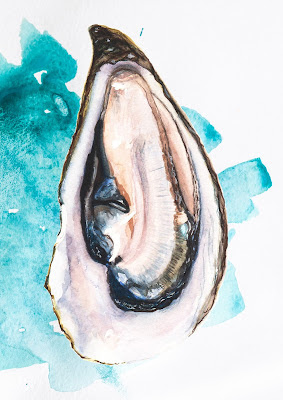
WEST COAST OYSTERS: T'LOXT'LOX

One of the now rare species of oysters in the Pacific Northwest is the Olympia oyster, Ostrea lurida, (Carpenter, 1864).  

While rare today, these are British Columbia’s only native oyster. 

Had you been dining on their brethren in the 1800s or earlier, it would have been this species you were consuming. Middens from Port Hardy to California are built from Ostrea lurida.

These wonderful invertebrates bare their souls with every bite. Have they lived in cold water, deep beneath the sea, protected from the sun's rays and heat? Are they the rough and tumble beach denizens whose thick shells tell us of a life spent withstanding the relentless pounding of the sea? Is the oyster in your mouth thin and slimy having just done the nasty—spurred by the warming waters of Spring? 

Is this oyster a local or was it shipped to your current local and, if asked, would greet you with "Kon'nichiwa?" Not if the beauty on your plate is indeed Ostrea lurida

Oyster in Kwak'wala is t̕łox̱t̕łox̱
We have been cultivating, indeed maximizing the influx of invasive species to the cold waters of the Salish Sea for many years. 

But in the wild waters off the coast of British Columbia is the last natural abundant habitat of the tasty Ostrea lurida in the pristine waters of  Nootka Sound. 

The area is home to the Nuu-chah-nulth First Nations who have consumed this species boiled or steamed for thousands of years. Here these ancient oysters not only survive but thrive — building reefs and providing habitat for crab, anemones and small marine animals. 

Oysters are in the family Ostreidae — the true oysters. Their lineage evolved in the Early Triassic — 251 - 247 million years ago. 

In the Kwak̓wala language of the Kwakwaka'wakw, speakers of Kwak'wala, of the Pacific Northwest and my family, an oyster is known as t̕łox̱t̕łox̱

I am curious to learn if any of the Nuu-chah-nulth have a different word for an oyster. If you happen to know, I would be grateful to learn.

Saturday, January 28, 2023

HARRISON LAKE: FOSSILS AND THE BEATING HEART

Located three hours east of Vancouver, most folks head to Harrison Lake to enjoy its crisp waters, soak in the hot springs, camp or four-wheel-drive immersed in rugged scenery, or look for the elusive Sasquatch reported to live in the area. 

But there are some who come to Harrison Lake and miss the town entirely. Instead, they favour the upper west side of the lake and the fossiliferous bounty found here.

Indeed, this is the perfect location for local citizen scientists to strut their stuff. Harrison is a perfect family day trip, where you can discover wonderful marine fossil specimens as complete or partially crushed fossilized shells embedded in rock. 

It is truly amazing that we can find them at all. These beauties range in age from Jurassic to Cretaceous, with most being Lower Callovian, meaning the ammonites here swam our ancient oceans more than 160 million years ago. 

The area around Harrison Lake has been home to the Sts’ailes, a sovereign Coast Salish First Nation for thousands of years. Sts’ailes’ means, “the beating heart,” and it sums up this glorious wilderness perfectly. They describe their ancient home as Xa’xa Temexw or Sacred Earth. 

With the settling of Canada, Geologists began exploring the area in the 1880s, calling upon the Sts’ailes to help them look for coal and a route for the Canadian Pacific Railway. Coal was the aim, but happily, they also found fossils. Sacred Earth, indeed.  

Belemnite Fossils
In my favourite outcrops, you can find large, smooth inflated Jurassic ammonites along with their small grey and brown cousins. 

Further up the road, you will see Cretaceous cigar-shaped squid-like cephalopods called Belemnites, and the bivalve (clam) Buchia — gifts deposited by glaciers. Here are the most common.

Ammonites

Almost all of the ammonite specimens found near Harrison Lake are the toonie sized Cadoceras (Paracadoceras) tonniense with well-preserved outer whorls but flattened inner whorls. We find semi-squished elliptical specimens here, too. If you see a large, smooth, inflated grapefruit-sized ammonite, you are holding a rare prize — a Cadoceras comma ammonite, the macroconch or female of the species.  

Ammonites were predatory, squid-like creatures that lived inside coil-shaped shells. Like other cephalopods, ammonites had sharp, beak-like jaws inside a ring of squid-like tentacles that extended from their shells. They used these tentacles to snare prey — plankton, vegetation, fish and crustaceans — similar to the way a squid or octopus hunts today.

Within their shells, ammonites had a number of chambers called septa filled with gas or fluid, and they were interconnected through a wee air tube. By pushing air in or out, they were able to control their buoyancy. 

These small but mighty marine predators lived in the last chamber of their shell and continuously built new shell material as they grew. As they added each new chamber, they would move their squid-like body down to occupy the final outside chamber.

Interestingly, ammonites from Harrison Lake are quite similar to the ones found within the lower part of the Chinitna Formation near Cook Inlet, Alaska, and Jurassic Point, Kyuquot, on the west coast of Vancouver Island — some of the most beautiful places on Earth. 

Buchia (bivalve) Clams

The bivalve or clam Buchia are commonly found at Harrison Lake. You will see them cemented together en masse. . They populated Upper Jurassic–Lower Cretaceous waters like a team sport. When they thrived, they really thrived, building up large coquinas of material. Large boulders of Buchia cemented together en masse hitched a ride with the glaciers and were deposited around Harrison Lake. Some kept going and we find similar erratics or glacier-deposited boulders as far south as Washington state. 

Buchia is used as Index Fossils. Index fossils help us to figure out the age of the rock we are looking at because they are abundant, populate an area en masse, and then die out quickly. In other words, they make it easy to identify a geologic time span.

So what does this mean to you? Now, when you are out and about with friends and discover rocks with Buchia, or made entirely of Buchia, you can say, “Oh, this looks to be Upper Jurassic or Lower Cretaceous. Come take a look! We're likely the first to lay eyes on this little clam since dinosaurs roamed the Earth.” 

Fossil Collecting at Harrison Lake Fossil Field Trip — Getting there

This Harrison Lake site is a great day trip from Vancouver or the Fraser Valley. You will need a vehicle with good tires for travel on gravel roads. Search out the route ahead of time and share your trip plan with someone you trust. If you can pre-load the Google Earth map of the area, you will thank yourself. 

Heading east on from Vancouver, it will take you 1.5-2 hours to reach Harrison Mills. 

Access Forestry Road #17 at the northeast end of the parking lot from the Sasquatch Inn at 46001 Lougheed Hwy, Harrison Mills. From there, it will take about an hour to get to the site. Look for signs for the Chehalis River Fish Hatchery to get you started. 

Drive 30 km up Forestry Road #1, and stop just past Hale Creek at 49.5° N, 121.9° W (paleo-coordinates 42.5° N, 63.4° W) on the west side of Harrison Lake. You will see Long Island to your right. 

The first of the yummy fossil exposures are just north of Hale Creek on the west side of the road. Keep in mind that this is an active logging road, so watch your kids and pets carefully. Everyone should be wearing something bright so they can be easily spotted.

How to Spot the Fossils

The fossils here are easily collected—look in the bedrock and in the loose material that gathers in the ditches. Specimens will show up as either dark grey, grey-brown or black. Look for the large, dark-grey boulders the size of smart cars packed with Buchia. 

And while you are at it, be on the lookout for anything that looks like bone. This site is also ripe for marine reptiles—think plesiosaur, mosasaur and elasmosaur. As a citizen scientist and budding palaeontologist, you might just find something new!

What to Know Before You Go

Fill your gas tank and pack a tasty lunch. As with all trips into British Columbia's wild places, dress for the weather. You will need hiking boots, rain gear, gloves, eye protection, and a good geologic hammer and rock (cold) chisel. 

Wear bright clothing and keep your head covered. Slides are common, and you may start a few if you hike the cliffs. If you are with a group, those collecting below may want to consider hardhats in case of rockfall — chunks of rock the size of your fist up to the size of a grapefruit. They pack a punch. 

Bring a colourful towel or something to put your keepers on. Once you set rock down, it can be hard to find again given the terrain. I take the extra precaution of spraying the ends of my hammers and chisels with yellow fluorescent paint, as I have lost too many in the field. You will also want to bring a camera for the blocks of Buchia that are too big to carry home. 

Identifying Your Treasures

When you have finished for the day, compare your treasures to see which ones you would like to keep. In British Columbia, you are a steward of the fossil, which means they belong to the province, but you can keep them safe. You are not allowed to sell or ship them outside British Columbia without a permit. 

Once you get home, wash and identify your finds. Harrison Lake does not have a large variety of fossil fauna, so this should not be difficult. If your find is coiled and round, it is an ammonite. If it is long and straight, it is a belemnite. And if it looks like a wee fat baby oyster, it is Buchia. This is not always true, but mostly true.

What about collecting fossils in all seasons?. Everyone has a preference. I prefer not to collect in the snow, but I have done it. While sunny days are lovely, it can also be easier to see the specimens when the rock is wet. So, do we do this in the rain? Heck, yeah! 

In torrential rain? 

Yes — once you are hooked, but for your casual friends or the kiddos, the answer is likely no. Choose your battles. They may come with you, but a cold day getting soaked is no fun. 

In time, you will find your inner fossil geek — probably with your first find. And that's just the tip of the iceberg. First, it will be you, then your kids, your friends and then your neighbour. Once you start, it is easy to get hooked. Fossil addiction is real, and the only cure is to get out there and do it some more. You've got this!

References and further information:

A. J. Arthur, P. L. Smith, J. W. H. Monger and H. W. Tipper. 1993. Mesozoic stratigraphy and Jurassic palaeontology west of Harrison Lake, southwestern British Columbia. Geological Survey of Canada Bulletin 441:1-62

R. W. Imlay. 1953. Callovian (Jurassic) ammonites from the United States and Alaska Part 2. The Alaska Peninsula and Cook Inlet regions. United States Geological Survey Professional Paper 249-B:41-108

An overview of the tectonic history of the southern Coast Mountains, British Columbia; Monger, J W H; in, Field trips to Harrison Lake and Vancouver Island, British Columbia; Haggart, J W (ed.); Smith, P L (ed.). Canadian Paleontology Conference, Field Trip Guidebook 16, 2011 p. 1-11 (ESS Cont.# 20110248).


Saturday, January 21, 2023

INDIGO: NATURAL DYES

Natural dyes are dyes or colourants derived from plants, invertebrates, or minerals. The majority of natural dyes are vegetable dyes from plant sources — roots, berries, bark, leaves, and wood — and other biological sources such as fungi and lichens.

Archaeologists have found evidence of textile dyeing dating back to the Neolithic period. In China, dyeing with plants, barks and insects has been traced back more than 5,000 years and looks to be our first attempt at the practice of chemistry.

The essential process of dyeing changed little over time. Typically, the dye material is put in a pot of water and then the textiles to be dyed are added to the pot, which is heated and stirred until the colour is transferred. Sometimes, we use workers with stout marching legs to mix this up.

Traditional dye works still operate in many parts of the world. There is a revival of using natural indigo in modern Egypt — although their indigo dye is mostly imported. The same is true further south in Sudan. They've been importing cloth from Upper Egypt as far back as we have written records and continue the practice of the cloth and dye imports today. Clean white cotton is more the style of western Sudan and Chad, but they still like to throw in a bit of colour.

Traditional Dye Vats
So do the folk living in North Africa. Years ago, I was travelling in Marrakesh and saw many men with noticeably orange, blueish or purplish legs. It wasn't one or two but dozens of men and I'd wondered why this was.

My guide took me to the top of a building so I could look down on rows and rows of coloured vats. In every other one was a man marching in place to work the dye into the wool. Their legs took on the colour from their daily march in place in huge tubs of liquid dye and sheared wool. 

This wool would be considered textile fibre dyed before spinning — dyed in the wool — but most textiles are yarn-dyed or piece-dyed after weaving. In either case, the finished product is quite fetching even if the dyer's legs are less so. 

Many natural dyes require the use of chemicals called mordants to bind the dye to the textile fibres; tannin from oak galls, salt, natural alum, vinegar, and ammonia from stale urine were staples of the early dyers.

Many mordants and some dyes themselves produce strong odours. Urine is a bit stinky. Not surprisingly, large-scale dyeworks were often isolated in their own districts.

Woad, Isatis tinctoria
Plant-based dyes such as Woad, Isatis tinctoria, indigo, saffron, and madder were raised commercially and were important trade goods in the economies of Asia and Europe. 

Across Asia and Africa, patterned fabrics were produced using resist dyeing techniques to control the absorption of colour in piece-dyed cloth.

Dyes such as cochineal and logwood, Haematoxylum campechianum, were brought to Europe by the Spanish treasure fleets, and the dyestuffs of Europe were carried by colonists to America.

Throughout history, people have dyed their textiles using common, locally available materials, but scarce dyestuffs that produced brilliant and permanent colours such as the natural invertebrate dyes. Crimson kermes became highly prized luxury items in the ancient and medieval world. Red, yellow and orange shades were fairly easy to procure as they exist as common colourants of plants. It was blue that people sought most of all and purple even more so.

Indigofera tinctoria, a member of the legume or bean family proved just the trick. This lovely plant —  named by the famous Swedish botanist Carl Linneaus, the father of formalized binomial nomenclature — grows in tropical to temperate Asia and subtropical regions, including parts of Africa.

The plants contain the glycoside indican, a molecule that contains a nitrogenous indoxyl molecule with some glucose playing piggyback. 

Indigo dye is a product of the reaction of indoxyl by a mild oxidizing agent, usually just good old oxygen.

To make the lovely blue and purple dyes, we harvest the plants and ferment them in vats with urine and ash. The fermentation splits off the glucose, a wee bit of oxygen mixes in with the air (with those sturdy legs helping) and we get indigotin — the happy luxury dye of royalty, emperors and kings.

While much of our early dye came from plants — now it is mostly synthesized — other critters played a role. Members of the large and varied taxonomic family of predatory sea snails, marine gastropod mollusks, commonly known as murex snails were harvested by the Phoenicians for the vivid dye known as Tyrian purple.

While the extant specimens maintained their royal lineage for quite some time; at least until we were able to manufacture synthetic dyes, it was their fossil brethren that first captured my attention. There are about 1,200 fossil species in the family Muricidae. 

They first appear in the fossil record during the Aptian of the Cretaceous. Their ornate shells fossilize beautifully. I first read about them in Addicott's Miocene Gastropods and Biostratigraphy of the Kern River Area, California. It is a wonderful survey of 182 early and middle Miocene gastropod taxa.

References:

George E. Radwin and Anthony D'Attilio: The Murex shells of the World, Stanford University press, 1976, ISBN 0-8047-0897-5

Pappalardo P., Rodríguez-Serrano E. & Fernández M. (2014). "Correlated Evolution between Mode of Larval Development and Habitat in Muricid Gastropods". PLoS ONE 9(4): e94104. doi:10.1371/journal.pone.0094104

Miocene Gastropods and Biostratigraphy of the Kern River Area, California; United States Geological Survey Professional Paper 642  

Friday, January 20, 2023

CHARIOCRINUS: FRANCE

Chariocrinus andrae, Collection: David Appleton
Crinoids are one of my favourite echinoderms. It is magical when all the elements come together to preserve a particularly lovely specimen in such glorious detail. 

This impressive block, chock full of lovely, well-preserved specimens of the crinoid, Chariocrinus andrae, hails from Bathonian outcrops in Beaune, Saône-et-Loire in the Bourgogne-Franche-Comté region of central-eastern France. They are intertwined to cover most of the surface area of the citrus coloured matrix. 

Crinoids are unusually beautiful and graceful members of the phylum Echinodermata. They resemble an underwater flower swaying in an ocean current. But make no mistake they are marine animals. Picture a flower with a mouth on the top surface that is surrounded by feeding arms. Awkwardly, add an anus right beside that mouth. That's him!

Crinoids with root-like anchors are called Sea Lilies. They have graceful stalks that grip the ocean floor. Those in deeper water have longish stalks up to 3.3 ft or a meter in length.

Then there are other varieties that are free-swimming with only vestigial stalks. They make up the majority of this group and are commonly known as feather stars or comatulids. 

Unlike the sea lilies, the feather stars can move about on tiny hook-like structures called cirri. It is these same cirri that allow crinoids to latch to surfaces on the seafloor. Like other echinoderms, crinoids have pentaradial symmetry. The aboral surface of the body is studded with plates of calcium carbonate, forming an endoskeleton similar to that in starfish and sea urchins.

These make the calyx somewhat cup-shaped, and there are few, if any, ossicles in the oral (upper) surface, an area we call the tegmen. It is divided into five ambulacral areas, including a deep groove from which the tube feet project, and five interambulacral areas between them. 

Crinoids are alive and well today. They are also some of the oldest fossils on the planet. We have lovely fossil specimens dating back to the Ordovician — if one ignores the enigmatic Echmatocrinus of the Burgess Shale. And they can be quite plentiful. Crinoid fossils, and in particular disarticulated crinoid columnals, can be so abundant that they at times serve as the primary supporting clasts in sedimentary rocks

This beautiful 7" x 6" piece was photographed in natural sunlight to help show off the amazing detail. Photo and collection of the deeply awesome David Appleton.

Saturday, January 14, 2023

FOUR TUSKS AND A TRUNK: TETRALOPHODON

Tetralophodon ("four-ridged tooth") is an extinct proboscidean genus belonging to the superfamily Elephantoidea. 

Their fossils have been found from the late Miocene to the Middle Pliocene of Europe, Asia, and Africa, which means many of our ancestors would have had the opportunity to see and hunt them. Lucky for them, these large elephant-like animals preferred fruits and vegetables. 

Like the gomphotheres, to which it was not closely related, Tetralophodon had an impressive four tusks and a trunk. They were big and on size with our modern elephants. You and I would come up to their hip bone on average. They were about 2.58–3.45 m (8.5–11.3 ft) tall at the shoulder and up to 10 tonnes in weight, larger than the size of the present Asian elephant, with a long trunk and incisors ranging up to 2 m (6.6 ft) long. 

Friday, January 13, 2023

BLUE JAY: KWASK'WAS

If you live in North American, there is a high probability that you have seen or heard the bird song of the Blue jay, Cyanocitta cristata (Linnaeus, 1758).

Blue Jays are in the family Corvidae — along with crows, ravens, rooks, magpies and jackdaws. They belong to a lineage of birds first seen in the Miocene — 25 million years ago. 

These beautifully plumed, blue, black and white birds can be found across southern Canada down to Florida. The distinctive blue you see in their feathers is a trick of the light. Their pigment, melanin, is actually a rather dull brown. The blue you see is caused by scattering light through modified cells on the surface of the feather as wee barbs.

Blue jays like to dine on nuts, seeds, suet, arthropods and some small vertebrates. 

If you are attempting to lure them to your yard with a bird feeder, they prefer those mounted on trays or posts versus hanging feeders. They will eat most anything you have on offer but sunflower seeds and peanuts are their favourites. 

They have a fondness for acorns and have been credited with helping expand the range of oak trees as the ice melted after the last glacial period.  

Their Binomial name, Cyanocitta cristata means, crested, blue chattering bird. I might have amended that to something less flattering, working in a Latin word or two for shrieks and screams — voce et gemitu or ululo et quiritor. While their plumage is a visual feast, their bird chatter leaves something to be desired. 

In the Kwak̓wala language of the Kwakiutl or Kwakwaka'wakw, speakers of Kwak'wala, of the Pacific Northwest and my family, a Blue Jay is known as kwa̱skwa̱s

The Kwak’wala word for blue is dzasa and cry is ḵ̕was'id. For interest, the word for bird song in Kwak'wala is t̕sa̱sḵwana. Both their songs and cries are quite helpful if you are an animal living nearby and concerned about predators. 


Sunday, September 4, 2022

FINDING SMILODON AMONGST THE BONES

This fierce predator with the luxurious coat is Smilodon fatalis — a compact but robust killer that weighed in around 160 to 280 kg and was 1.5 - 2.2 metres long.

Smilodon is a genus of the extinct machairodont subfamily of the felids. It is one of the most famous prehistoric mammals and the best known saber-toothed cat. 

Although commonly known as the saber-toothed tiger, it was not closely related to the tiger or other modern cats.

Up until a few years ago, all the great fossil specimens of this apex predator were found south of us in the United States. That was until some interesting bones from Medicine Hat, Alberta got a second look.

A few years ago, a fossil specimen caught the eye of researcher Ashley Reynolds as she was rummaging through the collections at the Royal Ontario Museum in Toronto. 

Back in the 1960s,  University of Toronto palaeontologist C.S. Churcher and his team had collected and donated more than 1,200 specimens from their many field seasons scouring the bluffs of the South Saskatchewan River near Medicine Hat, Alberta.

Churcher is a delightful storyteller and a palaeontologist with a keen eye. I had the very great pleasure of listening to many of his talks out at the University of British Columbia and a few Vancouver Paleontological Society meetings in the mid-2000s. 


He moved out to the West Coast for his retirement, first to Gabriola Island then to Victoria, but his keen love of the science kept him giving talks to enthralled listeners keen to hear about his survey of the Dakhleh Oasis in the Western Desert of Egypt, geomorphology, stratigraphy, recent biology, Pleistocene and Holocene lithic cultures, insights learned from Neolithic Islamic pottery to Roman settlements.

The specimens he had collected had been roughly sorted but never examined in detail. Reynolds, who was researching the growth patterns and life histories of extinct cats saw a familiar-looking bone from an ancient cat's right front paw. That tiny paw bone had reached through time and was positively identified as Canada's first Smilodon.

These Apex Predators used their exceptionally long upper canine teeth to hunt large mammals. 

Isotopes preserved in the bones of S. fatalis in the La Brea Tar Pits in California tell us that they liked to dine on bison (Bison antiquus) and camels (Camelops) along with deer and tapirs. Smilodon is thought to have killed its prey by holding it still with its forelimbs and biting it. And that was quite the bite!

Their razor-sharp incisors were arranged in an arch. Once they bit down, the teeth would hold their prey still and stabilize it while the canine bite was delivered — and what a bite that was. They could open their mouths a full 120 degrees.

Smilodon died out at the same time that most North and South American megafauna disappeared, about 10,000 years ago. Its reliance on large animals has been proposed as the cause of its extinction, along with climate change and competition with other species.