Showing posts with label habitat. Show all posts

Thursday, January 18, 2024

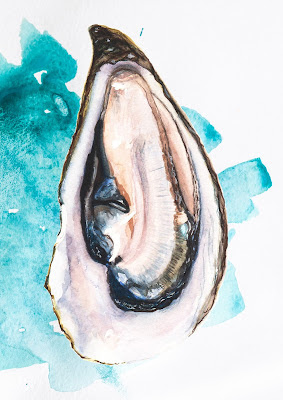
WEST COAST OYSTERS: T'LOXT'LOX

One of the now rare species of oysters in the Pacific Northwest is the Olympia oyster, Ostrea lurida, (Carpenter, 1864).  

While rare today, these are British Columbia’s only native oyster. 

Had you been dining on their brethren in the 1800s or earlier, it would have been this species you were consuming. Middens from Port Hardy to California are built from Ostrea lurida.

These wonderful invertebrates bare their souls with every bite. Have they lived in cold water, deep beneath the sea, protected from the sun's rays and heat? Are they the rough and tumble beach denizens whose thick shells tell us of a life spent withstanding the relentless pounding of the sea? Is the oyster in your mouth thin and slimy having just done the nasty—spurred by the warming waters of Spring? 

Is this oyster a local or was it shipped to your current local and, if asked, would greet you with "Kon'nichiwa?" Not if the beauty on your plate is indeed Ostrea lurida

Oyster in Kwak'wala is t̕łox̱t̕łox̱
We have been cultivating, indeed maximizing the influx of invasive species to the cold waters of the Salish Sea for many years. 

But in the wild waters off the coast of British Columbia is the last natural abundant habitat of the tasty Ostrea lurida in the pristine waters of  Nootka Sound. 

The area is home to the Nuu-chah-nulth First Nations who have consumed this species boiled or steamed for thousands of years. Here these ancient oysters not only survive but thrive — building reefs and providing habitat for crab, anemones and small marine animals. 

Oysters are in the family Ostreidae — the true oysters. Their lineage evolved in the Early Triassic — 251 - 247 million years ago. 

In the Kwak̓wala language of the Kwakwaka'wakw, speakers of Kwak'wala, of the Pacific Northwest and my family, an oyster is known as t̕łox̱t̕łox̱

I am curious to learn if any of the Nuu-chah-nulth have a different word for an oyster. If you happen to know, I would be grateful to learn.

Saturday, August 28, 2021

SERENE SIRENIA

This adorable aquatic vacuum is a dugong. I had always grouped the dugongs and manatees together. There are slight differences between these two but both belong to the order Sirenia. 

They shared a cousin in the Steller's sea cow, Hydrodamalis gigas, but that piece of their lineage was hunted to extinction by our species in the 18th century. 

Dugongs have tail flukes with pointed tips — similar to whales — and manatees have paddle-shaped tails, similar to a Canadian Beaver.

Both of these lovelies from the order Sirenia went from terrestrial to marine, taking to the water in search of more prosperous pastures, as it were. 

We find dugongs today in waters near northern Australia and parts of the Indian and Pacific Oceans. 

They inhabit rivers and shallow coastal waters, making the best use of their fusiform bodies that lack dorsal fins and hind limbs. I have been thinking about them in the context of some of the primitive armoured fish we find in the Chengjiang biota of China, specifically those primitive species that were also fusiform.

They favour locations where seagrass, their food of choice, grows plentiful and they eat it roots and all. While seagrass low in fibre, high in nitrogen, and easily digestible is preferred, dugongs will also dine on lower grade seagrass, algae, and invertebrates should the opportunity arise. They have been known to eat jellyfish, sea squirts, and shellfish over the course of their long lives. 

Some of the oldest dugongs have been known to live 70+ years, which is another statistic I find surprising. They are large, passive, have poor eyesight, and look pretty tasty floating in the water; a defenceless floating buffet. Their population is in decline and yet they live on.