Showing posts with label researcher. Show all posts

Sunday, April 7, 2024

ANCIENT OCTOPUS: KEUPPIA

A sweet as you please example of Keuppia levante (Fuchs, Bracchi & Weis, 2009), an extinct genus of octopus that swam our ancient seas back in the Cretaceous. 

This particular lovely adorns a special place in my heart and my office. His forever home will be within the collections of a local museum but we spend time together—me taking in the remarkable detail and preservation of this specimen and him enjoying a pretty good looking view and regular dustings. Win, win.

I say, he, but we cannot know for sure. 

The dark black and brown area you see here is his ink sac which has been preserved for a remarkable 95 million years.

This cutie is in the family Palaeoctopodidae, and one of the earliest representatives of the order Octopoda — and perhaps my favourite fossil. It was this perfect specimen that inspired the logo for the Fossil Huntress brand.  

These ancient marine beauties are in the class Cephalopoda making them relatives of our modern octopus, squid and cuttlefish.

There are two species of Keuppia, Keuppia hyperbolaris and Keuppia levante, both of which we find as fossils. We find their remains, along with those of the genus Styletoctopus, in Cretaceous-age Hâqel and Hjoula localities in Lebanon. 

For many years, Palaeoctopus newboldi (Woodward, 1896) from the Santonian limestones at Sâhel Aalma, Lebanon, was the only known pre‐Cenozoic coleoid cephalopod believed to have an unambiguous stem‐lineage representative of Octobrachia fioroni

With the unearthing of some extraordinary specimens with exquisite soft‐part preservation in the Lebanon limestones, our understanding of ancient octopus morphology has blossomed. The specimens are from the sub‐lithographical limestones of Hâqel and Hâdjoula, in northwestern Lebanon. The localities are about 15 km apart, 45 km away from Beirut and 15 km away from the coastal city of Jbail. Fuchs et al. put a nice little map in their 2009 paper that I have included and referenced here.

Palaeoctopus newboldi had a spherical mantle sac, a head‐mantle fusion, eight equal arms armed with suckers, an ink sac, a medially isolated shell vestige, and a pair of (sub‐) terminal fins. The bipartite shell vestige suggests that Palaeoctopus belongs to the octopod stem‐lineage, as the sister taxon of the Octopoda, the Cirroctopoda, is characterized by an unpaired clasp‐like shell vestige (Engeser 1988; Haas 2002; Bizikov 2004).

It is from the comparisons of Canadian fauna combined with those from Lebanon and Japan that things really started to get interesting with Octobrachia. Working with fossil specimens from the Campanian of Canada, Fuchs et al. (2007a ) published on the first record of an unpaired, saddle‐shaped shell vestige that might have belonged to a cirroctopod. 

Again from the Santonian–Campanian of Canada and Japan, Tanabe et al. (2008) reported on at least four different jaw morphotypes. Two of them — Paleocirroteuthis haggarti (Tanabe et al., 2008) and Paleocirroteuthis Pacifica  (Tanabe et al ., 2008) — have been interpreted as being of cirroctopod type, one of octopod type, and one of uncertain octobrachiate type. 

Interestingly Fuchs et al. have gone on to describe the second species of Palaeoctopus, the Turonian Palaeoctopus pelagicus from limestones at Vallecillo, Mexico. While more of this fauna will likely be recovered in time, their work is based solely on a medially isolated shell vestige.

Five new specimens have been found in the well-known Upper Cenomanian limestones at Hâqel and Hâdjoula in Lebanon that can be reliably placed within the Octopoda. Fuchs et al. described these exceptionally well‐preserved specimens and discuss their morphology in the context of phylogeny and evolution in their 2008 paper (2009 publishing) in the Palaeontology Association Journal, Volume 51, Issue 1.

The presence of a gladius vestige in this genus shows a transition from squid to octopus in which the inner shell has divided into two parts in early forms to eventually be reduced to lateralized stylets, as can be seen in Styletoctopus.

The adorable fellow you see here with his remarkable soft-bodied preservation and inks sack and beak clearly visible is Keuppia levante. He hails from Late Cretaceous (Upper Cenomanian) limestone deposits near Hâdjoula, northwestern Lebanon. The vampyropod coleoid, Glyphiteuthis abisaadiorum n. sp. is also found at this locality. This specimen is about 5 cm long.

Fuchs, D.; Bracchi, G.; Weis, R. (2009). "New octopods (Cephalopoda: Coleoidea) from the Late Cretaceous (Upper Cenomanian) of Hâkel and Hâdjoula, Lebanon". Palaeontology. 52: 65–81. doi:10.1111/j.1475-4983.2008.00828.x.

Photo one: Fossil Huntress. Figure Two: Topographic map of north‐western Lebanon with the outcrop area in the upper right-hand corner. Fuchs et al, 2009.  

Sunday, March 3, 2024

LATE HETTANGIAN FOSSIL FAUNA FROM THE TASEKO LAKES: BRITISH COLUMBIA

The late Hettangian ammonite fauna from Taseko Lakes is diverse and relatively well‐preserved. Over three field seasons, thirty-five taxa from the Mineralense and Rursicostatum zones were studied and three new species discovered and named: Fergusonites hendersonae, Eolytoceras constrictum and Pseudaetomoceras victoriense

This material is very important as it greatly expands our understanding of the fauna and ranges of ammonites currently included in the North American regional ammonite zonation. 

I had the very great honour of having the fellow below, Fergusonites hendersonae, a new species of nektonic carnivorous ammonite, named after me by palaeontologist Louse Longridge from the University of British Columbia. 

I'd met Louise as an undergrad and was pleased as punch to hear that she would be continuing the research by Dr. Howard Tipper, the authority on this area of the Chilcotins and Haida Gwaii — which he dearly loved. 

"Tip" was a renowned Jurassic ammonite palaeontologist and an excellent regional mapper who mapped large areas of the Cordillera. He made significant contributions to Jurassic paleobiogeography and taxonomy in collaboration with Dr. Paul Smith, Head of Earth and Ocean Science at the University of British Columbia. 

Tip’s regional mapping within BC has withstood the test of time and for many areas became the regions' base maps for future studies. The scope of Tip’s understanding of Cordilleran geology and Jurassic palaeontology will likely never be matched. He passed away on April 21, 2005. His humour, knowledge and leadership will be sorely missed. 

Fergusonites hendersonae
Before he left us, he shared that knowledge with many of whom who would help to secure his legacy for future generations. We did several trips over the years up to the Taseko Lake area of the Rockies joined by many wonderful researchers from Vancouver Island Palaeontological Society and Vancouver Paleontological Society, as well as the University of British Columbia. 

Both Dan Bowen and John Fam were instrumental in planning those expeditions and each of them benefited greatly from the knowledge of Dr. Howard Tipper. 

If not for Tipper's early work in the region, our shared understanding and much of what was accomplished in his last years and after his passing would not have been possible. 

Over the course of three field seasons, we endured elevation sickness, rain, snow, grizzly bears and very chilly nights  — we were sleeping right next to a glacier at one point — but were rewarded by the enthusiastic crew, helicopter rides — which really cut down the hiking time — excellent specimens including three new species of ammonites, along with a high-spired gastropod and lobster claw that have yet to be written up. This area of the world is wonderful to hike and explore — stunningly beautiful country. We were also blessed with access as the area is closed to all fossil collecting except with a permit.

This fauna understanding helps us to understand the correlations between different areas: (1) the Mineralense and Rursicostatum zones are present in Taseko Lakes and can be readily correlated with contemporaneous strata elsewhere in North America; (2) the Mineralense and Rursicostatum zones of North America are broadly equivalent to the Canadensis Zone and probably the Arcuatum horizon of the South American succession; (3) broad correlations are possible with middle–late Hettangian and earliest Sinemurian taxa in New Zealand; (4) the Mineralense and Rursicostatum zones are broadly equivalent to the circum‐Mediterranean Marmoreum Zone; (5) the Mineralense Zone and the lower to middle portion of the Rursicostatum Zone are probably equivalent to the Complanata Subzone whereas the upper portion of the Rursicostatum Zone may equate to the Depressa Subzone of the north‐west European succession.

Taseko Lake Area, BC
The Taseko Lakes area has yielded the best preserved and most diverse collection of late Hettangian ammonites yet discovered in British Columbia (BC). Early studies of the fauna were undertaken by Frebold (1951, 1967). At that time, eastern Pacific ammonite faunas were poorly understood and species were frequently shoehorned into established north‐west European taxa. 

Since then, knowledge of eastern Pacific Hettangian ammonite faunas has improved considerably. 

Detailed systematic studies have been completed on faunas from localities in other areas of BC, Alberta, Alaska, Oregon, Nevada, Mexico and South America (e.g. Guex 1980, 1995; Imlay 1981; Hillebrandt 1981, 1988, 1990, 1994, 2000a–d; Smith and Tipper 1986; Riccardi et al. 1991; Jakobs and Pálfy 1994; Pálfy et al. 1994, 1999; Taylor 1998; Hall et al. 2000; Taylor and Guex 2002; Hall and Pitaru 2004). 

These studies have demonstrated that Early Jurassic eastern Pacific ammonites had strong Tethyan affinities as well as a high degree of endemism (Guex 1980, 1995; Taylor et al. 1984; Smith et al. 1988; Jakobs et al. 1994; Pálfy et al. 1994). Frebold’s early studies were also hampered because they were based on small collections, which limited understanding of the diversity of the fauna and variation within populations. However, recent mapping has greatly improved our understanding of the geology of Taseko Lakes (Schiarizza et al. 1997; Smith et al. 1998; Umhoefer and Tipper 1998) and encouraged further collecting that has dramatically increased the size of the sample.

A study of the ammonite fauna from Taseko Lakes is of interest for several reasons. The data are important for increasing the precision of the late Hettangian portion of the North American Zonation. 

Owing to the principally Tethyan or endemic nature of Early Jurassic ammonites in the eastern Pacific, a separate zonation for the Hettangian and Sinemurian of the Western Cordillera of North America has been established by Taylor et al. (2001). Except for information available from the early studies by Frebold (1951, 1967), the only Taseko Lakes taxa included in the North American Zonation of Taylor et al. (2001) were species of Angulaticeras studied by Smith and Tipper (2000). 

Since then, Longridge et al. (2006) made significant changes to the zonation of the late Hettangian and early Sinemurian based on a detailed study of the Badouxia fauna from Taseko Lakes (Text‐fig. 2). An additional taxonomic study was recently completed on the late Hettangian ammonite Sunrisites (Longridge et al. 2008) and this information has not yet been included within the zonation. 

Hettangian Zonation
The systematics of the remaining ammonite fauna from Taseko Lakes are presented here. A comprehensive study of this material is important because the exceptional quality and diversity of the fauna provide important data for updating the North American Zonation, making it more comprehensive and more widely applicable, especially in Canada.

The Taseko Lakes fauna can improve Hettangian correlations within North America as well as between North America and the rest of the world. 

North‐west European ammonite successions (e.g. Dean et al. 1961; Mouterde and Corna 1997; Page 2003) are considered the primary standard for Early Jurassic biochronology (Callomon 1984). 

In north‐west Europe, the turnover from schlotheimiid dominated faunas in the late Hettangian to arietitid dominated faunas in the early Sinemurian was sharp (e.g. Dean et al. 1961; Bloos 1994; Bloos and Page 2002). In other areas, by contrast, these faunas were not so mutually exclusive and the transition was much more gradual. 

This makes correlations between north‐west Europe and other areas difficult (e.g. Bloos 1994; Bloos and Page 2000, 2002). Correlations are further impeded by endemism and provincialism. 

The Taseko Lakes fauna addresses these problems because it contains many taxa that are common throughout the eastern Pacific as well as several cosmopolitan taxa that make intercontinental correlation possible. Correlation between North America and other areas is of particular significance in that the interbedded volcanic and fossiliferous marine rocks in North America permit the calibration of geochronological and biochronological time scales (Pálfy et al. 1999, 2000). 

This correlation between the late Hettangian fauna in the Taseko Lakes area and contemporaneous faunas in other areas of North America, South America, New Zealand, western and eastern Tethys, and north‐west Europe is of particular interest to me — especially the correlation of the faunal sequences of Nevada, USA. 

Reference: PaleoDB 157367 M. Clapham GSC C-208992, Section A 09, Castle Pass Angulata - Jurassic 1 - Canada, Longridge et al. (2008)

L. M. Longridge, P. L. Smith, and H. W. Tipper. 2008. Late Hettangian (Early Jurassic) ammonites from Taseko Lakes, British Columbia, Canada. Palaeontology 51:367-404

PaleoDB taxon number: 297415; Cephalopoda - Ammonoidea - Juraphyllitidae; Fergusonites hendersonae Longridge et al. 2008 (ammonite); Average measurements (in mm): shell width 9.88, shell diameter 28.2; Age range: 201.6 to 196.5 Ma. Locality info: British Columbia, Canada (51.1° N, 123.0° W: paleo coordinates 22.1° N, 66.1° W)

Photo One: Hettangian Ammonites and Gastropods, Taseko Lakes. Photo Two: Fergusonites hendersonae, a Late Hettangian (Early Jurassic) ammonite from the Taseko Lakes area of British Columbia, Canadian Rockies, named by Dr. Louise Longridge after Heidi Henderson, Chair, Vancouver Paleontological Society who collected and subsequently donated many Hettangian specimens from Taseko Lakes to the GSC collections. Holotype. GSC 127423 from the Rursicostatum Zone, Castle Pass section A, level 06, Taseko Lakes.

Map: Localities of sections and isolated outcrops bearing late Hettangian ammonites in the Taseko Lakes map area. Figure Two: Zonation for the Hettangian showing correlation of North American zones with South America, north‐west Europe, western Tethys (circum‐Mediterranean), eastern Tethys and New Zealand. Only approximate correlations are implied. 

Thursday, January 18, 2024

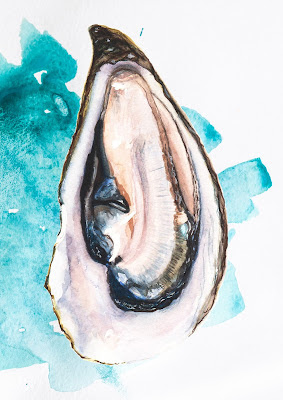
WEST COAST OYSTERS: T'LOXT'LOX

One of the now rare species of oysters in the Pacific Northwest is the Olympia oyster, Ostrea lurida, (Carpenter, 1864).  

While rare today, these are British Columbia’s only native oyster. 

Had you been dining on their brethren in the 1800s or earlier, it would have been this species you were consuming. Middens from Port Hardy to California are built from Ostrea lurida.

These wonderful invertebrates bare their souls with every bite. Have they lived in cold water, deep beneath the sea, protected from the sun's rays and heat? Are they the rough and tumble beach denizens whose thick shells tell us of a life spent withstanding the relentless pounding of the sea? Is the oyster in your mouth thin and slimy having just done the nasty—spurred by the warming waters of Spring? 

Is this oyster a local or was it shipped to your current local and, if asked, would greet you with "Kon'nichiwa?" Not if the beauty on your plate is indeed Ostrea lurida

Oyster in Kwak'wala is t̕łox̱t̕łox̱
We have been cultivating, indeed maximizing the influx of invasive species to the cold waters of the Salish Sea for many years. 

But in the wild waters off the coast of British Columbia is the last natural abundant habitat of the tasty Ostrea lurida in the pristine waters of  Nootka Sound. 

The area is home to the Nuu-chah-nulth First Nations who have consumed this species boiled or steamed for thousands of years. Here these ancient oysters not only survive but thrive — building reefs and providing habitat for crab, anemones and small marine animals. 

Oysters are in the family Ostreidae — the true oysters. Their lineage evolved in the Early Triassic — 251 - 247 million years ago. 

In the Kwak̓wala language of the Kwakwaka'wakw, speakers of Kwak'wala, of the Pacific Northwest and my family, an oyster is known as t̕łox̱t̕łox̱

I am curious to learn if any of the Nuu-chah-nulth have a different word for an oyster. If you happen to know, I would be grateful to learn.

Monday, January 10, 2022

COURTENAY HADROSAUROID FROM THE TRENT RIVER

This dapper fellow is a pine needle and horsetail connoisseur. He's a hadrosaurus — also known as a duck-billed dinosaur. They were a very successful group of plant-eaters that thrived throughout western Canada during the late Cretaceous, some 70 to 84 million years ago.

Hadrosaurs lived as part of a herd, dining on pine needles, horsetails, twigs and flowering plants.

Hadrosaurs are ornithischians — an extinct clade of mainly herbivorous dinosaurs characterized by a pelvic structure superficially similar to that of birds. They are close relatives and possibly descendants of the earlier iguanodontid dinosaurs. 

They had slightly webbed, camel-like feet with pads on the bottom for cushioning and perhaps a bit of extra propulsion in water. They were primarily terrestrial but did enjoy feeding on plants near and in shallow water. There had a sturdy build with a stiff tail and robust bone structure. 

At their emergence in the fossil record, they were quite small, roughly three meters long. That's slightly smaller than an American bison. They evolved during the Cretaceous with some of their lineage reaching up to 20 meters or 65 feet.

Hadrosaurs are very rare in British Columbia but a common fossil in our provincial neighbour, Alberta, to the east. Here, along with the rest of the world, they were more abundant than sauropods and a relatively common fossil find. They were common in the Upper Cretaceous of Europe, Asia, and North America.

There are two main groups of Hadrosaurs, crested and non-crested. The bony crest on the top of the head of the hadrosaurs was hollow and attached to the nasal passages. It is thought that the hollow crest was used to make different sounds. These sounds may have signalled distress or been the hadrosaur equivalent of a wolf whistle used to attract mates. Given their size it would have made for quite the trumpeting sound.

This beautiful specimen graces the back galleries of the Courtenay and District Museum on Vancouver Island, British Columbia, Canada. I was very fortunate to have a tour this past summer with the deeply awesome Mike Trask joined by the lovely Lori Vesper. The museum houses an extensive collection of palaeontological and archaeological material found on Vancouver Island, many of which have been donated by the Vancouver Island Palaeontological Society.

Dan Bowen, Chair of the Vancouver Island Palaeontological Society, shared the photo you see here of the first partly articulated dinosaur from Vancouver Island ever found. The vertebrate photo and illustration are from a presentation by Dr. David Evans at the 2018 Paleontological Symposium in Courtenay.  The research efforts of the VIPS run deep in British Columbia and this new very significant find is no exception. A Hadrosauroid dinosaur is a rare occurrence and further evidence of the terrestrial influence in the Upper Cretaceous, Nanaimo Group, Vancouver Island — outcrops that we traditionally thought of as marine from years of collecting well-preserved marine fossil fauna.

CDM 002 / Hadrosauroid Caudal Vertebrae
The fossil bone material was found years ago by Mike Trask of the Vancouver Island Palaeontological Society. You may recall that he was the same fellow who found the Courtenay Elasmosaur on the Puntledge River.

Mike was leading a fossil expedition on the Trent River. While searching through the Upper Cretaceous shales, the group found an articulated mass of bones that looked quite promising.

Given the history of the finds in the area, the bones were thought to be from a marine reptile.

Since that time, we've found a wonderful terrestrial helochelydrid turtle, Naomichelys speciosa, but up to this point, the Trent had been known for its fossil marine fauna, not terrestrial. Efforts were made to excavate more of the specimen, and in all more than 25 associated vertebrae were collected with the help of some 40+ volunteers. Identifying fossil bone is a tricky business. Encased in rock, the caudal vertebrae were thought to be marine reptile in origin. Some of these were put on display in the Courtenay Museum and mislabeled for years as an unidentified plesiosaur.

In 2016, after years of collecting dust and praise in equal measure, the bones were reexamined. They didn't quite match what we'd expect from a marine reptile. Shino Sugimoto, Fossil Preparator, Vertebrate Palaeontology Technician at the Royal Ontario Museum was called in to work her magic — painstakingly prepping out each caudal vertebrae from the block.

Once fully prepped, seemingly unlikely, they turned out to be from a terrestrial hadrosauroid. This is the second confirmed dinosaur from the Upper Cretaceous Nanaimo Group. The first being a theropod from Sucia Island consisting of a partial left thigh bone — the first dinosaur fossil ever found in Washington state.

Dr. David Evans, Temerty Chair in Vertebrate Palaeontology, Department of Natural History, Palaeobiology from the Royal Ontario Museum, confirmed the ID and began working on the partial duck-billed dinosaur skeleton to publish on the find.

Drawing of Trent River Hadrosauroid Caudal Vertebrae
Now fully prepped, the details of this articulated Hadrosauriod caudal vertebrae come to light. We can see the prominent chevron facets indicative of caudal vertebrae with a nice hexagonal centrum shape on its anterior view.

There are well-defined long, raked neural spines that expand distally — up and away from the acoelous centrum. 

Between the successive vertebrae, there would likely have been a fibrocartilaginous intervertebral body with a gel-like core —  the nucleus pulposus — which is derived from the embryonic notochord. This is a handy feature in a vertebrate built as sturdily as a hadrosaur. Acoelous vertebrae have evolved to be especially well-suited to receive and distribute compressive forces within the vertebral column.

This fellow has kissing cousins over in the state of New Jersey where this species is the official state fossil. The first of his kind was found by John Estaugh Hopkins in New Jersey back in 1838. Since that time, we've found many hadrosaurs in Alberta, particularly the Edmontosuaurs, another member of the subfamily Hadrosaurine.

In 1978, Princeton University found fifteen juvenile hadrosaurs, Maiasaura ("good mother lizard") on a paleontological expedition to the Upper Cretaceous, Two Medicine Formation of Teton County in western Montana. 

Their initial finds of several small skeletons had them on the hunt for potential nests — and they found them complete with wee baby hatchlings!

Photo One: Fossil Huntress / Heidi Henderson, VIPS

Photo Two / Sketch Three: Danielle Dufault, Palaeo-Scientific Ilustrator, Research Assistant at the Royal Ontario Museum, Host of Animalogic. 

The vertebrate photo and illustration were included in a presentation by Dr. David Evans at the 2018 BCPA Paleontological Symposium in Courtenay, British Columbia, Canada.

Photo Four: Illustration by the talented Greer Stothers, Illustrator & Natural Science-Enthusiast.

Wednesday, June 30, 2021

FOSSILS, TEXTILES AND URINE

Yorkshire Coast
You may recall the eight-metre Type Specimen of the ichthyosaur, Temnodontosaurus crassimanus, found in an alum quarry in Yorkshire, northern England.

The Yorkshire Museum was given this important ichthyosaur fossil back in 1857 when alum production was still a necessary staple of the textile industry. Without that industry, many wonderful specimens would likely never have been unearthed.

These quarries are an interesting bit of British history as they helped shape the Yorkshire Coast, created an entirely new industry and gave us more than a fixative for dyes. With them came the discovery of many remarkable fossil specimens and, oddly, local employment in the collection of urine.

In the 16th century, alum was essential in the textile industry as a fixative for dyes. 

By the first half of the 16th century, the clothing of the Low Countries, German states, and Scandinavia had developed in a different direction than that of England, France, and Italy, although all absorbed the sobering and formal influence of Spanish dress after the mid-1520s. Those fashions held true until the Inquisition when religious persecution, politics and fashion underwent a much-needed overhaul to something lighter.

Fashion in Medieval Livonia (1521): Albrecht Dürer
Elaborate slashing was popular, especially in Germany. In the depiction you see here, an artist pokes a bit of fun at Germanic fashion from the time. Bobbin lace arose from passementerie in the mid-16th century in Flanders, the Flemish Dutch-speaking northern portion of Belgium. Black was increasingly worn for the most formal occasions.

This century saw the rise of the ruff, which grew from a mere ruffle at the neckline to immense, slightly silly, cartwheel shapes. They adorned the necklines of the ultra-wealthy and uber-stylish men and women of the age.

At their most extravagant, ruffs required wire supports and were made of fine Italian reticella, a cutwork linen lace.

16th Century Fashion / Ruff Collars and Finery
In contrast to all that ruff, lace and cutwork linen, folk needed dyed fabrics. And to fix those dyes, they needed Alum. For a time, Italy was the source of that alum.

The Pope held a tidy monopoly on the industry, supplying both alum and the best dyes. He also did a nice trade in the colourful and rare pigments for painting. And for a time, all was well with dandy's strutting their finery to the local fops in Britain.

All that changed during the Reformation. Great Britain, heathens as they were, were cut-off from their Papal source and found themselves needing to fend for themselves.

The good Thomas Challoner took up the charge and set up Britain's first Alum works in Guisborough. Challoner looked to paleontology for inspiration. Noticing that the fossils found on the Yorkshire coast were very similar to those found in the Alum quarries in Europe, he hatched a plan to set-up an alum industry on home soil. As the industry grew, sites along the coast were favoured as access to the shales and subsequent transportation was much easier.

Alum House, Photo: Joyce Dobson and Keith Bowers
Alum was extracted from quarried shales through a large scale and complicated process which took months to complete. The process involved extracting then burning huge piles of shale for 9 months, before transferring it to leaching pits to extract an aluminum sulphate liquor. This was sent along channels to the alum works where human urine was added.

At the peak of alum production, the industry required 200 tonnes of urine every year. That's the equivalent of all the potty visits of more than 1,000 people. Yes, strange but true.

The steady demand was hard to keep up with and urine became an imported resource from markets as far away as London and Newcastle upon Tyne in the northeast of England. Wooden buckets were left on street corners for folk to do their business then carted back to the south to complete the alum extraction process. The urine and alum would be mixed into a thick liquid. Once mixed, the aromatic slosh was left to settle and then the alum crystals were removed.

I'm not sure if this is a folktale or plain truth, but as the story goes, one knows when the optimum amount of alum had been extracted as you can pop an egg in the bucket and it floats on its own.

Alum House. Photo: Ann Wedgewood and Keith Bowers
The last Alum works on the Yorkshire Coast closed in 1871. This was due to the invention of manufacturing synthetic alum in 1855, then subsequently the creation of aniline dyes that contained their own fixative.

There are many sites along the Yorkshire Coast which bear evidence of the alum industry. These include Loftus Alum Quarries where the cliff profile is drastically changed by extraction and huge shale tips remain.

Further South are the Ravenscar Alum Works, which are well preserved and enable visitors to visualize the processes which took place. The photos you see here are of Alum House at Hummersea. The first shows the ruin of Alum House printed on a postcard from 1906. The second (bottom) image shows the same ruin from on high with Cattersty Point in the background.

The good folk at the National Trust in Swindon are to thank for much of the background shared here. If you'd like to learn more about the Yorkshire area or donate to a very worthy charity, follow their link below.

Reference: https://www.nationaltrust.org.uk/yorkshire-coast/features/how-alum-shaped-the-yorkshire-coast