Showing posts with label oyster. Show all posts

Thursday, January 18, 2024

WEST COAST OYSTERS: T'LOXT'LOX

One of the now rare species of oysters in the Pacific Northwest is the Olympia oyster, Ostrea lurida, (Carpenter, 1864).  

While rare today, these are British Columbia’s only native oyster. 

Had you been dining on their brethren in the 1800s or earlier, it would have been this species you were consuming. Middens from Port Hardy to California are built from Ostrea lurida.

These wonderful invertebrates bare their souls with every bite. Have they lived in cold water, deep beneath the sea, protected from the sun's rays and heat? Are they the rough and tumble beach denizens whose thick shells tell us of a life spent withstanding the relentless pounding of the sea? Is the oyster in your mouth thin and slimy having just done the nasty—spurred by the warming waters of Spring? 

Is this oyster a local or was it shipped to your current local and, if asked, would greet you with "Kon'nichiwa?" Not if the beauty on your plate is indeed Ostrea lurida. 
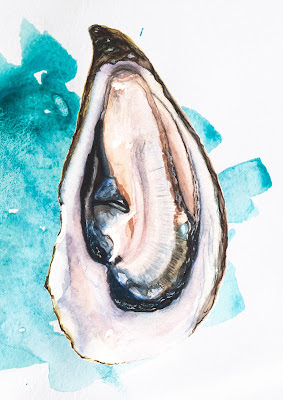
Oyster in Kwak'wala is t̕łox̱t̕łox̱
We have been cultivating, indeed maximizing the influx of invasive species to the cold waters of the Salish Sea for many years. 

But in the wild waters off the coast of British Columbia is the last natural abundant habitat of the tasty Ostrea lurida in the pristine waters of  Nootka Sound. 

The area is home to the Nuu-chah-nulth First Nations who have consumed this species boiled or steamed for thousands of years. Here these ancient oysters not only survive but thrive — building reefs and providing habitat for crab, anemones and small marine animals. 

Oysters are in the family Ostreidae — the true oysters. Their lineage evolved in the Early Triassic — 251 - 247 million years ago. 

In the Kwak̓wala language of the Kwakwaka'wakw, speakers of Kwak'wala, of the Pacific Northwest and my family, an oyster is known as t̕łox̱t̕łox̱. 

I am curious to learn if any of the Nuu-chah-nulth have a different word for an oyster. If you happen to know, I would be grateful to learn.

Monday, January 16, 2023

TUSK SHELL: OYSTER BAY FORMATION

The lovely large creamy tusk shell, Dentalium sp., you see here is in the collections of John Fam, Vice-Chair, Vancouver Paleontological Society.  

This particular scaphopod, or Tusk Shell, is one of many species of molluscs helping to untangle the complex geology of Vancouver Island. He hails from Early Paleocene - Early Eocene, Oyster Bay Formation, Appian Way Beds, near Cambell River, Vancouver Island, British Columbia, Canada. 

This area was mapped by the Geological Survey of Canada and initially included as part of the Cretaceous Nanaimo group. 

It was extensive collecting by members of the Vancouver Island Palaeontological Society that led to a revision of the geology of this area. Many of the fossils found in more recent years are a match for those found in the early Cenozoic of western North America, including the beautiful marine community captured in the block you see here.

Tusk shells are members of a class of shelled marine mollusc with a global distribution. Shells of species within this class range from about 0.5 to 15 cm in length. This fellow is 8 cm end to end, so near smack dab in the centre of his cohort.

The Scaphopoda get their nickname "tusk shells" because their shells are conical and slightly curved to the dorsal side, making the shells look like tiny tusks (picture a walrus or mammoth tusk in your mind’s eye). The scientific name Scaphopoda means "shovel foot," a term that refers to the "head" of the animal, which lacks eyes and is used for burrowing in marine sediments.

The most distinctive feature of scaphopods, however, and one that differentiates them from most molluscs, is the duo openings on their tubular shells. Most molluscs are open at just one end.

We could call scaphopods the great deniers. They live their adult lives with their heads literally buried in the sand. A tiny bit of their posterior end sticks up into the seawater for water exchange. Water is circulated around the mantle cavity by the action of numerous cilia.

When the available dissolved oxygen runs low for this fellow he ejects water from the top end of his shell by contraction of his "foot."


Tuesday, December 6, 2022

OYSTER: T'LOX'TLOX

One of the now rare species of oysters in the Pacific Northwest is the Olympia oyster, Ostrea lurida, (Carpenter, 1864).  

While rare today, these are British Columbia’s only native oyster. 

Had you been dining on their brethren in the 1800s or earlier, it would have been this species you were consuming. Middens from Port Hardy to California are built from Ostrea lurida.

These wonderful invertebrates bare their souls with every bite. Have they lived in cold water, deep beneath the sea, protected from the sun's rays and heat? Are they the rough and tumble beach denizens whose thick shells tell us of a life spent withstanding the relentless pounding of the sea? Is the oyster in your mouth thin and slimy having just done the nasty—spurred by the warming waters of Spring? 

Is this oyster a local or was it shipped to your current local and, if asked, would greet you with "Kon'nichiwa?" Not if the beauty on your plate is indeed Ostrea lurida. 

Oyster in Kwak'wala is t̕łox̱t̕łox̱
We have been cultivating, indeed maximizing the influx of invasive species to the cold waters of the Salish Sea for many years. 

But in the wild waters off the coast of British Columbia is the last natural abundant habitat of the tasty Ostrea lurida in the pristine waters of  Nootka Sound. 

The area is home to the Nuu-chah-nulth First Nations who have consumed this species boiled or steamed for thousands of years. Here these ancient oysters not only survive but thrive — building reefs and providing habitat for crab, anemones and small marine animals. 

Oysters are in the family Ostreidae — the true oysters. Their lineage evolved in the Early Triassic — 251 - 247 million years ago. 

In the Kwak̓wala language of the Kwakiutl or Kwakwaka'wakw, speakers of Kwak'wala, of the Pacific Northwest and my family, an oyster is known as t̕łox̱t̕łox̱. 

I am curious to learn if any of the Nuu-chah-nulth have a different word for an oyster. If you happen to know, I would be grateful to learn.