Showing posts with label Bay. Show all posts

Sunday, May 19, 2024

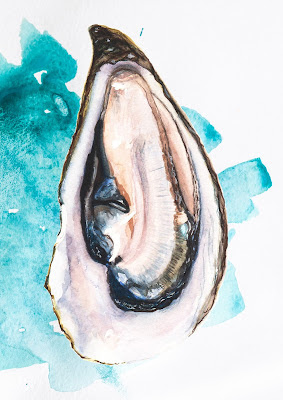
T'LOXT'LOX: WEST COAST OYSTERS

One of the now rare species of oysters in the Pacific Northwest is the Olympia oyster, Ostrea lurida, (Carpenter, 1864).  

While rare today, these are British Columbia’s only native oyster. 

Had you been dining on their brethren in the 1800s or earlier, it would have been this species you were consuming. Middens from Port Hardy to California are built from Ostrea lurida.

These wonderful invertebrates bare their souls with every bite. Have they lived in cold water, deep beneath the sea, protected from the sun's rays and heat? Are they the rough and tumble beach denizens whose thick shells tell us of a life spent withstanding the relentless pounding of the sea? Is the oyster in your mouth thin and slimy having just done the nasty—spurred by the warming waters of Spring? 

Is this oyster a local or was it shipped to your current local and, if asked, would greet you with "Kon'nichiwa?" Not if the beauty on your plate is indeed Ostrea lurida

Oyster in Kwak'wala is t̕łox̱t̕łox̱
We have been cultivating, indeed maximizing the influx of invasive species to the cold waters of the Salish Sea for many years. 

But in the wild waters off the coast of British Columbia is the last natural abundant habitat of the tasty Ostrea lurida in the pristine waters of  Nootka Sound. 

The area is home to the Nuu-chah-nulth First Nations who have consumed this species boiled or steamed for thousands of years. Here these ancient oysters not only survive but thrive — building reefs and providing habitat for crab, anemones and small marine animals. 

Oysters are in the family Ostreidae — the true oysters. Their lineage evolved in the Early Triassic — 251 - 247 million years ago. 

In the Kwak̓wala language of the Kwakwaka'wakw, speakers of Kwak'wala, of the Pacific Northwest and my family, an oyster is known as t̕łox̱t̕łox̱

I am curious to learn if any of the Nuu-chah-nulth have a different word for an oyster. If you happen to know, I would be grateful to learn.

Wednesday, January 25, 2023

BUMBLEBEES: HAMDZALAT'SI

This fuzzy yellow and black striped fellow is a bumblebee in the genus Bombus sp., family Apidae. We know him from our gardens where we see them busily lapping up nectar and pollen from flowers with their long hairy tongues.

My Norwegian cousins on my mother's side call them humle. Norway is a wonderful place to be something wild as the wild places have not been disturbed by our hands. 

There are an impressive thirty-five species of bumblebee species that call Norway hjem (home), and one, Bombus consobrinus, boasts the longest tongue that they use to feast solely on Monkshood, genus Aconitum, you may know by the name Wolf's-bane.

In the Kwak̓wala language of the Kwakwaka'wakw, speakers of Kwak'wala, and my family in the Pacific Northwest, bumblebees are known as ha̱mdzalat̕si — though I wonder if this is actually the word for a honey bee, Apis mellifera, as ha̱mdzat̕si is the word for a beehive.

I have a special fondness for all bees and look for them both in the garden and in First Nation art.

Bumblebees' habit of rolling around in flowers gives us a sense that these industrious insects are also playful. In First Nation art they provide levity — comic relief along with their cousins the mosquitoes and wasps — as First Nation dancers wear masks made to mimic their round faces, big round eyes and pointy stingers. A bit of artistic license is taken with their forms as each mask may have up to six stingers. The dancers weave amongst the watchful audience and swoop down to playfully give many of the guests a good, albeit gentle, poke. 

Honey bees actually do a little dance when they get back to the nest with news of an exciting new place to forage — truly they do. Bumblebees do not do a wee bee dance when they come home pleased with themselves from a successful foraging mission, but they do rush around excitedly, running to and fro to share their excitement. They are social learners, so this behaviour can signal those heading out to join them as they return to the perfect patch of wildflowers. 

Bumblebees are quite passive and usually sting in defence of their nest or if they feel threatened. Female bumblebees can sting several times and live on afterwards — unlike honeybees who hold back on their single sting as its barbs hook in once used and their exit shears it off, marking their demise.

They are important buzz pollinators both for our food crops and our wildflowers. Their wings beat at 130 times or more per second, literally shaking the pollen off the flowers with their vibration. 

And they truly are busy bees, spending their days fully focused on their work. Bumblebees collect and carry pollen and nectar back to the nest which may be as much as 25% to 75% of their body weight. 

And they are courteous — as they harvest each flower, they mark them with a particular scent to help others in their group know that the nectar is gone. 

The food they bring back to the nest is eaten to keep the hive healthy but is not used to make honey as each new season's queen bees hibernate over the winter and emerge reinvigorated to seek a new hive each Spring. She will choose a new site, primarily underground depending on the bumblebee species, and then set to work building wax cells for each of her fertilised eggs. 

Bumblebees are quite hardy. The plentiful hairs on their bodies are coated in oils that provide them with natural waterproofing. They can also generate more heat than their smaller, slender honey bee cousins, so they remain productive workers in cooler weather.    

We see the first bumblebees arise in the fossil record 100 million years ago and diversify alongside the earliest flowering plants. Their evolution is an entangled dance with the pollen and varied array of flowers that colour our world. 

We have found many wonderful examples within the fossil record, including a rather famous Eocene fossil bee found by a dear friend and naturalist who has left this Earth, Rene Savenye.

His namesake, H. Savenyei, is a lovely fossil halictine bee from Early Eocene deposits near Quilchena, British Columbia — and the first bee body-fossil known from the Okanagan Highlands — and indeed from Canada. 

It is a fitting homage, as bees symbolize honesty, playfulness and willingness to serve the community in our local First Nation lore and around the world — something Rene did his whole life.

Monday, January 16, 2023

TUSK SHELL: OYSTER BAY FORMATION

The lovely large creamy tusk shell, Dentalium sp., you see here is in the collections of John Fam, Vice-Chair, Vancouver Paleontological Society.  

This particular scaphopod, or Tusk Shell, is one of many species of molluscs helping to untangle the complex geology of Vancouver Island. He hails from Early Paleocene - Early Eocene, Oyster Bay Formation, Appian Way Beds, near Cambell River, Vancouver Island, British Columbia, Canada. 

This area was mapped by the Geological Survey of Canada and initially included as part of the Cretaceous Nanaimo group. 

It was extensive collecting by members of the Vancouver Island Palaeontological Society that led to a revision of the geology of this area. Many of the fossils found in more recent years are a match for those found in the early Cenozoic of western North America, including the beautiful marine community captured in the block you see here.

Tusk shells are members of a class of shelled marine mollusc with a global distribution. Shells of species within this class range from about 0.5 to 15 cm in length. This fellow is 8 cm end to end, so near smack dab in the centre of his cohort.

The Scaphopoda get their nickname "tusk shells" because their shells are conical and slightly curved to the dorsal side, making the shells look like tiny tusks (picture a walrus or mammoth tusk in your mind’s eye). The scientific name Scaphopoda means "shovel foot," a term that refers to the "head" of the animal, which lacks eyes and is used for burrowing in marine sediments.

The most distinctive feature of scaphopods, however, and one that differentiates them from most molluscs, is the duo openings on their tubular shells. Most molluscs are open at just one end.

We could call scaphopods the great deniers. They live their adult lives with their heads literally buried in the sand. A tiny bit of their posterior end sticks up into the seawater for water exchange. Water is circulated around the mantle cavity by the action of numerous cilia.

When the available dissolved oxygen runs low for this fellow he ejects water from the top end of his shell by contraction of his "foot."


Wednesday, September 28, 2022

TRACKING DINOSAURS

Stepping back in time can prove a challenge for the modern Time Traveller. But sometimes, if we're lucky, there are footsteps to follow.

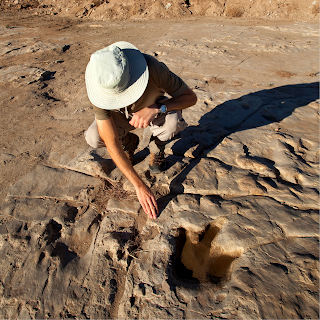
This is a theropod track left by an Allosaurus walking through a muddy bank that turned to stone. These big beasties were large carnosaurian theropod dinosaurs that lived 155 to 145 million years ago.

This track and many others are at Dinosaur Ridge, a segment of the Dakota Hogback in the Morrison Fossil Area National Natural Landmark located in Jefferson County, Colorado, near the town of Morrison and just west of Denver.

The Dinosaur Ridge area is one of the world's most famous dinosaur fossil localities. Along with the dinosaur bones, you find plant fossils, crocodile bones and a variety of reptile tracks. 

In 1877, fossil excavation began at Dinosaur Ridge under the direction of palaeontologist Othniel Charles Marsh. Some of the best-known dinosaurs were found here, including Stegosaurus, Apatosaurus, Diplodocus, and Allosaurus

In 1973, the area was recognized for its uniqueness as well as its historical and scientific significance when it was designated the Morrison Fossil Area National Natural Landmark by the National Park Service. In 1989, the Friends of Dinosaur Ridge was formed to address increasing concerns regarding the preservation of the site and to offer educational programs on the area's resources.

Visit Dinosaur Ridge Morrison Fossil Area National Natural Landmark

Fancy a trip? You can visit these wonderful tracks, the Dinosaur Ridge Exhibit Hall and walk the trails through the tracks. They have put up helpful interpretive signs that explain the local geology, a volcanic ash bed, trace fossils, paleo-ecology, economic development of coal, oil and clay, and many other geologic and paleontological features.

There are two trails and a visitor centre at Dinosaur Ridge. The visitor centre features information on trails and a small gift shop. If you do not pack a lunch, you'll want to visit the Stegosaurus Snack Shack located outside the visitor centre offering coffee, cold drinks, burritos, pretzels and more. It is open from 10am-4pm Mon-Sat and 11am-4pm on Sun from June through August. 

Check updates on their website concerning Covid-19 restrictions. This is a vast site with easy trails so it makes for a great family trip when museums and other indoor facilities are closed.

Know Before You Go

Uncover Colorado: https://www.uncovercolorado.com/landmarks/morrison-golden-fossil-areas-dinosaur-ridge/

Tuesday, September 20, 2022

OUR GREAT BEARS: URSAVUS TO NAN

GREAT BEAR NA̱N
Hiking in BC, both grizzly and black bear sightings are common. Nearly half the world's population, some 25,000 Grizzly Bears, roam the Canadian wilderness — of those, 14,000 or more call British Columbia home. 

These highly intelligent omnivores spend their days lumbering along our coastlines, mountains and forests.

Both bear families descend from a common ancestor, Ursavus, a bear-dog the size of a raccoon who lived more than 20 million years ago. Seems an implausible lineage given the size of their very large descendants. 

An average Grizzly weighs in around 800 lbs (363 kg), but a recent find in Alaska tops the charts at 1600 lbs (726 kg). 

This mighty beast stood 12' 6' high at the shoulder, 14' to the top of his head and is one of the largest grizzlies ever recorded — a na̱ndzi.

Adult bears tend to live solo except during mating season. Those looking for love congregate from May to July in the hopes of finding a mate. Through adaptation to shifting seasons, the females' reproductive system delays the implantation of fertilized eggs — blastocysts —until November or December to ensure her healthy pups arrive during hibernation. If food resources were slim that year, the newly formed embryo will not catch or attach itself to her uterine wall and she'll try again next year. 

Females reach mating maturity at 4-5 years of age. They give birth to a single or up to four cubs (though usually just two) in January or February. The newborn cubs are cute little nuggets — tiny, hairless, and helpless — weighing in at 2-3 kilograms or 4-8 pounds. They feast on their mother’s nutrient-dense milk for the first two months of life. The cubs stay with their mamma for 18 months or more. Once fully grown, they can run 56 km an hour, are good at climbing trees and swimming and live 20-25 years in the wild. 

A Grizzly bear encounter inspires a humbling appreciation of just how remarkable these massive beasts are. Knowing their level of intelligence, keen memory and that they have a bite force of over 8,000,000 pascals — enough to crush a bowling ball — inspires awe and caution in equal measure. 

They have an indescribable presence. It is likely because of this that these majestic bears show up often in the superb carvings and work of First Nations artists. I have had close encounters with many bears growing up in the Pacific Northwest, meeting them up close and personal in the South Chilcotins and along our many shorelines. 

First Nation Lore and Language

In the Kwak'wala language of the Kwakiutl First Nations of the Pacific Northwest — or Kwakwaka'wakw, speakers of Kwak'wala — a Grizzly bear is known as na̱n

The ornamental carved Grizzly bear headdress was worn by the comic Dluwalakha Grizzly Bear Dancers, Once more from Heaven, in the Grizzly Bear Dance or Gaga̱lalał, is known as na̱ng̱a̱mł

The Dluwalakha dancers were given supernatural treasures or dloogwi which they passed down from generation to generation. 

In the Hamat'sa Grizzly bear dance, Nanes Bakbakwalanooksiwae, no mask was worn. Instead, the dancers painted their faces red and wore a costume of bearskin or t̓ła̱ntsa̱m and long wooden claws attached to their hands. You can imagine how impressive that sight is lit by the warm flickering flames of firelight during a Winter Dance ceremony.

Smoke of the World / Speaking of the Ancestors — Na̱wiła

Kwaguʼł Winter Dancers — Qagyuhl
Should you encounter a black bear and wish to greet them in Kwak'wala, you would call them t̕ła'yi. Kwakiutl First Nations, Smoke of the World, count Grizzly Bears as an ancestor — along with Seagull, Sun and Thunderbird. 

To tell stories of the ancestors is na̱wiła. Each of these ancestors took off their masks to become human and founded the many groups that are now bound together by language and culture as Kwakwaka’wakw. 

The four First Nations who collectively make up the Kwakiutl are the Kwakiutl (Kwágu7lh), K’umk’utis/Komkiutis, Kwixa/Kweeha (Komoyoi) and Walas Kwakiutl (Lakwilala) First Nations. 

There is likely blood of the Lawit’sis in there, too, as they inhabited the village site at Tsax̱is/T'sakis, Fort Rupert before the Kwakiutl First Nations made it a permanent home. It was here that I grew up and learned to greet my ancestors. 

Not all Kwakwaka'wakw dance the Gaga̱lalał, but their ancestors likely attended feasts where the great bear was celebrated. To speak or tell stories of the ancestors is na̱wiła — and Grizzly bear as an ancestor is na̱n helus.

Visiting British Columbia's Great Bears

If you are interested in viewing British Columbia's Great Bears, do check out Indigenous Tourism BC's wonderfully informative website and the culturally-rich wildlife experiences on offer. You will discover travel ideas and resources to plan your next soul-powered adventure. To learn more about British Columbia's Great Bears and the continuing legacy of First Nation stewardship, visit: 

Indigenous Tourism BC: https://www.indigenousbc.com

Great Bear Lodge has been offering tours to view the majestic animals of the Pacific Northwest. They keep both the guests' and the animals' comfort and protection in mind. I highly recommend their hospitality and expertise. To see their offerings, visit: www.greatbeartours.com

Image: Group of Winter Dancers--Qagyuhl; Curtis, Edward S., 1868-1952, https://lccn.loc.gov/2003652753. 

Note: The Qagyuhl in the title of this photograph refers to the First Nation group, not the dancers themselves. I think our dear Edward was trying to spell Kwaguʼł and came as close as he was able. In Kwak'wala, the language of the Kwaguʼł or Kwakwakaʼwakw, speakers of Kwak'wala, the Head Winter Dancer is called t̕seḵa̱me' — and to call someone a really good dancer, you would use ya̱'winux̱w

Charmingly, when Edward S. Curtis was visiting Tsaxis/T'sakis, he was challenged to a wrestling competition with a Giant Pacific Octopus, Enteroctopus dofleini. George Hunt (1854-1933) my great great grandfather's elder brother had issued the challenge and laughed himself senseless when Edward got himself completely wrapped up in tentacles and was unable to move. Edward was soon untangled and went on to take many more photos of the First Nations of the Pacific Northwest. Things did not go as well for the octopus or ta̱ḵ̕wa. It was later served for dinner or dzaḵwax̱stala, as it seemed calamari was destined for that night's menu.