Showing posts with label ostrea. Show all posts

Sunday, May 19, 2024

T'LOXT'LOX: WEST COAST OYSTERS

One of the now rare species of oysters in the Pacific Northwest is the Olympia oyster, Ostrea lurida, (Carpenter, 1864).  

While rare today, these are British Columbia’s only native oyster. 

Had you been dining on their brethren in the 1800s or earlier, it would have been this species you were consuming. Middens from Port Hardy to California are built from Ostrea lurida.

These wonderful invertebrates bare their souls with every bite. Have they lived in cold water, deep beneath the sea, protected from the sun's rays and heat? Are they the rough and tumble beach denizens whose thick shells tell us of a life spent withstanding the relentless pounding of the sea? Is the oyster in your mouth thin and slimy having just done the nasty—spurred by the warming waters of Spring? 

Is this oyster a local or was it shipped to your current local and, if asked, would greet you with "Kon'nichiwa?" Not if the beauty on your plate is indeed Ostrea lurida. 
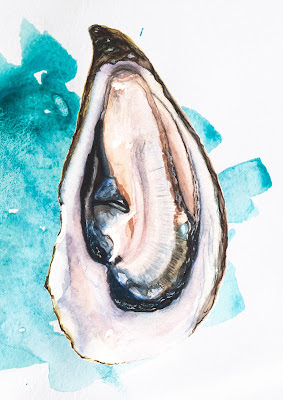
Oyster in Kwak'wala is t̕łox̱t̕łox̱
We have been cultivating, indeed maximizing the influx of invasive species to the cold waters of the Salish Sea for many years. 

But in the wild waters off the coast of British Columbia is the last natural abundant habitat of the tasty Ostrea lurida in the pristine waters of  Nootka Sound. 

The area is home to the Nuu-chah-nulth First Nations who have consumed this species boiled or steamed for thousands of years. Here these ancient oysters not only survive but thrive — building reefs and providing habitat for crab, anemones and small marine animals. 

Oysters are in the family Ostreidae — the true oysters. Their lineage evolved in the Early Triassic — 251 - 247 million years ago. 

In the Kwak̓wala language of the Kwakwaka'wakw, speakers of Kwak'wala, of the Pacific Northwest and my family, an oyster is known as t̕łox̱t̕łox̱. 

I am curious to learn if any of the Nuu-chah-nulth have a different word for an oyster. If you happen to know, I would be grateful to learn.

Friday, July 29, 2022

AN AMMONITE HOSTING WEE BIVALVES

What you are seeing here is a protuberance extruding from the venter of Quenstedtoceras cf. leachi (Sowerby). It is a pathology in the shell from hosting immature bivalves that shared the seas with these Middle Jurassic, Upper Callovian, Lamberti zone fauna from the Volga River basin. The collecting site is the now inactive Dubki commercial clay quarry and brickyard near Saratov, Russia. 

The site has produced thousands of ammonite specimens. A good 1,100 of those ended up at the Black Hills Institute of Geological Research in Hill City, South Dakota. 

Roughly 1,000 of those are Quenstedtoceras (Lamberticeras) lamberti and the other 100 are a mix of other species found in the same zone. These included Eboraciceras, Peltoceras, Kosmoceras, Grossouvria, Proriceras, Cadoceras and Rursiceras. 

What is especially interesting is the volume of specimens — 167 Quenstedtoceras (Lamberticeras) lamberti and 89 other species in the Black Hills collection — with healed predation injuries. It seems Quenstedtoceras (Lamberticeras) lamberti are the most common specimens found here and so not surprisingly the most common species found injured. Of the 1,000, 655 of the Quenstedtoceras (Lamberticeras) lamberti displayed some sort of deformation or growth on the shell or had grown in a tilted manner. 

Again, some of the Q. lamberti had small depressions in the centre likely due to a healed bite and hosting infestations of the immature bivalve Placunopsis and some Ostrea. 

The bivalves thrived on their accommodating hosts and the ammonites carried on, growing their shells right up and over their bivalve guests. This relationship led to some weird and deformities of their shells. They grow in, around, up and over nearly every surface of the shell and seem to have lived out their lives there. It must have gotten a bit unworkable for the ammonites, their shells becoming warped and unevenly weighted. Over time, both the flourishing bivalves and the ammonite shells growing up and over them produced some of the most interesting pathology specimens I have ever seen.    

In the photo here from Emil Black, you can see some of the distorted shapes of Quenstedtoceras sp. Look closely and you see a trochospiral or flattened appearance on one side while they are rounded on the other. 

All of these beauties hail from the Dubki Quarry near Saratov, Russia. The ammonites were collected in marl or clay used in brick making. The clay particles suggest a calm, deep marine environment. One of the lovely features of the preservation here is the amount of pyrite filling and replacement. It looks like these ammonites were buried in an oxygen-deficient environment. 

The ammonites were likely living higher in the water column, well above the oxygen-poor bottom. An isotopic study would be interesting to prove this hypothesis. There's certainly enough of these ammonites that have been recovered to make that possible. It's estimated that over a thousand specimens have been recovered from the site but that number is likely much higher. But these are not complete specimens. We mostly find the phragmocones and partial body chambers. Given the numbers, this may be a site documenting a mass spawning death over several years or generations.

If you fancy a read on all things cephie, consider picking up a copy of Cephalopods Present and Past: New Insights and Fresh Perspectives edited by Neil Landman and Richard Davis. Figure 16.2 is from page 348 of that publication and shows the hosting predation quite well. 

Photos: Courtesy of the deeply awesome Emil Black. These are in his personal collection that I hope to see in person one day. 

It was his sharing of the top photo and the strange anomaly that had me explore more about the fossils from Dubki and the weird and wonderful hosting relationship between ammonites and bivalves. Thank you, my friend!