Showing posts with label hardy. Show all posts

Sunday, May 19, 2024

T'LOXT'LOX: WEST COAST OYSTERS

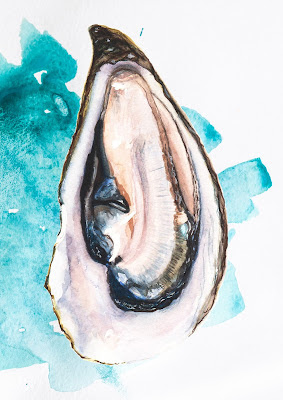
One of the now rare species of oysters in the Pacific Northwest is the Olympia oyster, Ostrea lurida, (Carpenter, 1864).  

While rare today, these are British Columbia’s only native oyster. 

Had you been dining on their brethren in the 1800s or earlier, it would have been this species you were consuming. Middens from Port Hardy to California are built from Ostrea lurida.

These wonderful invertebrates bare their souls with every bite. Have they lived in cold water, deep beneath the sea, protected from the sun's rays and heat? Are they the rough and tumble beach denizens whose thick shells tell us of a life spent withstanding the relentless pounding of the sea? Is the oyster in your mouth thin and slimy having just done the nasty—spurred by the warming waters of Spring? 

Is this oyster a local or was it shipped to your current local and, if asked, would greet you with "Kon'nichiwa?" Not if the beauty on your plate is indeed Ostrea lurida

Oyster in Kwak'wala is t̕łox̱t̕łox̱
We have been cultivating, indeed maximizing the influx of invasive species to the cold waters of the Salish Sea for many years. 

But in the wild waters off the coast of British Columbia is the last natural abundant habitat of the tasty Ostrea lurida in the pristine waters of  Nootka Sound. 

The area is home to the Nuu-chah-nulth First Nations who have consumed this species boiled or steamed for thousands of years. Here these ancient oysters not only survive but thrive — building reefs and providing habitat for crab, anemones and small marine animals. 

Oysters are in the family Ostreidae — the true oysters. Their lineage evolved in the Early Triassic — 251 - 247 million years ago. 

In the Kwak̓wala language of the Kwakwaka'wakw, speakers of Kwak'wala, of the Pacific Northwest and my family, an oyster is known as t̕łox̱t̕łox̱

I am curious to learn if any of the Nuu-chah-nulth have a different word for an oyster. If you happen to know, I would be grateful to learn.

Tuesday, January 9, 2024

BEARS OF THE PACIFIC NORTHWEST

A Grizzly Bear takes a rest on a fallen log in Alaska. While stumbling upon them may cause us surprise, they have heard us 
(and smelled us) coming for miles.

If you work or play in the woods of British Columbia, both grizzly and black bear sightings are common.

Nearly half the world's population, some 25,000 Grizzly Bears, roam the Canadian wilderness — of those, 14,000 or more call British Columbia home. These highly intelligent omnivores spend their days lumbering along our coastlines, mountains and forests.

Both bear families descend from a common ancestor, Ursavus, a bear-dog the size of a raccoon who lived more than 20 million years ago. Seems an implausible lineage given the size of their very large descendants. 

An average Grizzly weighs in around 800 lbs (363 kg), but a recent find in Alaska tops the charts at 1600 lbs (726 kg). This mighty beast stood 12' 6' high at the shoulder, 14' to the top of his head and is one of the largest grizzlies ever recorded — a na̱ndzi.

Adult bears tend to live solo except during mating season. Those looking for love congregate from May to July in the hopes of finding a mate. Through adaptation to shifting seasons, the females' reproductive system delays the implantation of fertilized eggs — blastocysts —until November or December to ensure her healthy pups arrive during hibernation. If food resources were slim that year, the newly formed embryo will not catch or attach itself to her uterine wall and she'll try again next year. 

Females reach mating maturity at 4-5 years of age. They give birth to a single or up to four cubs (though usually just two) in January or February. The newborn cubs are cute little nuggets — tiny, hairless, and helpless — weighing in at 2-3 kilograms or 4-8 pounds. They feast on their mother’s nutrient-dense milk for the first two months of life. The cubs stay with their mamma for 18 months or more. Once fully grown, they can run 56 km an hour, are good at climbing trees and swimming and live 20-25 years in the wild. 

A Grizzly bear encounter inspires a humbling appreciation of just how remarkable these massive beasts are. Knowing their level of intelligence, keen memory and that they have a bite force of over 8,000,000 pascals — enough to crush a bowling ball — inspires awe and caution in equal measure. 

They have an indescribable presence. It is likely because of this that these majestic bears show up often in the superb carvings and work of First Nations artists. I have had close encounters with many bears growing up in the Pacific Northwest, meeting them up close and personal in the South Chilcotins and along our many shorelines. 

First Nation Lore and Language

In the Kwak'wala language of the Kwakiutl First Nations of the Pacific Northwest — or Kwakwaka'wakw, speakers of Kwak'wala — a Grizzly bear is known as na̱n

The ornamental carved Grizzly bear headdress was worn by the comic Dluwalakha Grizzly Bear Dancers, Once more from Heaven, in the Grizzly Bear Dance or Gaga̱lalał, is known as na̱ng̱a̱mł

The Dluwalakha dancers were given supernatural treasures or dloogwi which they passed down from generation to generation. 

In the Hamat'sa Grizzly bear dance, Nanes Bakbakwalanooksiwae, no mask was worn. Instead, the dancers painted their faces red and wore a costume of bearskin or t̓ła̱ntsa̱m and long wooden claws attached to their hands. You can imagine how impressive that sight is lit by the warm flickering flames of firelight during a Winter Dance ceremony.

Smoke of the World / Speaking of the Ancestors — Na̱wiła

Kwaguʼł Winter Dancers — Qagyuhl
Should you encounter a black bear and wish to greet them in Kwak'wala, you would call them t̕ła'yi. Kwakiutl First Nations, Smoke of the World, count Grizzly Bears as an ancestor — along with Seagull, Sun and Thunderbird. 

To tell stories of the ancestors is na̱wiła. Each of these ancestors took off their masks to become human and founded the many groups that are now bound together by language and culture as Kwakwaka’wakw. 

The four First Nations who collectively make up the Kwakiutl are the Kwakiutl (Kwágu7lh), K’umk’utis/Komkiutis, Kwixa/Kweeha (Komoyoi) and Walas Kwakiutl (Lakwilala) First Nations. 

There is likely blood of the Lawit’sis in there, too, as they inhabited the village site at Tsax̱is, Fort Rupert before the Kwakiutl made it a permanent home. 

Not all Kwakwaka'wakw dance the Gaga̱lalał, but their ancestors likely attended feasts where the great bear was celebrated. To speak or tell stories of the ancestors is na̱wiła — and Grizzly bear as an ancestor is na̱n helus.

Visiting British Columbia's Great Bears

If you are interested in viewing British Columbia's Great Bears, do check out Indigenous Tourism BC's wonderfully informative website and the culturally-rich wildlife experiences on offer. 

You will discover travel ideas and resources to plan your next soul-powered adventure. To learn more about British Columbia's Great Bears and the continuing legacy of First Nation stewardship, visit: 

Indigenous Tourism BC: https://www.indigenousbc.com

Great Bear Lodge has been offering tours to view the majestic animals of the Pacific Northwest. They keep both the guests and the animals' comfort and protection in mind. I highly recommend their hospitality and expertise. To see their offerings, visit: www.greatbeartours.com

Image: Group of Winter Dancers--Qagyuhl; Curtis, Edward S., 1868-1952, https://lccn.loc.gov/2003652753. 

Note: The Qagyuhl in the title of this photograph refers to the First Nation group, not the dancers themselves. I think our dear Edward was trying to spell Kwaguʼł and came as close as he was able. In Kwak'wala, the language of the Kwaguʼł or Kwakwakaʼwakw, speakers of Kwak'wala, the Head Winter Dancer is called t̕seḵa̱me' — and to call someone a really good dancer, you would use ya̱'winux̱w

Charmingly, when Edward S. Curtis was visiting Tsaxis/T'sakis, he was challenged to a wrestling competition with a Giant Pacific Octopus, Enteroctopus dofleini. George Hunt (1854-1933) had issued the challenge and laughed himself senseless when Edward got himself completely wrapped up in tentacles and was unable to move. Edward was soon untangled and went on to take many more photos of the First Nations of the Pacific Northwest. Things did not go as well for the octopus or ta̱ḵ̕wa. It was later served for dinner or dzaḵwax̱stala, as it seemed calamari was destined for that night's menu.  


Saturday, August 27, 2022

WARRIOR CRAB: KU'MIS

Look how epic this little guy is! 

He is a crab — and if you asked him, the fiercest warrior that ever lived. While that may not be strictly true, crabs do have the heart of a warrior and will raise their claws, sometimes only millimetres into the air, to assert dominance over their world. 

Crabs are decapod crustaceans of the Phylum Arthropoda. 

In the Kwak'wala language of the Kwakwa̱ka̱ʼwakw First Nations of the Pacific Northwest, this brave fellow is ḵ̓u'mis — both a tasty snack and familiar to the supernatural deity Tuxw'id, a female warrior spirit. Given their natural armour and clear bravery, it is a fitting role.

They inhabit all the world's oceans, sandy beaches, many of our freshwater lakes and streams. Some few prefer to live in forests.

Crabs build their shells from highly mineralized chitin — and chitin gets around. It is the main structural component of the exoskeletons of many of our crustacean and insect friends. Shrimp, crab, and lobster all use it to build their exoskeletons.

Chitin is a polysaccharide — a large molecule made of many smaller monosaccharides or simple sugars, like glucose. 

It is handy stuff, forming crystalline nanofibrils or whiskers. Chitin is actually the second most abundant polysaccharide after cellulose. It is interesting as we usually think of these molecules in the context of their sugary context but they build many other very useful things in nature — not the least of these are the hard shells or exoskeletons of our crustacean friends.

Crabs in the Fossil Record

The earliest unambiguous crab fossils date from the Early Jurassic, with the oldest being Eocarcinus from the early Pliensbachian of Britain, which likely represents a stem-group lineage, as it lacks several key morphological features that define modern crabs. 

Most Jurassic crabs are only known from dorsal — or top half of the body — carapaces, making it difficult to determine their relationships. Crabs radiated in the Late Jurassic, corresponding with an increase in reef habitats, though they would decline at the end of the Jurassic as the result of the decline of reef ecosystems. Crabs increased in diversity through the Cretaceous and represented the dominant group of decapods by the end.

We find wonderful fossil crab specimens on Vancouver Island. The first I ever collected was at Shelter Point, then again on Hornby Island, down on the Olympic Peninsula and along Vancouver Island's west coast near Nootka Sound. They are, of course, found globally and are one of the most pleasing fossils to find and aggravating to prep of all the specimens you will ever have in your collection. Bless them.


Monday, July 4, 2022

NOOTKA FOSSIL AND FIRST NATIONS HISTORY

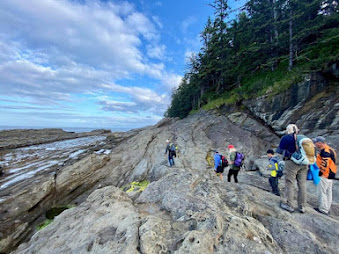
Nootka Fossil Field Trip. Photo: John Fam
The rugged west coast of Vancouver Island offers spectacular views of a wild British Columbia. Here the seas heave along the shores slowly eroding the magnificent deposits that often contain fossils. 

Just off the shores of Vancouver Island, east of Gold River and south of Tahsis is the picturesque and remote Nootka Island.

This is the land of the proud and thriving Nuu-chah-nulth First Nations who have lived here always

Always is a long time, but we know from oral history and archaeological evidence that the Mowachaht and Muchalaht peoples lived here, along with many others, for many thousands of years — a time span much like always

While we know this area as Nootka Sound and the land we explore for fossils as Nootka Island, these names stem from a wee misunderstanding. 

Just four years after the 1774 visit by Spanish explorer Juan Pérez — and only a year before the Spanish established a military and fur trading post on the site of Yuquot — the Nuu-chah-nulth met the Englishman, James Cook.  

Captain Cook sailed to the village of Yuquot just west of Vancouver Island to a very warm welcome. He and his crew stayed on for a month of storytelling, trading and ship repairs. Friendly, but not familiar with the local language, he misunderstood the name for both the people and land to be Nootka. In actual fact, Nootka means, go around, go around

Two hundred years later, in 1978, the Nuu-chah-nulth chose the collective term Nuu-chah-nulth — nuučaan̓uł, meaning all along the mountains and sea or along the outside (of Vancouver Island) — to describe themselves. 

It is a term now used to describe several First Nations people living along western Vancouver Island, British Columbia. 

It is similar in a way to the use of the United Kingdom to refer to the lands of England, Scotland and Wales — though using United Kingdom-ers would be odd. Bless the Nuu-chah-nulth for their grace in choosing this collective name.  

An older term for this group of peoples was Aht, which means people in their language and is a component in all the names of their subgroups, and of some locations — Yuquot, Mowachaht, Kyuquot, Opitsaht. While collectively, they are the Nuu-chah-nulth, be interested in their more regional name should you meet them. 

But why does it matter? If you have ever mistakenly referred to someone from New Zealand as an Aussie or someone from Scotland as English, you have likely been schooled by an immediate — sometimes forceful, sometimes gracious — correction of your ways. The best answer to why it matters is because it matters.

Each of the subgroups of the Nuu-chah-nulth viewed their lands and seasonal migration within them (though not outside of them) from a viewpoint of inside and outside. Kla'a or outside is the term for their coastal environment and hilstis for their inside or inland environment.

It is to their kla'a that I was most keen to explore. Here, the lovely Late Eocene and Early Miocene exposures offer up fossil crab, mostly the species Raninid, along with fossil gastropods, bivalves, pine cones and spectacularly — a singular seed pod. These wonderfully preserved specimens are found in concretion along the foreshore where time and tide erode them out each year.

Five years after Spanish explorer Juan Pérez's first visit, the Spanish built and maintained a military post at Yuquot where they tore down the local houses to build their own structures and set up what would become a significant fur trade port for the Northwest Coast — with the local Chief Maquinna's blessing and his warriors acting as middlemen to other First Nations. 

Following reports of Cook's exploration British traders began to use the harbour of Nootka (Friendly Cove) as a base for a promising trade with China in sea-otter pelts but became embroiled with the Spanish who claimed (albeit erroneously) sovereignty over the Pacific Ocean. 
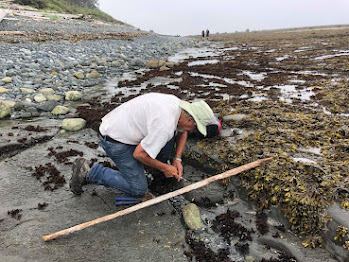
Dan Bowen searching an outcrop. Photo: John Fam
The ensuing Nootka Incident of 1790 nearly led to war between Britain and Spain (over lands neither could actually claim) but talk of war settled and the dispute was settled diplomatically. 

George Vancouver on his subsequent exploration in 1792 circumnavigated the island and charted much of the coastline. His meeting with the Spanish captain Bodega y Quadra at Nootka was friendly but did not accomplish the expected formal ceding of land by the Spanish to the British. 

It resulted however in his vain naming the island "Vancouver and Quadra." The Spanish captain's name was later dropped and given to the island on the east side of Discovery Strait. Again, another vain and unearned title that persists to this day.

Early settlement of the island was carried out mainly under the sponsorship of the Hudson's Bay Company whose lease from the Crown amounted to 7 shillings per year — that's roughly equal to £100.00 or $174 CDN today. Victoria, the capital of British Columbia, was founded in 1843 as Fort Victoria on the southern end of Vancouver Island by the Hudson's Bay Company's Chief Factor, Sir James Douglas. 

With Douglas's help, the Hudson's Bay Company established Fort Rupert on the north end of Vancouver Island in 1849. Both became centres of fur trade and trade between First Nations and solidified the Hudson's Bay Company's trading monopoly in the Pacific Northwest.

The settlement of Fort Victoria on the southern tip of Vancouver Island — handily south of the 49th parallel — greatly aided British negotiators to retain all of the islands when a line was finally set to mark the northern boundary of the United States with the signing of the Oregon Boundary Treaty of 1846. Vancouver Island became a separate British colony in 1858. British Columbia, exclusive of the island, was made a colony in 1858 and in 1866 the two colonies were joined into one — becoming a province of Canada in 1871 with Victoria as the capital.

Dan Bowen, Chair of the Vancouver Island Palaeontological Society (VIPS) did a truly splendid talk on the Fossils of Nootka Sound. With his permission, I have uploaded the talk to the ARCHEA YouTube Channel for all to enjoy. Do take a boo, he is a great presenter. Dan also graciously provided the photos you see here. The last of the photos you see here is from the August 2021 Nootka Fossil Field Trip. Photo: John Fam, Vice-Chair, Vancouver Paleontological Society (VanPS).

Know Before You Go — Nootka Trail

The Nootka Trail passes through the traditional lands of the Mowachaht/Muchalat First Nations who have lived here since always. They share this area with humpback and Gray whales, orcas, seals, sea lions, black bears, wolves, cougars, eagles, ravens, sea birds, river otters, insects and the many colourful intertidal creatures that you'll want to photograph.

This is a remote West Coast wilderness experience. Getting to Nootka Island requires some planning as you'll need to take a seaplane or water taxi to reach the trailhead. The trail takes 4-8 days to cover the 37 km year-round hike. The peak season is July to September. Permits are not required for the hike. 

Access via: Air Nootka floatplane, water taxi, or MV Uchuck III

  • Dan Bowen, VIPS on the Fossils of Nootka: https://youtu.be/rsewBFztxSY
  • https://www.thecanadianencyclopedia.ca/en/article/sir-james-douglas
  • file:///C:/Users/tosca/Downloads/186162-Article%20Text-199217-1-10-20151106.pdf
  • Nootka Trip Planning: https://mbguiding.ca/nootka-trail-nootka-island/#overview


Monday, April 25, 2022

ABALONE: GWA'LIT'SA

Abalone is the common name for a group of large marine snails — gastropod molluscs in the genus Haliotis, family Haliotidae.

Haliotis once contained six subgenera but these are now grouped together as alternate representations of Haliotis

In the Pacific Northwest, our rocky shores are home to the Northern or Pinto abalone, Haliotis kamtschatkana

In the Kwak̓wala language of the Kwakiutl or Kwakwaka'wakw, speakers of Kwak'wala, of the Pacific Northwest, abalone are known as gwa'lit̕sa.

They range from Mexico to Alaska and are the only abalone species found in Washington state, British Columbia and Alaska. Abalone prefer to live amongst the cold waters and high surf of rocky reef habitats. They are easily harvested as their sweet spot is water between 3-18 meters or 10-60 feet deep.  

The shells of abalones have a low, open spiral structure, and are characterized by several open respiratory pores in a row near the shell's outer edge. The thick inner layer of the shell is composed of nacre or mother-of-pearl. Their iridescent nacre is gorgeous and runs from white to blue to green. Both their meat and their shells are highly prized. 

The Northern or Pinto abalone is protected today. Those looking to use the shell for decorative purposes must now look to California or New Zealand. The California abalone is more colourful than its northern cousin and has long been preferred by First Nations artists, particularly for the large earrings favoured by women of rank amongst First Nation clans.