Showing posts with label usa. Show all posts

Monday, May 20, 2024

GOOSE / NAXAK

What's good for the goose is good for the gander. A goose is a bird of any of several waterfowl species in the family Anatidae. 

They can fly 40 mph and you'll notice that in the sky they choose the highly efficient V form as it gives them a 71% increased flight range. Smart those geese. 

A male goose is called a gander and a group of geese are charmingly called a gaggle. We use geese for the plural of male, female or a mix of both. The females are referred to as goose, as in Mother Goose from your childhood stories.

These social birds are very loyal and will follow you around like puppies if you happen to raise one from a wee gosling. And no matter which of the many geese you see as wee goslings, they are all charmingly fluffy and cute.

Geese fossils have been found ranging from 10 to 12 million years ago, so a relatively recent addition to our species list. We have found proto-geese fossils in Gargano, one of the most scenic but overlooked parts of the southern Italian region of Puglia in central Italy. This massive relative of our modern geese stood one and a half metres tall and was likely flightless, unlike modern geese.

The family Anatidae comprises the genera Anser — the grey geese and white geese — and Branta —the black geese. Some other birds, mostly related to the shelducks, have goose as part of their names which can muddle things a bit. More distantly related members of the family Anatidae are swans, most of which are larger than true geese, and ducks, which are significantly smaller.

The word goose is a direct descendant of the Proto-Indo-European root, ghans. In the Germanic languages, the root gave Old English gōs with the plural gēs and gandres — becoming our Modern English goose, geese, gander, and gosling, respectively. The Frisian's use goes, gies and guoske. In New High German, Gans, Gänse, and Ganter, and Old Norse gās.

In the Kwak̓wala language of the or Kwakwaka'wakw, speakers of Kwak'wala, of the Pacific Northwest, we use na̱x̱aḵ as the word for goose. 

Around the world, we refer to these birds as: Lithuanian: žąsìs, Irish: gé (goose, from Old Irish géiss), Latin: anser, Spanish: ganso, Ancient Greek: χήν (khēn), Dutch: gans, Albanian: gatë (heron), Sanskrit haṃsa and haṃsī ("gander" and "goose", also the words for male and female swans), Finnish: hanhi, Avestan zāō, Polish: gęś, Romanian: gâscă / gânsac, Ukrainian: гуска / гусак (huska / husak), Russian: гусыня / гусь (gusyna / gus), Czech: husa, and Persian: غاز‎ (ghāz). 

By any name, geese are majestic birds. They are long lived at around 20 years for some species and spend their days eating seeds, nuts, plants and berries. Once fattened up, they have been on our menu for a very long time. They grace the wilderness around the globe and are fond of our parks, golf courses and are surprisingly comfortable in major cities. And while they are social and friendly, a threatened goose will chase you and take wee nips of your bottom if they take issue with your presence. You go, goose!

Wednesday, September 28, 2022

TRACKING DINOSAURS

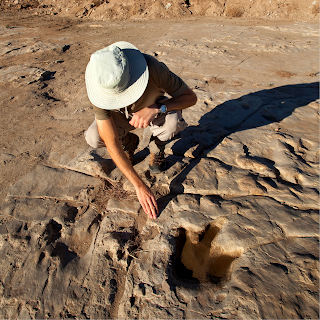
Stepping back in time can prove a challenge for the modern Time Traveller. But sometimes, if we're lucky, there are footsteps to follow.

This is a theropod track left by an Allosaurus walking through a muddy bank that turned to stone. These big beasties were large carnosaurian theropod dinosaurs that lived 155 to 145 million years ago.

This track and many others are at Dinosaur Ridge, a segment of the Dakota Hogback in the Morrison Fossil Area National Natural Landmark located in Jefferson County, Colorado, near the town of Morrison and just west of Denver.

The Dinosaur Ridge area is one of the world's most famous dinosaur fossil localities. Along with the dinosaur bones, you find plant fossils, crocodile bones and a variety of reptile tracks. 

In 1877, fossil excavation began at Dinosaur Ridge under the direction of palaeontologist Othniel Charles Marsh. Some of the best-known dinosaurs were found here, including Stegosaurus, Apatosaurus, Diplodocus, and Allosaurus

In 1973, the area was recognized for its uniqueness as well as its historical and scientific significance when it was designated the Morrison Fossil Area National Natural Landmark by the National Park Service. In 1989, the Friends of Dinosaur Ridge was formed to address increasing concerns regarding the preservation of the site and to offer educational programs on the area's resources.

Visit Dinosaur Ridge Morrison Fossil Area National Natural Landmark

Fancy a trip? You can visit these wonderful tracks, the Dinosaur Ridge Exhibit Hall and walk the trails through the tracks. They have put up helpful interpretive signs that explain the local geology, a volcanic ash bed, trace fossils, paleo-ecology, economic development of coal, oil and clay, and many other geologic and paleontological features.

There are two trails and a visitor centre at Dinosaur Ridge. The visitor centre features information on trails and a small gift shop. If you do not pack a lunch, you'll want to visit the Stegosaurus Snack Shack located outside the visitor centre offering coffee, cold drinks, burritos, pretzels and more. It is open from 10am-4pm Mon-Sat and 11am-4pm on Sun from June through August. 

Check updates on their website concerning Covid-19 restrictions. This is a vast site with easy trails so it makes for a great family trip when museums and other indoor facilities are closed.

Know Before You Go

Uncover Colorado: https://www.uncovercolorado.com/landmarks/morrison-golden-fossil-areas-dinosaur-ridge/

Saturday, March 19, 2022

INUKTITUT OF THE NUNATSIARMIUT

Nunatsiarmiut Mother and Child, Baffin Island, Nunavut
Warm light bathes this lovely Nunatsiarmiut mother and child from Baffin Island, Nunavut. 

They speak Inuktitut, the mother tongue of the majority of the Nunatsiarmiut who call Baffin Island home. 

Baffin is the largest island in the Arctic Archipelago in the territory of Nunavut in Canada's far north. 

As part of the Qikiqtaaluk Region of Nunavut, Baffin Island is home to a constellation of remote Inuit communities each with a deep cultural connection to the land — Iqaluit, Pond Inlet, Pangnirtung, Clyde River, Arctic Bay, Kimmirut and Nanisivik. 

The ratio of Inuit to non-Inuit here is roughly three to one and perhaps the reason why the Inuktitut language has remained intact and serves as the mother tongue for more than 36,000 residents. Inuktitut has several subdialects — these, along with a myriad of other languages — are spoken across the north.  

If you look at the helpful visual below you begin to get a feel for the diversity of these many tongues. The languages vary by region. There is the Iñupiaq of the Inupiatun/Inupiat; Inuvialuktun of the Inuinnaqtun, Natsilingmiutut, Kivallirmiutut, Aivilingmiutut, Qikiqtaaluk Uannanganii and Siglitun. Kalaallisut is spoken by many Greenlandic peoples though, in northwest Greenland, Inuktun is the language of the Inughuit.

We use the word Inuktitut when referring to a specific dialect and inuktut when referring to all the dialects of Inuktitut and Inuinnaqtun.

Northern Language Map (Click to Enlarge)
Should you travel to the serene glacier-capped wilds and rolling tundra of our far north, you will want to dress for the weather and learn a few of the basics to put your best mukluk shod feet forward. 

The word for hello or welcome in Inuktitut is Atelihai — pronounced ahh-tee-lee-hi. And thank you is nakurmiik, pronounced na-kur-MIIK.  

Perhaps my favourite Inuktitut expression is Naglingniq qaikautigijunnaqtuq maannakautigi, pronounced NAG-ling-niq QAI-kau-ti-gi-jun-naqtuq MAAN-na-KAU-ti-gi. This tongue-twister is well worth the linguistic challenge as it translates to love can travel anywhere in an instant. Indeed it can.

You have likely seen or heard the word Eskimo used in older books to refer to the Inuit, Iñupiat, Kalaallit or Yupik. This misnomer is a colonial term derived from the Montagnais or Innu word ayas̆kimewnetter of snowshoes. It is a bit like meeting a whole new group of people who happen to wear shoes and referring to them all as cobblers — not as a nickname, but as a legal term to describe populations from diverse communities disregarding the way each self-refer. 

Inukshuk / Inuksuk Marker Cairn
For those who identify as Inupiaq or Yupik, the preferred term is Inuit meaning people — though some lingering use of the term Eskimo lives on. The Inuit as a group are made up of many smaller groups. 

The Inuit of Greenland self-refer as Kalaallit or Greenlanders when speaking Kalaallisut. The Inupiat of Alaska, or real people, use Yupik as the singular for real person and yuk to simply mean person.

When taken all together, Inuit is used to mean all the peoples in reference to the Inuit, Iñupiat, Kalaallit and Yupik. Inuit is the plural of inuk or person

You likely recognize this word from inuksuk or inukshuk, pronounced ih-nook-suuk — the human-shaped stone cairns built by the Inuit, Iñupiat, Kalaallit, Yupik, and other peoples of the Arctic regions of northern Canada, Greenland, and Alaska — helpful reference markers for hunters and navigation. The word inuksuk means that which acts in the capacity of a human, combining inuk or person and suk, to substitute

A World of Confusion

You may be disappointed to learn that our northern friends do not live in igloos. I remember answering the phone as a child and the fellow calling was hoping to speak to my parents about some wonderful new invention perfect for use in an igloo. He was disappointed to hear that I was standing in a wooden house with the standard four walls to a room and a handy roof topping it off. "Well, what about your neighbours? Surely some of them live in igloos..." It seems that some of the atlases in circulation at the time, and certainly the one he was looking at, simply blanketed everything north of the 49th parallel in a snowy white. His clearly showed an igloo sitting proudly in the centre of the province.

My cousin Shawn brought one such simplified book back from his elementary school in California. British Columbia had a nice image of a grizzly bear and a wee bit further up, a polar bear grinned smugly. British Columbia's beaver population would be sad to know that they did not inhabit the province though there were two chipper beavers with big bright smiles — one in Ontario and another gracing the province of Quebec. Further north, where folk do build igloos, they were curiously lacking. 

Igloos are used for winter hunting trips much the same way we use tents for camping. The Inuit do not have fifty words for snow — you can thank the ethnographer Franz Boas for that wee fabrication — but within the collective languages of the frozen north there are more than fifty words to describe it. And kisses are not nose-to-nose. To give a tender kiss or kunik to a loved one, you press your nose and upper lip to their forehead or cheek and rub gently. 

Fancy to try a wee bit of Inuktitut yourself? This link will bring you to a great place to start: https://inhabitmedia.com/inuitnipingit/

Inuit Language Map:  By Noahedits - Own work, CC BY-SA 4.0. If you want to the image full size, head to this link: https://commons.wikimedia.org/w/index.php?curid=85587388

Monday, January 24, 2022

CRINOIDS — UNDERWATER FLOWERS OR LIVING ANIMALS?

Agaricocrinus splendens
This lovely is Agaricocrinus splendens, an aptly named and wonderfully preserved fossil crinoid. 

Crinoids are one of my favourite echinoderms. It is magical when all the elements come together to preserve a particularly lovely specimen in such glorious detail. 

Crinoids are unusually beautiful and graceful members of the phylum Echinodermata. They resemble an underwater flower swaying in an ocean current. 

But make no mistake they are marine animals. Picture a flower with a mouth on the top surface that is surrounded by feeding arms. Awkwardly, add an anus right beside that mouth. 

Crinoids with root-like anchors are called sea lilies. They have graceful stalks that grip the ocean floor. Those in deeper water have longish stalks up to 3.3 ft or a meter in length. Then there are other varieties that are free-swimming with only vestigial stalks. They make up the majority of this group and are commonly known as feather stars or comatulids. 

Unlike the sea lilies, the feather stars can move about on tiny hook-like structures called cirri. It is these same cirri that allow crinoids to latch to surfaces on the seafloor. Like other echinoderms, crinoids have pentaradial symmetry. The aboral surface of the body is studded with plates of calcium carbonate, forming an endoskeleton similar to that in starfish and sea urchins.

These make the calyx somewhat cup-shaped, and there are few, if any, ossicles in the oral (upper) surface, an area we call the tegmen. It is divided into five ambulacral areas, including a deep groove from which the tube feet project, and five interambulacral areas between them. 

Crinoids are alive and well today. They are also some of the oldest fossils on the planet. We have lovely fossil specimens dating back to the Ordovician — if one ignores the enigmatic Echmatocrinus of the Burgess Shale. And they can be quite plentiful. Crinoid fossils, and in particular disarticulated crinoid columnals, can be so abundant that they at times serve as the primary supporting clasts in sedimentary rocks.

Friday, September 17, 2021

FOSSIL SEED FERN

These lovely fossil seed ferns are plentiful examples of Neuropteris sp. from Carboniferous outcrops in the Llewellyn Shales of St. Clair, a small, impoverished borough in Schuylkill County, Pennsylvania. 

They are members of the Order Medullosales — closely related to modern-day cycads.

These extinct ferns lived 310 million years ago during the Great Coal Age — a timeframe that includes the Pennsylvanian and Mississippian periods when much of the Earth's coal was formed. 

As ferns, trees and other plant matter decayed, vast deposits of peat accumulated. Floodwaters brought silt deposits, covering and intermingling with the decaying peat. Time and pressure turned that mixture to the coal we mine today. 

Back when they were alive, Pennsylvania was largely a tropical swamp with ferns towering at more than 50 feet high. They dominated the landscape, lived and died a full 185 million years before the first of our lovely flowering plants had even arrived.