Showing posts with label alberta. Show all posts

Tuesday, March 26, 2024

PARASAUROLOPHUS WALKERI OF ALBERTA

Holotype Specimen of P. walkeri, Royal Ontario Museum
Love Dinosaurs? We can find this beauty— Parasaurolophus walkeri in the Dinosaur Park Formation of Alberta, Canada. 

The Dinosaur Park Formation is the uppermost member of the Belly River Group — also known as the Judith River Group, a major geologic unit in southern Alberta. 

It is an area rich in fossils. The formation contains dense concentrations of dinosaur skeletons, both articulated and disarticulated, often found with preserved remains of soft-tissues. Remains of other animals such as fish, turtles, and crocodilians, as well as plant remains, are also abundant. The formation has been named after Dinosaur Provincial Park, a UNESCO World Heritage Site where the formation is well-exposed in the badlands that flank the Red Deer River.

The Dinosaur Park Formation was deposited during the Campanian stage of the Late Cretaceous, between about 76.9 and 75.8 million years ago in what was an alluvial and coastal plain environment. It is bounded by the nonmarine Oldman Formation below and the marine Bearpaw Formation above.

The formation includes diverse and well-documented fauna including dinosaurs such as the horned Centrosaurus, Chasmosaurus, and Styracosaurus, fellow duckbills Gryposaurus and Corythosaurus, the mighty tyrannosaurid Gorgosaurus, and armoured Edmontonia, Euoplocephalus and Dyoplosaurus

Dinosaur Park Formation is interpreted as a low-relief setting of rivers and floodplains that became more swampy and influenced by marine conditions over time as the Western Interior Seaway transgressed westward. The climate was warmer than present-day Alberta, without frost, but with wetter and drier seasons. Conifers were apparently the dominant canopy plants, with an understory of ferns, tree ferns, and angiosperms.

Some of the less common hadrosaurs in the Dinosaur Park Formation of Dinosaur Provincial Park, such as Parasaurolophus, may represent the remains of individuals who died while migrating through the region. They might also have had a more upland habitat where they may have nested or fed. The presence of Parasaurolophus and Kritosaurus in northern latitude fossil sites may represent faunal exchange between otherwise distinct northern and southern biomes in Late Cretaceous North America. Both taxa are uncommon outside of the southern biome, where, along with Pentaceratops, they are predominant members of the fauna.

Photo: Holotype Specimen: The incomplete Parasaurolophus walkeri type specimen in the Royal Ontario Museum. Location: 43° 40′ 5.09″ N, 79° 23′ 40.59″ W. Shared by MissBossy.

Wednesday, January 31, 2024

H. SAVENYEI: RENE'S BEE

This is a tale of friendship, tragic loss and fossil bees and an introduction to one of the most delightful paleo enthusiasts I have ever had the pleasure to know and collect with — Rene Savenye. He and I enjoyed many years of waxing poetic about our shared love of palaeontology and natural history. 

Rene was a mountain goat in the field, stalking the hills in his signature red t-shirt. He was tremendously knowledgeable about the natural world and delighted in it. For many years, he was Chair of the White Rock and Surrey Naturalists, while I was Chair of the Vancouver Paleontological Society. Together, we would plan and often co-lead field trips to many of the wonderful fossil outcrops in British Columbia and Washington state. 

In 2002, we were planning a very exciting round of field trips. I was offered a fully paid trip to India with Karen Lund to hike to the headwaters of the Ganges, a trip which I was to forgo in favour of a hike up to the outcrops of the Cathedral Escarpment and Burgess Shale and then to yummy Lower Jurassic and Lower Cretaceous, Albian, outcrops accessed only by boat in Haida Gwaii. 

Rene and I had talked about "walking in the shoes" of Joseph Whiteaves, the GSC's chief palaeontologist in Ottawa. He published a paper in 1876 describing the Jurassic and Cretaceous faunas of Skidegate Inlet and spent a significant portion of his career working out the fossil fauna of the Burgess Shale. Combining these two sites within the same field season was a fitting homage. 

John Fam, Vancouver Paleontological Society (VanPS) and Dan Bowen, Vancouver Island Palaeontological Society (VIPS), did much of the planning for that Haida Gwaii trip, they too being inspired by Whiteaves papers and the work of James Richardson and George Dawson — as a whole, we were giddy with the prospect of the year ahead.

Rene and I had planned to do both, but in the end, I had to give up the hike to Burgess that year and Rene never made it back to join me in Haida Gwaii. 

Rene Savenye
In the days before the official trip to Burgess, Rene did some solo hiking in the mountains and hills near Field, British Columbia. He was excited to test his stamina against the steep passes that protect the majestic ridges of Wapta Mountain, Mount Field and Mount Stephen — ever mindful of collecting only with his camera. 

He walked through the hallowed footsteps of Joseph Whiteaves and Charles Doolittle Walcott over ground that should have been named La Entrada de Dios, The Gateway of God, for each footfall brought him closer to meeting the big man. While a naturalist, Rene held to the belief that once his days were done on this Earth, he would be breaking bread in heaven above. 

Rene started with clear skies and a pack full of geology hammers, maps and chisels — the hillside a sea of white and pink flecked wildflowers in the sunlight. As the day went on, the skies filled with rolling clouds, then thunder. Grey sheets of rain covered the landscape. Seeing the danger of being solo in darkening weather, he started down the slope back to his car — his shadow long and thin striking out before him in the fading light — but he never made it. On the afternoon of July 28th, he was struck and killed by lightning — a tragic loss. 

I take heart that he lived and died doing what he loved most. I got the news a few days later and cried for the loss of a great friend. I am sharing my memory of him with you so that you can remember him, too, and share in the delight and loss of one of the loveliest men to ever walk our planet. His years of teaching, mentoring, encouragement and generosity have helped shape natural science and those who have gone on to make it their passion or career — or happily, both.   

Rene's name will not be forgotten to science. His namesake, H. Savenyei, is a lovely fossil halictine bee from Early Eocene deposits near Quilchena, British Columbia — and the first bee body-fossil known from the Okanagan Highlands — and indeed from Canada. 

As a school teacher, Rene once taught the, then student, now SFU biology instructor, Rolf Mathewes. Rene passed his scientifically valuable specimen to Mathews, knowing it was important to science. Mathewes brought it to the attention of Bruce Archibald and Michael Engel, who described Rene's bee in the Canadian Journal of Zoology. Their work is a lovely legacy to a wonderful man and a specimen from one of his favourite collecting sites — Quilchena — a small road-cut exposure of the Coldwater beds of the Princeton Group, one of several depositional basins in the Merritt region of south-central British Columbia.

Rene is also remembered in spirit by the British Columbia Paleontological Alliance (BCPA) Rene Savenye Award. It was established in 2003 to honour those who have demonstrated outstanding service to the science of palaeontology or to palaeontological education in British Columbia. 

Notable past recipients are a veritable who's who from the Pacific Northwest — Graham Beard of Qualicum in 2005, Charles Helm of Tumbler Ridge in 2011, Pat Trask of Courtenay in 2014, Rod Bartlett in 2016, and Joseph "Joe" Haegert in 2018. I'll share a link to the award below so you can read more at your leisure about Rene and those who bear the award with his name.

About H. Savenyei, (Engel & Archibald, 2003): The type specimen is a fairly well preserved complete adult female preserved with portions of the fore-wings and hind-wings. The specimen is 7.04 millimetres (0.277 in) long with the possibility of alteration in length during fossilization. The sections of the forewing which are preserved are approximately 4.8 millimetres (0.19 in) long and show dark brown to black colouration. The presence of a pygidial plate bordered by setae on the fifth metasomal tergum supports the placement into the Halictidae subfamily Halictinae. Placement into the tribe Halictini is based on the lack of a medial cleft in the fifth tergum.

References:

Archibald, B. & R. W. Mathewes. 2000. “Early Eocene Insects from Quilchena, BC, and their Paleoclimatic Implications.” Canadian Journal of Zoology, Volume 78, Number 6: pp 1441-1462.

Grimaldi, D. 1999. “The Co-radiations of Pollinating Insects and Angiosperms in the Cretaceous.” Annals of the Missouri Botanical Garden. 86: 373-406.

Photo: Halictidae sp.; Archibald and Mathewes 2000: 1453.

Rene Savenye Award: https://bcfossils.ca/rene-savenye-award

Sunday, October 2, 2022

TRUMPET CALLS FROM THE CRETACEOUS

Reconstruction of Prosaurolophus maximus
When this good looking fellow was originally described by Brown, Prosaurolophus maximus was known only from a skull and jaw. Half of the skull was badly weathered at the time of examination, and the level of the parietal was distorted and crushed upwards to the side. 

You can imagine that these deformations in preservation created some grief in the final description.

Prosaurolophus maximus was a large-headed duckbill dinosaur, or hadrosaurid, in the ornithischian family Hadrosauridae.

The most complete Prosaurolophus maximus specimen had a massive skull an impressive 0.9 metres (3.0 ft) long that graced a skeleton about 8.5 metres (28 ft) long. 

He had a small, stout, triangular crest in front of his eyes. The sides of the crest are concave, forming depressions. 

The crest grew isometrically — without changing in proportion — throughout the lifetime of each individual, leading one to wonder if Prosaurolophus had had a soft tissue display structure such as inflatable nasal sacs. We see this feature in hooded seals, Cystophora cristata, who live in the central and western North Atlantic today. Prosaurolophus maximus may have used their inflatable nasal sac for a display to warn a predator or to entice the ladies, attracting the attention of a female.

The different bones of the skull are easily defined with the exception of the parietal and nasal bones. Brown found that the skull of the already described genus Saurolophus was very similar overall, just smaller than the skull of Prosaurolophus maximus. The unique feature of a shortened frontal in lambeosaurines is also found in Prosaurolophus maximus, and the other horned hadrosaurines Brachylophosaurus, Maiasaura, and Saurolophus. Although they lack a shorter frontal, the genera Edmontosaurus and Shantungosaurus share an elongated dentary structure.

Prosaurolophus maximus, Ottawa Museum of Nature
Patches of preserved skin are known from two juvenile specimens, TMP 1998.50.1 and TMP 2016.37.1; these pertain to the ventral extremity of the ninth through fourteenth dorsal ribs, the caudal margin of the scapular blade, and the pelvic region. 

Small basement scales (scales that make up the majority of the skin surface), 3–7 millimetres (0.12–0.28 in) in diameter, are preserved on these patches - this is similar to the condition seen in other saurolophine hadrosaurs.

More uniquely, feature scales (larger, less numerous scales which are interspersed within the basement scales) around 5 millimetres (0.20 in) wide and 29 millimetres (1.1 in) long are found interspersed in the smaller scales in the patches from the ribs and scapula (they are absent from the pelvic patches). 

Similar scales are known from the tail of the related Saurolophus angustirostris (on which they have been speculated to indicate pattern), and it is considered likely adult Prosaurolophus would've retained the feature scales on their flanks like the juveniles.

Image: Three-dimensional reconstruction of Prosaurolophus maximus. Created using the skull reconstructions in the original description as reference. (Fig. 1 and 3 in Brown 1916). According to Lull and Wright (1942), the muzzle was restored too long in its original description. The colours and/or patterns, as with nearly all reconstructions of prehistoric creatures, are speculative. Created & uploaded to Wikipedia by Steveoc 86.

Sunday, September 4, 2022

FINDING SMILODON AMONGST THE BONES

This fierce predator with the luxurious coat is Smilodon fatalis — a compact but robust killer that weighed in around 160 to 280 kg and was 1.5 - 2.2 metres long.

Smilodon is a genus of the extinct machairodont subfamily of the felids. It is one of the most famous prehistoric mammals and the best known saber-toothed cat. 

Although commonly known as the saber-toothed tiger, it was not closely related to the tiger or other modern cats.

Up until a few years ago, all the great fossil specimens of this apex predator were found south of us in the United States. That was until some interesting bones from Medicine Hat, Alberta got a second look.

A few years ago, a fossil specimen caught the eye of researcher Ashley Reynolds as she was rummaging through the collections at the Royal Ontario Museum in Toronto. 

Back in the 1960s,  University of Toronto palaeontologist C.S. Churcher and his team had collected and donated more than 1,200 specimens from their many field seasons scouring the bluffs of the South Saskatchewan River near Medicine Hat, Alberta.

Churcher is a delightful storyteller and a palaeontologist with a keen eye. I had the very great pleasure of listening to many of his talks out at the University of British Columbia and a few Vancouver Paleontological Society meetings in the mid-2000s. 


He moved out to the West Coast for his retirement, first to Gabriola Island then to Victoria, but his keen love of the science kept him giving talks to enthralled listeners keen to hear about his survey of the Dakhleh Oasis in the Western Desert of Egypt, geomorphology, stratigraphy, recent biology, Pleistocene and Holocene lithic cultures, insights learned from Neolithic Islamic pottery to Roman settlements.

The specimens he had collected had been roughly sorted but never examined in detail. Reynolds, who was researching the growth patterns and life histories of extinct cats saw a familiar-looking bone from an ancient cat's right front paw. That tiny paw bone had reached through time and was positively identified as Canada's first Smilodon.

These Apex Predators used their exceptionally long upper canine teeth to hunt large mammals. 

Isotopes preserved in the bones of S. fatalis in the La Brea Tar Pits in California tell us that they liked to dine on bison (Bison antiquus) and camels (Camelops) along with deer and tapirs. Smilodon is thought to have killed its prey by holding it still with its forelimbs and biting it. And that was quite the bite!

Their razor-sharp incisors were arranged in an arch. Once they bit down, the teeth would hold their prey still and stabilize it while the canine bite was delivered — and what a bite that was. They could open their mouths a full 120 degrees.

Smilodon died out at the same time that most North and South American megafauna disappeared, about 10,000 years ago. Its reliance on large animals has been proposed as the cause of its extinction, along with climate change and competition with other species. 

Friday, August 19, 2022

BOSS VERSUS HORN: PACHYRHINOSAURUS

The skulls of many dinosaurs had bumps, crests or horns for display, scaring rivals and impressing potential mates.

Instead of the sharp nose horn of many of their large plant-eating cousins, Pachyrhinosuaurs had a big, bony lump on their snout.

Pachyrhinosaurus were ceratopsian dinosaurs that lived in North America during the Late Cretaceous. 

Unlike their Triceratops cousins, Pachyrhinosaurus can be distinguished by their large lumps or bosses over their nose rather than horns.

The first fossil specimens were found in western Canada in Alberta by Charles M. Sternberg in 1946 and named in 1950. Charles Mortram Sternberg (1885–1981) was an American-Canadian fossil collector and palaeontologist, and son of the famous Charles Hazelius Sternberg (1850-1943) who worked with Edward Drinker Cope and Othniel C. Marsh, and for the British Museum, the San Diego Natural History Museum and other museums. 

Late in his career, Charles M. collected and described Pachyrhinosaurus, Brachylophosaurus, Parksosaurus and Edmontonia. A contemporary author wrote, "No published study of Canadian dinosaurs is possible today without citing one or another of Sternberg's papers. 

Over a dozen partial skulls and a large assortment of other fossils from various species have been found in Alberta and Alaska. A great number were not available for study until the 1980s, resulting in a relatively recent increase of interest in Pachyrhinosaurus.

Three species have been identified. P. lakustai, from the Wapiti Formation, the bonebed horizon of which is roughly equivalent age to the upper Bearpaw and lower Horseshoe Canyon Formations, is known to have existed from about 73.5–72.5 million years ago. P. canadensis is younger, known from the lower Horseshoe Canyon Formation, about 71.5–71 Ma ago and the St. Mary River Formation. 

Fossils of the youngest species, P. perotorum, have been recovered from the Prince Creek Formation of Alaska, and date to 70–69 Ma ago. The presence of three known species makes this genus the most speciose among the centrosaurines.

Thursday, August 11, 2022

TRUMPET CALLS FROM THE CRETACEOUS

Reconstruction of Prosaurolophus maximus
When this good looking fellow was originally described by Brown, Prosaurolophus maximus was known only from a skull and jaw. Half of the skull was badly weathered at the time of examination, and the level of the parietal was distorted and crushed upwards to the side. 

You can imagine that these deformations in preservation created some grief in the final description.

Prosaurolophus maximus was a large-headed duckbill dinosaur, or hadrosaurid, in the ornithischian family Hadrosauridae.

The most complete Prosaurolophus maximus specimen had a massive skull an impressive 0.9 metres (3.0 ft) long that graced a skeleton about 8.5 metres (28 ft) long. 

He had a small, stout, triangular crest in front of his eyes. The sides of the crest are concave, forming depressions. 

The crest grew isometrically — without changing in proportion — throughout the lifetime of each individual, leading one to wonder if Prosaurolophus had had a soft tissue display structure such as inflatable nasal sacs. We see this feature in hooded seals, Cystophora cristata, who live in the central and western North Atlantic today. Prosaurolophus maximus may have used their inflatable nasal sac for a display to warn a predator or to entice the ladies, attracting the attention of a female.

The different bones of the skull are easily defined with the exception of the parietal and nasal bones. Brown found that the skull of the already described genus Saurolophus was very similar overall, just smaller than the skull of Prosaurolophus maximus. The unique feature of a shortened frontal in lambeosaurines is also found in Prosaurolophus maximus, and the other horned hadrosaurines Brachylophosaurus, Maiasaura, and Saurolophus. Although they lack a shorter frontal, the genera Edmontosaurus and Shantungosaurus share an elongated dentary structure.

Prosaurolophus maximus, Ottawa Museum of Nature
Patches of preserved skin are known from two juvenile specimens, TMP 1998.50.1 and TMP 2016.37.1; these pertain to the ventral extremity of the ninth through fourteenth dorsal ribs, the caudal margin of the scapular blade, and the pelvic region. 

Small basement scales (scales that make up the majority of the skin surface), 3–7 millimetres (0.12–0.28 in) in diameter, are preserved on these patches - this is similar to the condition seen in other saurolophine hadrosaurs.

More uniquely, feature scales (larger, less numerous scales which are interspersed within the basement scales) around 5 millimetres (0.20 in) wide and 29 millimetres (1.1 in) long are found interspersed in the smaller scales in the patches from the ribs and scapula (they are absent from the pelvic patches). 

Similar scales are known from the tail of the related Saurolophus angustirostris (on which they have been speculated to indicate pattern), and it is considered likely adult Prosaurolophus would've retained the feature scales on their flanks like the juveniles.

Image: Three-dimensional reconstruction of Prosaurolophus maximus. Created using the skull reconstructions in the original description as reference. (Fig. 1 and 3 in Brown 1916). According to Lull and Wright (1942), the muzzle was restored too long in its original description. The colours and/or patterns, as with nearly all reconstructions of prehistoric creatures, are speculative. Created & uploaded to Wikipedia by Steveoc 86.

Saturday, May 21, 2022

UNESCOCERATOPS KOPPELHUSAE BY JULIUS CSOTONYI

Unescoceratops koppelhusae, Julius Csotonyi
A very sweet small leptoceratopsid dinosaur, Unescoceratops koppelhusae — a new species in the collections of the Royal Tyrrell Museum of Palaeontology in Drumheller, Alberta.

The colourful and beautifully detailed painting you see here is by the very talented Julius Csotonyi who captured the magnificence of form, texture and palette to bring this small leptoceratopsid dinosaur to life.

The Royal Tyrrell Museum of Palaeontology, named in honour of Joseph Burr Tyrrell, is a palaeontology museum and research facility in Drumheller, Alberta, Canada. 

This jaw is the holotype specimen of this small leptoceratopsid dinosaur. Only a handful of isolated fossils have been found from this species, including a jaw that is the holotype specimen now in collections at the Royal Tyrell. 

The Royal Tyrrell Museum of Palaeontology, named in honour of Joseph Burr Tyrrell, is a palaeontology museum and research facility in Drumheller, Alberta, Canada. 

Unescoceratops koppelhusae, RTMP Collections
The rusty chocolate jaw bone you see here is the puzzle piece that helped all of the research come together and help us to better understand more about the diminutive leptoceratopsid dinosaurs from Alberta. 

The Cleveland Museum of Natural History's Michael Ryan and David Evans of the Royal Ontario Museum in Toronto recently determined that the specimen was a new genus and species. 

Unescoceratops is a genus of leptoceratopsid ceratopsian dinosaurs known from the Late Cretaceous (about 76.5-75 million years ago) of Alberta, Canada. Unescoceratops is thought to have been between one and two meters long and less than 91 kilograms. A plant-eater, its teeth were the roundest of all Leptocertopsids.

Dinosaur Provincial Park, Alberta, Canada
The genus name acknowledges the UNESCO  World Heritage Site, Dinosaur Provincial Park, where the fossil was found. 

In addition to its particularly beautiful scenery, Dinosaur Provincial Park – located at the heart of the province of Alberta's badlands – is unmatched in terms of the number and variety of high-quality specimens.

To date, they represent more than 44 species, 34 genera and 10 families of dinosaurs, dating back 75-77 million years. This provides us with remarkable insight into life millions of years ago.

The park contains exceptional riparian habitat features as well as badlands of outstanding aesthetic value.

The creamy honey, beige and rust coloured hills around the fossil locality are outstanding examples of major geological processes and fluvial erosion patterns in semi-arid steppes — think glorious! 

The scenic badlands stretch along 26 kilometres of high quality and virtually undisturbed riparian habitat, presenting a landscape of stark but exceptional natural beauty.

The species name honours Dr. Eva Koppelhus, who has made significant contributions to vertebrate palaeontology and palynology. 

The genus is named to honour the UNESCO World Heritage Site designation for the locality where the specimen was found and from the Greek “ceratops,” which means 'horned face'. 

Dr Michael Ryan explained that he meant to honour UNESCO's efforts to increase understanding of natural history sites around the world.

© Julius T. Csotonyi An illustration of Unescoceratops koppelhusae, a plant-eating dinosaur from the Late Cretaceous period that lived approximately 75 million years ago shared with his gracious permission. 

ABOUT THE ARTIST

Dr. Julius Csotonyi is a Vancouver-based scientific illustrator and natural history fine artist. He is a featured paleoartist on Season One of BC's Fossil Bounty. Julius has a scientific background in ecology (MSc) and microbiology (PhD) which has taken him to study sensitive ecosystems, from sand dunes in the Rocky Mountain parks to hydrothermal vents at the bottom of the Pacific Ocean. 

These experiences have fuelled his strong resolve to work toward preserving our Earth’s biota. Painting biological subjects is one means that he uses to both enhance public awareness of biological diversity and to motivate concern for its welfare.   

He paints murals and panels that have appeared in numerous museums including the Smithsonian’s National Museum of Natural History, press release images for scientific publications, books, stamp sets — including the outstanding 2018 “Sharks of Canada” set for Canada Post — and coins for the Royal Canadian Mint. To view more of Julius Csotonyi's exquisite work visit: https://csotonyi.com/

Saturday, February 19, 2022

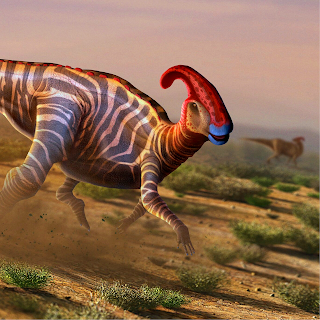
CRESTED BEAUTY: PARASAUROLOPHUS

A delightful red crested hadrosaur
What do elephants, whales and duckbill dinosaurs have in common? A huge trumpeting sound. That's right.

Parasaurolophus was one of the last of the duckbills to roam the Earth and their great crests were the original trumpets. 

We now know that their bizarre head adornments help them produce a low B-Flat or Bb. This is the same B-Flat you hear wind ensembles tune to with the help of their tuba, horn or clarinet players. 

You can image these crested dinosaurs signaling the morning reveille, joy or sounding the alarm over great distances with their bugle-like calls to the other plant-eating members of their herd. 

These herbivorous ornithopod dinosaurs lived in what is now North America — and possibly Asia — during the Late Cretaceous, about 76.5–73 million years ago. 

Parasaurolophus had an interesting jaw structure with dental batteries containing hundreds of teeth that allowed these plant-eaters to tackle their meals with a sort of grinding motion analogous to chewing. 

With all that grinding came significant wear and tear on their specialized dentition so they evolved to have extra teeth waiting in reserve. They dined on plants from the ground up to a height of 4 metres or 13 feet. Once chosen, they would bite their chosen vegetarian meal, begin grinding and any extra green, leafy bits were held in their jaws by a cheek-like organ.  

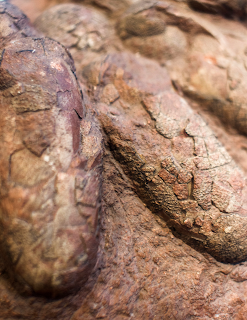
Hadrosaur Eggs
As noted by the awesome American, cowboy hat-wearing palaeontologist Bob Bakker, lambeosaurines have narrower beaks than hadrosaurines, implying that Parasaurolophus and its relatives fed more selectively than their broad-beaked, crestless counterparts.

Parasaurolophus was a hadrosaurid, part of a diverse family of Cretaceous dinosaurs known for their range of bizarre head adornments. This genus is known for its large, elaborate cranial crest, which at its largest forms a long curved tube projecting upwards and back from the skull. 

Charonosaurus from China, which may have been its closest relative, had a similar skull and potentially a similar crest. Visual recognition of both species and sex, acoustic resonance, and thermoregulation has been proposed as functional explanations for the crest beyond its trumpeting roar. 

It may have produced low-frequency noises, similar to elephants, that you and I wouldn't hear but help them keep in touch over vast distances. The infrasounds of elephants are between 1 to 20 Hertz and can be heard by the herd up to 10 kilometres away. 

Enter Charles H. Sternberg in New Mexico

Charles H. Sternberg, American Palaeontologist
In 1921, Charles H. Sternberg recovered a partial skull (PMU.R1250) from what is now known as the slightly younger Kirtland Formation in San Juan County, New Mexico. 

Sternberg was an American fossil collector and palaeontologist active in the field from 1876 to 1928. He collected fossils for a whose who of famous folk and museums including Edward Drinker Cope and Othniel C. Marsh, and for the British Museum, the San Diego Natural History Museum and other museums. 

He sent his specimen to Uppsala, Sweden, where Carl Wiman described it as a second species, P. tubicen, in 1931. The specific epithet is derived from the Latin tǔbǐcěn  or trumpeter

A second, nearly complete P. tubicen skull (NMMNH P-25100) was found in New Mexico in 1995. Using computed tomography scanning of the skull, Robert Sullivan and Thomas Williamson gave the genus a thorough analysis and interpretation of its anatomy and taxonomy, including various hypothesis for the functions of its crest. Williamson later published an independent review of the remains challenging the previous taxonomic placement.

John Ostrom described another good specimen (FMNH P27393) from New Mexico as P. cyrtocristatus in 1961. Ostrom was an American palaeontologist who revolutionized our understanding of dinosaurs in the 1960s. 

His find from New Mexico included a partial skull with a short, rounded crest, and much of the postcranial skeleton except for the feet, neck, and parts of the tail. Its specific name was derived from the Latin curtus "shortened" and cristatus "crested." The specimen was reported as being found at the top of the Fruitland Formation but was likely from the base of the overlying Kirtland Formation. 

The range of this species was expanded in 1979, when David B. Weishampel and James A. Jensen described a partial skull with a similar crest (BYU 2467) from the Campanian-age Kaiparowits Formation of Garfield County, Utah. Since then, another skull has been found in Utah with the short/round P. cyrtocristatus crest morphology.


References:
  • Abel, Othenio (1924). "Die neuen Dinosaurierfunde in der Oberkreide Canadas". Jarbuch Naturwissenschaften (in German). 12 (36): 709–716. Bibcode:1924NW.....12..709A. doi:10.1007/BF01504818.
  • Bakker, R.T. (1986). The Dinosaur Heresies: New Theories Unlocking the Mysteries of Dinosaurs and their Extinction. William Morrow. p. 194. ISBN 978-0-8217-2859-8.
  • Benson, R.J.; Brussatte, S.J.; Anderson; Hone, D.; Parsons, K.; Xu, X.; Milner, D.; Naish, D. (2012). Prehistoric Life. Dorling Kindersley. p. 342. ISBN 978-0-7566-9910-9.
  • Brett-Surman, Michael K.; Wagner, Jonathan R. (2006). "Appendicular anatomy in Campanian and Maastrichtian North American hadrosaurids". In Carpenter, Kenneth (ed.). Horns and Beaks: Ceratopsian and Ornithopod Dinosaurs. Bloomington and Indianapolis: Indiana University Press. pp. 135–169. ISBN 978-0-253-34817-3.
  • Carr, T.D.; Williamson, T.E. (2010). "Bistahieversor sealeyi, gen. et sp. nov., a new tyrannosauroid from New Mexico and the origin of deep snouts in Tyrannosauroidea". Journal of Vertebrate Paleontology. 30 (1): 1–16. doi:10.1080/02724630903413032.

Saturday, January 22, 2022

CANADA'S FIRST SABRE-TOOTHED CAT: SMILODON

This fierce predator with the luxurious coat is Smilodon fatalis — a compact but robust killer that weighed in around 160 to 280 kg and was 1.5 - 2.2 metres long.

Smilodon is a genus of the extinct machairodont subfamily of the felids. It is one of the most famous prehistoric mammals and the best known saber-toothed cat. Although commonly known as the saber-toothed tiger, it was not closely related to the tiger or other modern cats.

Up until a few years ago, all the great fossil specimens of this apex predator were found south of us in the United States. That was until some interesting bones from Medicine Hat, Alberta got a second look.

A few years ago, a fossil specimen caught the eye of researcher Ashley Reynolds as she was rummaging through the collections at the Royal Ontario Museum in Toronto. 

Back in the 1960s,  University of Toronto palaeontologist C.S. Churcher and his team had collected and donated more than 1,200 specimens from their many field seasons scouring the bluffs of the South Saskatchewan River near Medicine Hat, Alberta.

Churcher is a delightful storyteller and a palaeontologist with a keen eye. I had the very great pleasure of listening to many of his talks out at the University of British Columbia and a few Vancouver Paleontological Society meetings in the mid-2000s. 

"Rufus" was a thoroughly charming storyteller and shared many of his adventures from the field. 

He moved out to the West Coast for his retirement, first to Gabriola Island then to Victoria, but his keen love of the science kept him giving talks to enthralled listeners keen to hear about his survey of the Dakhleh Oasis in the Western Desert of Egypt, geomorphology, stratigraphy, recent biology, Pleistocene and Holocene lithic cultures, insights learned from Neolithic Islamic pottery to Roman settlements.

The specimens he had collected had been roughly sorted but never examined in detail. Reynolds, who was researching the growth patterns and life histories of extinct cats saw a familiar-looking bone from an ancient cat's right front paw. That tiny paw bone had reached through time and was positively identified as Canada's first Smilodon.

These Apex Predators used their exceptionally long upper canine teeth to hunt large mammals. 

Isotopes preserved in the bones of S. fatalis in the La Brea Tar Pits in California tell us that they liked to dine on bison (Bison antiquus) and camels (Camelops) along with deer and tapirs. Smilodon is thought to have killed its prey by holding it still with its forelimbs and biting it. And that was quite the bite!

Their razor-sharp incisors were arranged in an arch. Once they bit down, the teeth would hold their prey still and stabilize it while the canine bite was delivered — and what a bite that was. They could open their mouths a full 120 degrees.

Smilodon died out at the same time that most North and South American megafauna disappeared, about 10,000 years ago. Its reliance on large animals has been proposed as the cause of its extinction, along with climate change and competition with other species.