Showing posts with label index. Show all posts

Friday, May 17, 2024

SEXUAL DIMORPHISM: PLIENSBACHIAN APODEROCERAS

Apodoceras / Stonebarrow Fossils
Apoderoceras is a wonderful example of sexual dimorphism within ammonites as the macroconch (female) shell grew to diameters in excess of 40 cm – many times larger than the diameters of the microconch (male) shell.

Apoderoceras has been found in the Lower Jurassic of Argentina, Hungary, Italy, Portugal, and most of North-West and central Europe, including as this one is, the United Kingdom. This specimen was found on the beaches of Charmouth in West Dorset.

Neither Apoderoceras nor Bifericeras donovani are strictly index fossils for the Taylori subzone, the index being Phricodoceras taylori. Note that Bifericeras is typical of the earlier Oxynotum Zone, and ‘Bifericerasdonovani is doubtfully attributable to the genus. The International Commission on Stratigraphy (ICS) has assigned the First Appearance Datum of genus Apoderoceras and of Bifericeras donovani the defining biological marker for the start of the Pliensbachian Stage of the Jurassic, 190.8 ± 1.0 million years ago.

Apoderoceras, Family Coeloceratidae, appears out of nowhere in the basal Pliensbachian and dominates the ammonite faunas of NW Europe. It is superficially similar to the earlier Eteoderoceras, Family Eoderoceratidae, of the Raricostatum Zone, but on close inspection can be seen to be quite different. It is therefore an ‘invader’ and its ancestry is cryptic.

The Pacific ammonite Andicoeloceras, known from Chile, appears quite closely related and may be ancestral, but the time correlation of Pacific and NW European ammonite faunas is challenging. 

Even if Andicoeloceras is ancestral to Apoderoceras, no other preceding ammonites attributable to Coeloceratidae are known. We may yet find clues in the Lias of Canada. Apoderoceras remains present in NW Europe throughout the Taylori Subzone, showing endemic evolution. It becomes progressively more inflated during this interval of time, the adult ribs more distant, and there is evidence that the diameter of the macroconch evolved to become larger. 

At the end of the Taylori Subzone, Apoderoceras disappeared as suddenly as it appeared in the region, and ammonite faunas of the remaining Jamesoni Zone are dominated by the Platypleuroceras–Uptonia lineage, generally assigned (though erroneously) to the Family Polymorphitidae.

In the NW European Taylori Subzone, Apoderoceras is accompanied (as well as by the Eoderoceratid, B. donovani, which is only documented from the Yorkshire coast, although there are known examples from Northern Ireland) by the oxycones Radstockiceras (quite common) and Oxynoticeras (very rare), the late Schlotheimid, Phricoderoceras (uncommon) 

Note: P. taylori is a microconch, and P. lamellosum, the macroconch), and the Eoderoceratid, Tetraspidoceras (very rare). The lovely large specimen (macroconch) of Apoderoceras pictured here is likely a female. Her larger body perfected for egg production.

Thursday, September 8, 2022

AMMONITE TIME KEEPERS: INDEX FOSSILS

Argonauticeras besairei, José Juárez Ruiz
An exceptional example of the fractal building of an ammonite septum, in this clytoceratid Argonauticeras besairei from the awesome José Juárez Ruiz.

Ammonites were predatory, squidlike creatures that lived inside coil-shaped shells.

Like other cephalopods, ammonites had sharp, beak-like jaws inside a ring of squid-like tentacles that extended from their shells. 

They used these tentacles to snare prey, — plankton, vegetation, fish and crustaceans — similar to the way a squid or octopus hunt today.

Catching a fish with your hands is no easy feat, as I am sure you know. But the Ammonites were skilled and successful hunters. They caught their prey while swimming and floating in the water column. 

Within their shells, they had a number of chambers, called septa, filled with gas or fluid that were interconnected by a wee air tube. By pushing air in or out, they were able to control their buoyancy in the water column.

They lived in the last chamber of their shells, continuously building new shell material as they grew. As each new chamber was added, the squid-like body of the ammonite would move down to occupy the final outside chamber.

They were a group of extinct marine mollusc animals in the subclass Ammonoidea of the class Cephalopoda. 

These molluscs, commonly referred to as ammonites, are more closely related to living coleoids — octopuses, squid, and cuttlefish) than they are to shelled nautiloids such as the living Nautilus species.

The Ammonoidea can be divided into six orders:

  • Agoniatitida, Lower Devonian - Middle Devonian
  • Clymeniida, Upper Devonian
  • Goniatitida, Middle Devonian - Upper Permian
  • Prolecanitida, Upper Devonian - Upper Triassic
  • Ceratitida, Upper Permian - Upper Triassic
  • Ammonitida, Lower Jurassic - Upper Cretaceous

Ammonites have intricate and complex patterns on their shells called sutures. The suture patterns differ across species and tell us what time period the ammonite is from. If they are geometric with numerous undivided lobes and saddles and eight lobes around the conch, we refer to their pattern as goniatitic, a characteristic of Paleozoic ammonites.

If they are ceratitic with lobes that have subdivided tips; giving them a saw-toothed appearance and rounded undivided saddles, they are likely Triassic. For some lovely Triassic ammonites, take a look at the specimens that come out of Hallstatt, Austria and from the outcrops in the Humboldt Mountains of Nevada.

Hoplites bennettiana (Sowby, 1826) Christophe Marot
If they have lobes and saddles that are fluted, with rounded subdivisions instead of saw-toothed, they are likely Jurassic or Cretaceous. If you'd like to see a particularly beautiful Lower Jurassic ammonite, take a peek at Apodoceras. Wonderful ridging in that species.

One of my favourite Cretaceous ammonites is the ammonite, Hoplites bennettiana (Sowby, 1826). This beauty is from Albian deposits near Carrière de Courcelles, Villemoyenne, near la région de Troyes (Aube) Champagne in northeastern France.

At the time that this fellow was swimming in our oceans, ankylosaurs were strolling about Mongolia and stomping through the foliage in Utah, Kansas and Texas. Bony fish were swimming over what would become the strata making up Canada, the Czech Republic and Australia. Cartilaginous fish were prowling the western interior seaway of North America and a strange extinct herbivorous mammal, Eobaatar, was snuffling through Mongolia, Spain and England.

In some classifications, these are left as suborders, included in only three orders: Goniatitida, Ceratitida, and Ammonitida. Once you get to know them, ammonites in their various shapes and suturing patterns make it much easier to date an ammonite and the rock formation where it is found.

Ammonites first appeared about 240 million years ago, though they descended from straight-shelled cephalopods called bacrites that date back to the Devonian, about 415 million years ago, and the last species vanished in the Cretaceous–Paleogene extinction event.

They were prolific breeders that evolved rapidly. If you could cast a fishing line into our ancient seas, it is likely that you would hook an ammonite, not a fish. They were prolific back in the day, living (and sometimes dying) in schools in oceans around the globe. We find ammonite fossils (and plenty of them) in sedimentary rock from all over the world.

In some cases, we find rock beds where we can see evidence of a new species that evolved, lived and died out in such a short time span that we can walk through time, following the course of evolution using ammonites as a window into the past.

For this reason, they make excellent index fossils. An index fossil is a species that allows us to link a particular rock formation, layered in time with a particular species or genus found there. 

Generally, deeper is older, so we use the sedimentary layers of rock to match up to specific geologic time periods, rather like the way we use tree rings to date trees. A handy way to compare fossils and date strata across the globe.

References: Inoue, S., Kondo, S. Suture pattern formation in ammonites and the unknown rear mantle structure. Sci Rep 6, 33689 (2016). https://doi.org/10.1038/srep33689

https://www.nature.com/articles/srep33689?fbclid=IwAR1BhBrDqhv8LDjqF60EXdfLR7wPE4zDivwGORTUEgCd2GghD5W7KOfg6Co#citeas

Photos: Argonauticeras besairei from the awesome José Juárez Ruiz.

Photo: Hoplites bennettiana from near Troyes, France. Collection de Christophe Marot

Sunday, July 10, 2022

AMMONITE TIME KEEPERS

Argonauticeras besairei, José Juárez Ruiz
An exceptional example of the fractal building of an ammonite septum, in this clytoceratid Argonauticeras besairei from the awesome José Juárez Ruiz.

Ammonites were predatory, squidlike creatures that lived inside coil-shaped shells.

Like other cephalopods, ammonites had sharp, beak-like jaws inside a ring of squid-like tentacles that extended from their shells. 

They used these tentacles to snare prey, — plankton, vegetation, fish and crustaceans — similar to the way a squid or octopus hunt today.

Catching a fish with your hands is no easy feat, as I am sure you know. But the Ammonites were skilled and successful hunters. They caught their prey while swimming and floating in the water column. 

Within their shells, they had a number of chambers, called septa, filled with gas or fluid that were interconnected by a wee air tube. By pushing air in or out, they were able to control their buoyancy in the water column.

They lived in the last chamber of their shells, continuously building new shell material as they grew. As each new chamber was added, the squid-like body of the ammonite would move down to occupy the final outside chamber.

They were a group of extinct marine mollusc animals in the subclass Ammonoidea of the class Cephalopoda. 

These molluscs, commonly referred to as ammonites, are more closely related to living coleoids — octopuses, squid, and cuttlefish) than they are to shelled nautiloids such as the living Nautilus species.

The Ammonoidea can be divided into six orders:

  • Agoniatitida, Lower Devonian - Middle Devonian
  • Clymeniida, Upper Devonian
  • Goniatitida, Middle Devonian - Upper Permian
  • Prolecanitida, Upper Devonian - Upper Triassic
  • Ceratitida, Upper Permian - Upper Triassic
  • Ammonitida, Lower Jurassic - Upper Cretaceous

Ammonites have intricate and complex patterns on their shells called sutures. The suture patterns differ across species and tell us what time period the ammonite is from. If they are geometric with numerous undivided lobes and saddles and eight lobes around the conch, we refer to their pattern as goniatitic, a characteristic of Paleozoic ammonites.

If they are ceratitic with lobes that have subdivided tips; giving them a saw-toothed appearance and rounded undivided saddles, they are likely Triassic. For some lovely Triassic ammonites, take a look at the specimens that come out of Hallstatt, Austria and from the outcrops in the Humboldt Mountains of Nevada.

Hoplites bennettiana (Sowby, 1826) Christophe Marot
If they have lobes and saddles that are fluted, with rounded subdivisions instead of saw-toothed, they are likely Jurassic or Cretaceous. If you'd like to see a particularly beautiful Lower Jurassic ammonite, take a peek at Apodoceras. Wonderful ridging in that species.

One of my favourite Cretaceous ammonites is the ammonite, Hoplites bennettiana (Sowby, 1826). This beauty is from Albian deposits near Carrière de Courcelles, Villemoyenne, near la région de Troyes (Aube) Champagne in northeastern France.

At the time that this fellow was swimming in our oceans, ankylosaurs were strolling about Mongolia and stomping through the foliage in Utah, Kansas and Texas. Bony fish were swimming over what would become the strata making up Canada, the Czech Republic and Australia. Cartilaginous fish were prowling the western interior seaway of North America and a strange extinct herbivorous mammal, Eobaatar, was snuffling through Mongolia, Spain and England.

In some classifications, these are left as suborders, included in only three orders: Goniatitida, Ceratitida, and Ammonitida. Once you get to know them, ammonites in their various shapes and suturing patterns make it much easier to date an ammonite and the rock formation where it is found.

Ammonites first appeared about 240 million years ago, though they descended from straight-shelled cephalopods called bacrites that date back to the Devonian, about 415 million years ago, and the last species vanished in the Cretaceous–Paleogene extinction event.

They were prolific breeders that evolved rapidly. If you could cast a fishing line into our ancient seas, it is likely that you would hook an ammonite, not a fish. They were prolific back in the day, living (and sometimes dying) in schools in oceans around the globe. We find ammonite fossils (and plenty of them) in sedimentary rock from all over the world.

In some cases, we find rock beds where we can see evidence of a new species that evolved, lived and died out in such a short time span that we can walk through time, following the course of evolution using ammonites as a window into the past.

For this reason, they make excellent index fossils. An index fossil is a species that allows us to link a particular rock formation, layered in time with a particular species or genus found there. 

Generally, deeper is older, so we use the sedimentary layers of rock to match up to specific geologic time periods, rather like the way we use tree rings to date trees. A handy way to compare fossils and date strata across the globe.

References: Inoue, S., Kondo, S. Suture pattern formation in ammonites and the unknown rear mantle structure. Sci Rep 6, 33689 (2016). https://doi.org/10.1038/srep33689

https://www.nature.com/articles/srep33689?fbclid=IwAR1BhBrDqhv8LDjqF60EXdfLR7wPE4zDivwGORTUEgCd2GghD5W7KOfg6Co#citeas

Photos: Argonauticeras besairei from the awesome José Juárez Ruiz.

Photo: Hoplites bennettiana from near Troyes, France. Collection de Christophe Marot

Saturday, February 19, 2022

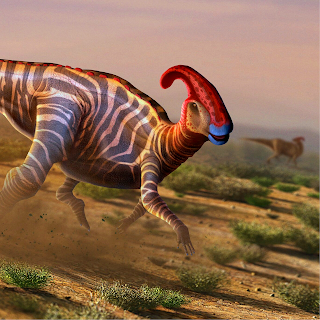
CRESTED BEAUTY: PARASAUROLOPHUS

A delightful red crested hadrosaur
What do elephants, whales and duckbill dinosaurs have in common? A huge trumpeting sound. That's right.

Parasaurolophus was one of the last of the duckbills to roam the Earth and their great crests were the original trumpets. 

We now know that their bizarre head adornments help them produce a low B-Flat or Bb. This is the same B-Flat you hear wind ensembles tune to with the help of their tuba, horn or clarinet players. 

You can image these crested dinosaurs signaling the morning reveille, joy or sounding the alarm over great distances with their bugle-like calls to the other plant-eating members of their herd. 

These herbivorous ornithopod dinosaurs lived in what is now North America — and possibly Asia — during the Late Cretaceous, about 76.5–73 million years ago. 

Parasaurolophus had an interesting jaw structure with dental batteries containing hundreds of teeth that allowed these plant-eaters to tackle their meals with a sort of grinding motion analogous to chewing. 

With all that grinding came significant wear and tear on their specialized dentition so they evolved to have extra teeth waiting in reserve. They dined on plants from the ground up to a height of 4 metres or 13 feet. Once chosen, they would bite their chosen vegetarian meal, begin grinding and any extra green, leafy bits were held in their jaws by a cheek-like organ.  

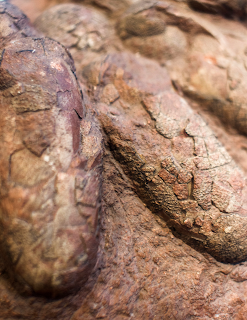
Hadrosaur Eggs
As noted by the awesome American, cowboy hat-wearing palaeontologist Bob Bakker, lambeosaurines have narrower beaks than hadrosaurines, implying that Parasaurolophus and its relatives fed more selectively than their broad-beaked, crestless counterparts.

Parasaurolophus was a hadrosaurid, part of a diverse family of Cretaceous dinosaurs known for their range of bizarre head adornments. This genus is known for its large, elaborate cranial crest, which at its largest forms a long curved tube projecting upwards and back from the skull. 

Charonosaurus from China, which may have been its closest relative, had a similar skull and potentially a similar crest. Visual recognition of both species and sex, acoustic resonance, and thermoregulation has been proposed as functional explanations for the crest beyond its trumpeting roar. 

It may have produced low-frequency noises, similar to elephants, that you and I wouldn't hear but help them keep in touch over vast distances. The infrasounds of elephants are between 1 to 20 Hertz and can be heard by the herd up to 10 kilometres away. 

Enter Charles H. Sternberg in New Mexico

Charles H. Sternberg, American Palaeontologist
In 1921, Charles H. Sternberg recovered a partial skull (PMU.R1250) from what is now known as the slightly younger Kirtland Formation in San Juan County, New Mexico. 

Sternberg was an American fossil collector and palaeontologist active in the field from 1876 to 1928. He collected fossils for a whose who of famous folk and museums including Edward Drinker Cope and Othniel C. Marsh, and for the British Museum, the San Diego Natural History Museum and other museums. 

He sent his specimen to Uppsala, Sweden, where Carl Wiman described it as a second species, P. tubicen, in 1931. The specific epithet is derived from the Latin tǔbǐcěn  or trumpeter

A second, nearly complete P. tubicen skull (NMMNH P-25100) was found in New Mexico in 1995. Using computed tomography scanning of the skull, Robert Sullivan and Thomas Williamson gave the genus a thorough analysis and interpretation of its anatomy and taxonomy, including various hypothesis for the functions of its crest. Williamson later published an independent review of the remains challenging the previous taxonomic placement.

John Ostrom described another good specimen (FMNH P27393) from New Mexico as P. cyrtocristatus in 1961. Ostrom was an American palaeontologist who revolutionized our understanding of dinosaurs in the 1960s. 

His find from New Mexico included a partial skull with a short, rounded crest, and much of the postcranial skeleton except for the feet, neck, and parts of the tail. Its specific name was derived from the Latin curtus "shortened" and cristatus "crested." The specimen was reported as being found at the top of the Fruitland Formation but was likely from the base of the overlying Kirtland Formation. 

The range of this species was expanded in 1979, when David B. Weishampel and James A. Jensen described a partial skull with a similar crest (BYU 2467) from the Campanian-age Kaiparowits Formation of Garfield County, Utah. Since then, another skull has been found in Utah with the short/round P. cyrtocristatus crest morphology.


References:
  • Abel, Othenio (1924). "Die neuen Dinosaurierfunde in der Oberkreide Canadas". Jarbuch Naturwissenschaften (in German). 12 (36): 709–716. Bibcode:1924NW.....12..709A. doi:10.1007/BF01504818.
  • Bakker, R.T. (1986). The Dinosaur Heresies: New Theories Unlocking the Mysteries of Dinosaurs and their Extinction. William Morrow. p. 194. ISBN 978-0-8217-2859-8.
  • Benson, R.J.; Brussatte, S.J.; Anderson; Hone, D.; Parsons, K.; Xu, X.; Milner, D.; Naish, D. (2012). Prehistoric Life. Dorling Kindersley. p. 342. ISBN 978-0-7566-9910-9.
  • Brett-Surman, Michael K.; Wagner, Jonathan R. (2006). "Appendicular anatomy in Campanian and Maastrichtian North American hadrosaurids". In Carpenter, Kenneth (ed.). Horns and Beaks: Ceratopsian and Ornithopod Dinosaurs. Bloomington and Indianapolis: Indiana University Press. pp. 135–169. ISBN 978-0-253-34817-3.
  • Carr, T.D.; Williamson, T.E. (2010). "Bistahieversor sealeyi, gen. et sp. nov., a new tyrannosauroid from New Mexico and the origin of deep snouts in Tyrannosauroidea". Journal of Vertebrate Paleontology. 30 (1): 1–16. doi:10.1080/02724630903413032.

Wednesday, September 15, 2021

FISHING IN ANCIENT SEAS

If you could cast a fishing line into our ancient seas, it is likely that you would hook an ammonite, not a fish. When we find them, it is their hugely varied fossilized shells that we see. 

Rarely is the very soft, squid-like fellow inside preserved so we can easily forget what the entire animal looked like. 

These marine cephalopods were predatory, squid-like creatures that lived inside the coil-shaped shells we find. Like other cephalopods, ammonites had sharp, beak-like jaws inside a ring of squid-like tentacles that extended from their shells. They used these tentacles to snare prey, — plankton, vegetation, fish and crustaceans — similar to the way a squid or octopus hunt today.

Catching a fish with your hands is no easy feat, as I am sure you know. But the Ammonites were skilled and successful hunters. They caught their prey while swimming and floating in the water column. 

Within their shells, they had a number of chambers, called septa, filled with gas or fluid that were interconnected by a wee air tube called a siphuncle. By pushing air in or out, they were able to control their buoyancy in the water column.

They lived in the last chamber of their shells, continuously building new shell material as they grew. As each new chamber was added, the squid-like body of the ammonite would move down to occupy the final outside chamber.

We find ammonite fossils, and plenty of them, in sedimentary rock from all over the world. They were prolific breeders that evolved rapidly. 

In some cases, we find rock beds where we can see evidence of a new species that evolved, lived and died out in such a short time span that we can walk through time, following the course of evolution using ammonites as a window into the past. 

For this reason, they make excellent index fossils. An index fossil is a species that allows us to link a particular rock formation, layered in time with a particular species or genus found there. Generally, deeper is older, so we use the sedimentary layers of rock to match up to specific geologic time periods, rather like the way we use tree rings to date trees.

Tuesday, August 17, 2021

AMMONITE: INDEX FOSSILS AS TIME KEEPERS

Argonauticeras besairei, José Juárez Ruiz
An exceptional example of the fractal building of an ammonite septum, in this clytoceratid Argonauticeras besairei from the awesome José Juárez Ruiz.

Ammonites were predatory, squidlike creatures that lived inside coil-shaped shells.

Like other cephalopods, ammonites had sharp, beak-like jaws inside a ring of squid-like tentacles that extended from their shells. 

They used these tentacles to snare prey, — plankton, vegetation, fish and crustaceans — similar to the way a squid or octopus hunt today.

Catching a fish with your hands is no easy feat, as I am sure you know. But the Ammonites were skilled and successful hunters. They caught their prey while swimming and floating in the water column. 

Within their shells, they had a number of chambers, called septa, filled with gas or fluid that were interconnected by a wee air tube. By pushing air in or out, they were able to control their buoyancy in the water column.

They lived in the last chamber of their shells, continuously building new shell material as they grew. As each new chamber was added, the squid-like body of the ammonite would move down to occupy the final outside chamber.

They were a group of extinct marine mollusc animals in the subclass Ammonoidea of the class Cephalopoda. 

These molluscs, commonly referred to as ammonites, are more closely related to living coleoids — octopuses, squid, and cuttlefish) than they are to shelled nautiloids such as the living Nautilus species.

The Ammonoidea can be divided into six orders:

  • Agoniatitida, Lower Devonian - Middle Devonian
  • Clymeniida, Upper Devonian
  • Goniatitida, Middle Devonian - Upper Permian
  • Prolecanitida, Upper Devonian - Upper Triassic
  • Ceratitida, Upper Permian - Upper Triassic
  • Ammonitida, Lower Jurassic - Upper Cretaceous

Ammonites have intricate and complex patterns on their shells called sutures. The suture patterns differ across species and tell us what time period the ammonite is from. If they are geometric with numerous undivided lobes and saddles and eight lobes around the conch, we refer to their pattern as goniatitic, a characteristic of Paleozoic ammonites.

If they are ceratitic with lobes that have subdivided tips; giving them a saw-toothed appearance and rounded undivided saddles, they are likely Triassic. For some lovely Triassic ammonites, take a look at the specimens that come out of Hallstatt, Austria and from the outcrops in the Humboldt Mountains of Nevada.

Hoplites bennettiana (Sowby, 1826) Christophe Marot
If they have lobes and saddles that are fluted, with rounded subdivisions instead of saw-toothed, they are likely Jurassic or Cretaceous. If you'd like to see a particularly beautiful Lower Jurassic ammonite, take a peek at Apodoceras. Wonderful ridging in that species.

One of my favourite Cretaceous ammonites is the ammonite, Hoplites bennettiana (Sowby, 1826). This beauty is from Albian deposits near Carrière de Courcelles, Villemoyenne, near la région de Troyes (Aube) Champagne in northeastern France.

At the time that this fellow was swimming in our oceans, ankylosaurs were strolling about Mongolia and stomping through the foliage in Utah, Kansas and Texas. Bony fish were swimming over what would become the strata making up Canada, the Czech Republic and Australia. Cartilaginous fish were prowling the western interior seaway of North America and a strange extinct herbivorous mammal, Eobaatar, was snuffling through Mongolia, Spain and England.

In some classifications, these are left as suborders, included in only three orders: Goniatitida, Ceratitida, and Ammonitida. Once you get to know them, ammonites in their various shapes and suturing patterns make it much easier to date an ammonite and the rock formation where it is found.

Ammonites first appeared about 240 million years ago, though they descended from straight-shelled cephalopods called bacrites that date back to the Devonian, about 415 million years ago, and the last species vanished in the Cretaceous–Paleogene extinction event.

They were prolific breeders that evolved rapidly. If you could cast a fishing line into our ancient seas, it is likely that you would hook an ammonite, not a fish. They were prolific back in the day, living (and sometimes dying) in schools in oceans around the globe. We find ammonite fossils (and plenty of them) in sedimentary rock from all over the world.

In some cases, we find rock beds where we can see evidence of a new species that evolved, lived and died out in such a short time span that we can walk through time, following the course of evolution using ammonites as a window into the past.

For this reason, they make excellent index fossils. An index fossil is a species that allows us to link a particular rock formation, layered in time with a particular species or genus found there. 

Generally, deeper is older, so we use the sedimentary layers of rock to match up to specific geologic time periods, rather like the way we use tree rings to date trees. A handy way to compare fossils and date strata across the globe.

References: Inoue, S., Kondo, S. Suture pattern formation in ammonites and the unknown rear mantle structure. Sci Rep 6, 33689 (2016). https://doi.org/10.1038/srep33689

https://www.nature.com/articles/srep33689?fbclid=IwAR1BhBrDqhv8LDjqF60EXdfLR7wPE4zDivwGORTUEgCd2GghD5W7KOfg6Co#citeas

Photos: Argonauticeras besairei from the awesome José Juárez Ruiz.

Photo: Hoplites bennettiana from near Troyes, France. Collection de Christophe Marot

Saturday, July 10, 2021

SPINY HETEROMORPH AMMONITE: INDEX FOSSILS

Ammonites, like this gorgeous spiny heteromorph, were prolific breeders that evolved rapidly. If you could cast a fishing line into our ancient seas, it is likely that you would hook an ammonite, not a fish.

We find ammonite fossils, and plenty of them, in sedimentary rock from all over the world. In some cases, we find rock beds where we can see evidence of a new species that evolved, lived and died out in such a short time span that we can walk through time, following the course of evolution using ammonites as a window into the past. For this reason, they make excellent index fossils. 

An index fossil is a species that allows us to link a particular rock formation, layered in time with a particular species or genus found there. Generally, deeper is older, so we use the sedimentary layers of rock to match up to specific geologic time periods, rather like the way we use tree rings to date trees.