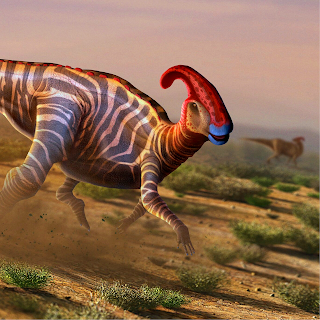
Hadrosaurs lived as part of a herd, dining on pine needles, horsetails, twigs and flowering plants.
Hadrosaurs are ornithischians — an extinct clade of mainly herbivorous dinosaurs characterized by a pelvic structure superficially similar to that of birds. They are close relatives and possibly descendants of the earlier iguanodontid dinosaurs.
They had slightly webbed, camel-like feet with pads on the bottom for cushioning and perhaps a bit of extra propulsion in water. They were primarily terrestrial but did enjoy feeding on plants near and in shallow water. There had a sturdy build with a stiff tail and robust bone structure.
At their emergence in the fossil record, they were quite small, roughly three meters long. That's slightly smaller than an American bison. They evolved during the Cretaceous with some of their lineage reaching up to 20 meters or 65 feet.
Hadrosaurs are very rare in British Columbia but a common fossil in our provincial neighbour, Alberta, to the east. Here, along with the rest of the world, they were more abundant than sauropods and a relatively common fossil find. They were common in the Upper Cretaceous of Europe, Asia, and North America.
There are two main groups of Hadrosaurs, crested and non-crested. The bony crest on the top of the head of the hadrosaurs was hollow and attached to the nasal passages. It is thought that the hollow crest was used to make different sounds. These sounds may have signalled distress or been the hadrosaur equivalent of a wolf whistle used to attract mates. Given their size it would have made for quite the trumpeting sound.
This beautiful specimen graces the back galleries of the Courtenay and District Museum on Vancouver Island, British Columbia, Canada. I was very fortunate to have a tour this past summer with the deeply awesome Mike Trask joined by the lovely Lori Vesper. The museum houses an extensive collection of palaeontological and archaeological material found on Vancouver Island, many of which have been donated by the Vancouver Island Palaeontological Society.
Dan Bowen, Chair of the Vancouver Island Palaeontological Society, shared the photo you see here of the first partly articulated dinosaur from Vancouver Island ever found. The vertebrate photo and illustration are from a presentation by Dr. David Evans at the 2018 Paleontological Symposium in Courtenay. The research efforts of the VIPS run deep in British Columbia and this new very significant find is no exception. A Hadrosauroid dinosaur is a rare occurrence and further evidence of the terrestrial influence in the Upper Cretaceous, Nanaimo Group, Vancouver Island — outcrops that we traditionally thought of as marine from years of collecting well-preserved marine fossil fauna.
The fossil bone material was found years ago by Mike Trask of the Vancouver Island Palaeontological Society. You may recall that he was the same fellow who found the Courtenay Elasmosaur on the Puntledge River.
Mike was leading a fossil expedition on the Trent River. While searching through the Upper Cretaceous shales, the group found an articulated mass of bones that looked quite promising.
Given the history of the finds in the area, the bones were thought to be from a marine reptile.
Since that time, we've found a wonderful terrestrial helochelydrid turtle, Naomichelys speciosa, but up to this point, the Trent had been known for its fossil marine fauna, not terrestrial. Efforts were made to excavate more of the specimen, and in all more than 25 associated vertebrae were collected with the help of some 40+ volunteers. Identifying fossil bone is a tricky business. Encased in rock, the caudal vertebrae were thought to be marine reptile in origin. Some of these were put on display in the Courtenay Museum and mislabeled for years as an unidentified plesiosaur.
In 2016, after years of collecting dust and praise in equal measure, the bones were reexamined. They didn't quite match what we'd expect from a marine reptile. Shino Sugimoto, Fossil Preparator, Vertebrate Palaeontology Technician at the Royal Ontario Museum was called in to work her magic — painstakingly prepping out each caudal vertebrae from the block.
At their emergence in the fossil record, they were quite small, roughly three meters long. That's slightly smaller than an American bison. They evolved during the Cretaceous with some of their lineage reaching up to 20 meters or 65 feet.
Hadrosaurs are very rare in British Columbia but a common fossil in our provincial neighbour, Alberta, to the east. Here, along with the rest of the world, they were more abundant than sauropods and a relatively common fossil find. They were common in the Upper Cretaceous of Europe, Asia, and North America.
There are two main groups of Hadrosaurs, crested and non-crested. The bony crest on the top of the head of the hadrosaurs was hollow and attached to the nasal passages. It is thought that the hollow crest was used to make different sounds. These sounds may have signalled distress or been the hadrosaur equivalent of a wolf whistle used to attract mates. Given their size it would have made for quite the trumpeting sound.
This beautiful specimen graces the back galleries of the Courtenay and District Museum on Vancouver Island, British Columbia, Canada. I was very fortunate to have a tour this past summer with the deeply awesome Mike Trask joined by the lovely Lori Vesper. The museum houses an extensive collection of palaeontological and archaeological material found on Vancouver Island, many of which have been donated by the Vancouver Island Palaeontological Society.
Dan Bowen, Chair of the Vancouver Island Palaeontological Society, shared the photo you see here of the first partly articulated dinosaur from Vancouver Island ever found. The vertebrate photo and illustration are from a presentation by Dr. David Evans at the 2018 Paleontological Symposium in Courtenay. The research efforts of the VIPS run deep in British Columbia and this new very significant find is no exception. A Hadrosauroid dinosaur is a rare occurrence and further evidence of the terrestrial influence in the Upper Cretaceous, Nanaimo Group, Vancouver Island — outcrops that we traditionally thought of as marine from years of collecting well-preserved marine fossil fauna.
 |
| CDM 002 / Hadrosauroid Caudal Vertebrae |
Mike was leading a fossil expedition on the Trent River. While searching through the Upper Cretaceous shales, the group found an articulated mass of bones that looked quite promising.
Given the history of the finds in the area, the bones were thought to be from a marine reptile.
Since that time, we've found a wonderful terrestrial helochelydrid turtle, Naomichelys speciosa, but up to this point, the Trent had been known for its fossil marine fauna, not terrestrial. Efforts were made to excavate more of the specimen, and in all more than 25 associated vertebrae were collected with the help of some 40+ volunteers. Identifying fossil bone is a tricky business. Encased in rock, the caudal vertebrae were thought to be marine reptile in origin. Some of these were put on display in the Courtenay Museum and mislabeled for years as an unidentified plesiosaur.
In 2016, after years of collecting dust and praise in equal measure, the bones were reexamined. They didn't quite match what we'd expect from a marine reptile. Shino Sugimoto, Fossil Preparator, Vertebrate Palaeontology Technician at the Royal Ontario Museum was called in to work her magic — painstakingly prepping out each caudal vertebrae from the block.
Once fully prepped, seemingly unlikely, they turned out to be from a terrestrial hadrosauroid. This is the second confirmed dinosaur from the Upper Cretaceous Nanaimo Group. The first being a theropod from Sucia Island consisting of a partial left thigh bone — the first dinosaur fossil ever found in Washington state.
Dr. David Evans, Temerty Chair in Vertebrate Palaeontology, Department of Natural History, Palaeobiology from the Royal Ontario Museum, confirmed the ID and began working on the partial duck-billed dinosaur skeleton to publish on the find.
Now fully prepped, the details of this articulated Hadrosauriod caudal vertebrae come to light. We can see the prominent chevron facets indicative of caudal vertebrae with a nice hexagonal centrum shape on its anterior view.
There are well-defined long, raked neural spines that expand distally — up and away from the acoelous centrum.
 |
| Drawing of Trent River Hadrosauroid Caudal Vertebrae |
There are well-defined long, raked neural spines that expand distally — up and away from the acoelous centrum.
Between the successive vertebrae, there would likely have been a fibrocartilaginous intervertebral body with a gel-like core — the nucleus pulposus — which is derived from the embryonic notochord. This is a handy feature in a vertebrate built as sturdily as a hadrosaur. Acoelous vertebrae have evolved to be especially well-suited to receive and distribute compressive forces within the vertebral column.
This fellow has kissing cousins over in the state of New Jersey where this species is the official state fossil. The first of his kind was found by John Estaugh Hopkins in New Jersey back in 1838. Since that time, we've found many hadrosaurs in Alberta, particularly the Edmontosuaurs, another member of the subfamily Hadrosaurine.
This fellow has kissing cousins over in the state of New Jersey where this species is the official state fossil. The first of his kind was found by John Estaugh Hopkins in New Jersey back in 1838. Since that time, we've found many hadrosaurs in Alberta, particularly the Edmontosuaurs, another member of the subfamily Hadrosaurine.

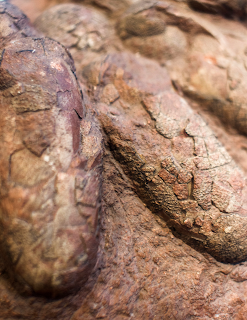
Their initial finds of several small skeletons had them on the hunt for potential nests — and they found them complete with wee baby hatchlings!
Photo One: Fossil Huntress / Heidi Henderson, VIPS
Photo One: Fossil Huntress / Heidi Henderson, VIPS
Photo Two / Sketch Three: Danielle Dufault, Palaeo-Scientific Ilustrator, Research Assistant at the Royal Ontario Museum, Host of Animalogic.
The vertebrate photo and illustration were included in a presentation by Dr. David Evans at the 2018 BCPA Paleontological Symposium in Courtenay, British Columbia, Canada.
Photo Four: Illustration by the talented Greer Stothers, Illustrator & Natural Science-Enthusiast.