Showing posts with label eat. Show all posts

Thursday, May 16, 2024

PARTY OF TWO: ANGLERFISH

The festive lassie you see here is an Anglerfish. They always look to be celebrating a birthday of some kind, albeit solo. This party is happening deep in our oceans and for those that join in, I hope they like it rough.

The wee candle you see on her forehead is a photophore, a tiny bit of luminous dorsal spine. Many of our sea dwellers have these candle-like bits illuminating the depths. You may have noticed them glowing around the eyes of many of our cephalopod friends. 

These light organs can be a simple grouping of photogenic cells or more complex with light reflectors, lenses, colour filters able to adjust the intensity or angular distribution of the light they produce. Some species have adapted their photophores to avoid being eaten, in others, it's an invitation to lunch.

In anglerfish' world, this swaying light is dead sexy. It's an adaptation used to attract prey and mates alike.

Deep in the murky depths of the Atlantic and Antarctic oceans, hopeful female anglerfish light up their sexy lures. When a male latches onto this tasty bit of flesh, he fuses himself totally. He might be one of several potential mates. She's not picky, just hungry. Lure. Feed. Mate. Repeat.

A friend asked if anglerfish mate for life. Well, yes.... yes, indeed they do.

Mating is a tough business down in the depths. Her body absorbs all the yummy nutrients of his body over time until all that's left are his testes. While unusual, it is only one of many weird and whacky ways our fishy friends communicate, entice, hunt and creatively survive and thrive. The deepest, darkest part of the ocean isn't empty — its hungry.

The evolution of fish began about 530 million years ago with the first fish lineages belonging to the Agnatha, a superclass of jawless fish. We still see them in our waters as cyclostomes but have lost the conodonts and ostracoderms to the annals of time. Like all vertebrates, fish have bilateral symmetry; when divided down the middle or central axis, each half is the same. Organisms with bilateral symmetry are generally more agile, making finding a mate, hunting or avoiding being hunted a whole lot easier.

When we envision fish, we generally picture large eyes, gills, a well-developed mouth. The earliest animals that we classify as fish appeared as soft-bodied chordates who lacked a true spine. While they were spineless, they did have notochords, a cartilaginous skeletal rod that gave them more dexterity than the cold-blooded invertebrates who shared those ancient seas and evolved without a backbone. 

Fish would continue to evolve throughout the Paleozoic, diversifying into a wide range of forms. Several forms of Paleozoic fish developed external armour that protected them from predators. The first fish with jaws appeared in the Silurian period, after which many species, including sharks, became formidable marine predators rather than just the prey of arthropods.

Fish in general respire using gills, are most often covered with bony scales and propel themselves using fins. There are two main types of fins, median fins and paired fins. The median fins include the caudal fin or tail fin, the dorsal fin, and the anal fin. Now there may be more than one dorsal, and one anal fin in some fishes.

The paired fins include the pectoral fins and the pelvic fins. And these paired fins are connected to, and supported by, pectoral and pelvic girdles, at the shoulder and hip; in the same way, our arms and legs are connected to and supported by, pectoral and pelvic girdles. This arrangement is something we inherited from the ancestors we share with fish. They are homologous structures.

When we speak of early vertebrates, we are often talking about fish. Fish is a term we use a lot in our everyday lives but taxonomically it is not all that useful. When we say, fish we generally mean an ectothermic, aquatic vertebrate with gills and fins.

Fortunately, many of our fishy friends have ended up in the fossil record. We may see some of the soft bits from time to time, as in the lovely fossil fish found in concretion in Brazil, but we often see fish skeletons. Vertebrates with hard skeletons had a much better chance of being preserved. 

Eohiodon Fish, McAbee Fossil Beds
In British Columbia, we have lovely two-dimensional Eocene fossil fish well-represented from the Allenby of Princeton and the McAbee Fossil Beds. 

We have the Tiktaalik roseae, a large freshwater fish, from 375 million-year-old Devonian deposits on Ellesmere Island in Canada's Arctic. Tiktaalik is a wonderfully bizarre creature with a flat, almost reptilian head but also fins, scales and gills. We have other wonders from this time. 

Canada also boasts spectacular antiarch placoderms, Bothriolepsis, found in the Upper Devonian shales of Miguasha in Quebec.

There are fragments of bone-like tissues from as early as the Late Cambrian with the oldest fossils that are truly recognizable as fishes come from the Middle Ordovician from North America, South America and Australia. At the time, South America and Australia were part of a supercontinent called Gondwana. North America was part of another supercontinent called Laurentia and the two were separated by deep oceans.

These two supercontinents and others that were also present were partially covered by shallow equatorial seas and the continents themselves were barren and rocky. Land plants didn't evolve until later in the Silurian Period. In these shallow equatorial seas, a large diverse and widespread group of armoured, jawless fishes evolved: the Pteraspidomorphi. The first of our three groups of ostracoderms. The Pteraspidomorphi are divided into three major groups: the Astraspida, Arandaspida and the Heterostraci.

The oldest and most primitive pteraspidomorphs were the Astraspida and the Arandaspida. You'll notice that all three of these taxon names contain 'aspid', which means shield. This is because these early fishes — and many of the Pteraspidomorphi — possessed large plates of dermal bone at the anterior end of their bodies. This dermal armour was very common in early vertebrates, but it was lost in their descendants. 

Arandaspida is represented by two well-known genera: Sacabampaspis, from South America and Arandaspis from Australia. Arandaspis have large, simple, dorsal and ventral head shields. Their bodies were fusiform, which means they were shaped sort of like a spindle, fat in the middle and tapering at both ends. Picture a sausage that is a bit wider near the centre with a crisp outer shell.

If you're a keen bean to see an anglerfish that recently washed up on the shores of Newport Beach this past May, hit this link: https://www.theguardian.com/us-news/2021/may/11/deep-sea-anglerfish-california-beach-finding-nemo. Kudos for my colleague, Giovanni, bringing this gloriously horrific lovely to my attention. 

Saturday, May 4, 2024

DARWIN: A TASTE FOR STUDIES

Chelonia. Schildkröten by Ernst Haeckel, 1904
Care for some tarantula with that walrus? No? how about some Woolly mammoth?

While eating study specimens is not de rigueur today, it was once common practice for researchers in the 1700-1880s. 

The English naturalist, Charles Darwin belonged to an elite men's club dedicated to tasting exotic meats. In his first book, Darwin wrote almost three times as much about dishes like armadillo and tortoise urine as he did on the biogeography of his Galapagos finches. 

From his great love of gastronomy, I am surprised any of his tasty specimens made it back from his historic voyage on the HMS Beagle — particularly the turtles.

One of the most famous scientific meals occurred one Saturday evening on the 13th of January, 1951. This was at the 47th Explorers Club Annual Dinner (ECAD) when members purportedly dined on a frozen woolly mammoth. 

Commander Wendell Phillips Dodge was the promotor of the banquet. He sent out press notices proclaiming the event's signature dish would be a selection of prehistoric meat. Whether Dodge did this simply to gain attendees or play a joke remains a mystery. 

The prehistoric meat was supposedly found at Woolly Cove on Akutan in the Aleutians Islands of Alaska, USA, by the eminent polar explorers' Father Bernard Rosecrans Hubbard, American geologist, explorer sometimes called the Glacier Priest, and polar explorer Captain George Francis Kosco of the United States Navy.

Fried Tarantula & Goat Eyeballs

This much-publicized meal captured the public’s imagination and became an enduring legend and source of pride for the Club, popularizing an annual menu of exotics that continues today. The Club is well-known for its notorious hors d’oeuvres like fried tarantulas and goat eyeballs as it is for its veritable whose who of notable members — Teddy Roosevelt, Neil Armstrong, Buzz Aldrin, Roy Chapman Andrews, Thor Heyerdahl, James Cameron.

The Yale Peabody Museum holds a sample of meat preserved from the 1951 meal, interestingly labelled as a South American Giant Ground Sloth, Megatherium, not Mammoth. The specimen of meat from that famous meal was originally designated BRCM 16925 before a transfer in 2001 from the Bruce Museum to the Yale Peabody Museum of Natural History (New Haven, CT, USA) where it gained the number YPM MAM 14399.

The specimen is now permanently deposited in the Yale Peabody Museum with the designation YPM HERR 19475 and is accessible to outside researchers. The meat was never fixed in formalin and was initially stored in isopropyl alcohol before being transferred to ethanol when it arrived at the Peabody Museum. DNA extraction occurred at Yale University in a clean room with equipment reserved exclusively for aDNA analyses.

In 2016, Jessica Glass and her colleagues sequenced a fragment of the mitochondrial cytochrome-b gene and studied archival material to verify its identity, which if genuine, would extend the range of Megatherium over 600% and alter views on ground sloth evolution. 

Mammoth, Megatherium — Green Sea Turtle

Their results showed that the meat was not Mammoth or Megatherium, but a bit of Green Sea Turtle, Chelonia mydas. So much for elaborate legends. The prehistoric dinner was likely meant as a publicity stunt. 

Glass's study emphasizes the value of museums collecting and curating voucher specimens, particularly those used for evidence of extraordinary claims. Not so long before Glass et al. did their experiment, a friend's mother (and my kayaking partners) served up a venison steak from her freezer to dinner guests in Castlegar that hailed from 1978. Tough? Inedible? I have it on good report that the meat was surprisingly divine.

Reference: Glass, J. R., Davis, M., Walsh, T. J., Sargis, E. J., & Caccone, A. (2016). Was Frozen Mammoth or Giant Ground Sloth Served for Dinner at The Explorers Club?. PloS one, 11(2), e0146825. https://doi.org/10.1371/journal.pone.0146825

Image: Chelonia. Schildkröten by Ernst Haeckel, 1904, Prints & Photographs Division, Library of Congress, LC-DIG-ds-07619.

Join the Explorer's Club

Fancy yourself an explorer who should join the club? Here is a link to their membership application. The monied days of old are still inherent, but you will be well pleased to learn you can now join for as little as $50 US.

Link: https://www.explorers.org/wp-content/uploads/Membership-Application_2021-11-19.pdf

Friday, March 29, 2024

AMYLASE: YOU ARE WHAT YOU EAT


The old adage, you are what you eat, might be best amended to you are what you can digest. 

For all the mammals, you and I included, we need the amylase gene (AMY). It codes for a starch-digesting enzyme needed to break down the vegetation we eat. 

Humans, dogs and mice have record numbers of the amylase gene. The AMY gene copy number increases in mammal populations where starch-based foods are more abundant. Think toast and jam versus raw chicken.

A good example of this is seen when we compare wolves living in the wild to dogs from agricultural societies. Dogs split off the lineage from wolves around 30,000–40,000 years ago. 

Domesticated dogs have extra copies of amylase and other genes involved in starch digestion that contribute to an increased ability to thrive on a starch-rich diet, allowing Fido to make the most of those table scraps. Similar to humans, some dog breeds produce amylase in their saliva, a clear marker of a high starch diet. So do mice, rats, and pigs, as expected as they live in concert with humans. Curiously, so do some New World monkeys, boars, deer mice, woodrats, and giant African pouched rats. 

More like cats and less like other omnivores, dogs can only produce bile acid with taurine and they cannot produce vitamin D, which they obtain from animal flesh. Also, more like cats, dogs require arginine to maintain their nitrogen balance. These nutritional requirements place dogs halfway between carnivores and omnivores.

The amount of AMY and starch in the diet varies among subspecies, and sometimes even amongst geographically distinct populations of the same species. I was at a talk recently given by Alaskan wolf researchers who shared that two individual packs of wolves separated by less than a kilometre ate vastly different diets. This had me thinking about what we eat and it is mostly driven by what is on offer. 

Diet impacts our genetics and this, in turn, allows the fittest to eat, digest and survive. While wolves win the carnivore contest, they will still eat opportunistically and that includes vegetation when other food is scarce. Would they evolve similar levels of AMY as humans, dogs and mice? Maybe if their diets evolved to be similar. Likely. The choice would be that or starvation.

The evolution of amylase in other domesticated or human commensal mammals remains an alluring area of inquiry.

Reference: 

Amylase in Dietary Food Preferences in Mammals: https://www.ncbi.nlm.nih.gov/pmc/articles/PMC6516957/

Monday, June 13, 2022

AMYLASE: YOU ARE WHAT YOU EAT


The old adage, you are what you eat, might be best amended to you are what you can digest. 

For all the mammals, you and I included, we need the amylase gene (AMY). It codes for a starch-digesting enzyme needed to break down the vegetation we eat. 

Humans, dogs and mice have record numbers of the amylase gene. The AMY gene copy number increases in mammal populations where starch-based foods are more abundant. Think toast and jam versus raw chicken.

A good example of this is seen when we compare wolves living in the wild to dogs from agricultural societies. Dogs split off the lineage from wolves around 30,000–40,000 years ago. 

Domesticated dogs have extra copies of amylase and other genes involved in starch digestion that contribute to an increased ability to thrive on a starch-rich diet, allowing Fido to make the most of those table scraps. Similar to humans, some dog breeds produce amylase in their saliva, a clear marker of a high starch diet. So do mice, rats, and pigs, as expected as they live in concert with humans. Curiously, so do some New World monkeys, boars, deer mice, woodrats, and giant African pouched rats. 

More like cats and less like other omnivores, dogs can only produce bile acid with taurine and they cannot produce vitamin D, which they obtain from animal flesh. Also, more like cats, dogs require arginine to maintain their nitrogen balance. These nutritional requirements place dogs halfway between carnivores and omnivores.

The amount of AMY and starch in the diet varies among subspecies, and sometimes even amongst geographically distinct populations of the same species. I was at a talk recently given by Alaskan wolf researchers who shared that two individual packs of wolves separated by less than a kilometre ate vastly different diets. This had me thinking about what we eat and it is mostly driven by what is on offer. 

Diet impacts our genetics and this, in turn, allows the fittest to eat, digest and survive. While wolves win the carnivore contest, they will still eat opportunistically and that includes vegetation when other food is scarce. Would they evolve similar levels of AMY as humans, dogs and mice? Maybe if their diets evolved to be similar. Likely. The choice would be that or starvation.

The evolution of amylase in other domesticated or human commensal mammals remains an alluring area of inquiry.

Reference: 

Amylase in Dietary Food Preferences in Mammals: https://www.ncbi.nlm.nih.gov/pmc/articles/PMC6516957/

Saturday, February 19, 2022

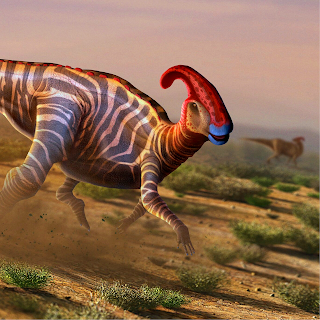
CRESTED BEAUTY: PARASAUROLOPHUS

A delightful red crested hadrosaur
What do elephants, whales and duckbill dinosaurs have in common? A huge trumpeting sound. That's right.

Parasaurolophus was one of the last of the duckbills to roam the Earth and their great crests were the original trumpets. 

We now know that their bizarre head adornments help them produce a low B-Flat or Bb. This is the same B-Flat you hear wind ensembles tune to with the help of their tuba, horn or clarinet players. 

You can image these crested dinosaurs signaling the morning reveille, joy or sounding the alarm over great distances with their bugle-like calls to the other plant-eating members of their herd. 

These herbivorous ornithopod dinosaurs lived in what is now North America — and possibly Asia — during the Late Cretaceous, about 76.5–73 million years ago. 

Parasaurolophus had an interesting jaw structure with dental batteries containing hundreds of teeth that allowed these plant-eaters to tackle their meals with a sort of grinding motion analogous to chewing. 

With all that grinding came significant wear and tear on their specialized dentition so they evolved to have extra teeth waiting in reserve. They dined on plants from the ground up to a height of 4 metres or 13 feet. Once chosen, they would bite their chosen vegetarian meal, begin grinding and any extra green, leafy bits were held in their jaws by a cheek-like organ.  

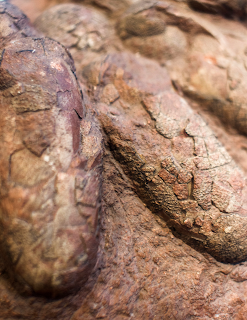
Hadrosaur Eggs
As noted by the awesome American, cowboy hat-wearing palaeontologist Bob Bakker, lambeosaurines have narrower beaks than hadrosaurines, implying that Parasaurolophus and its relatives fed more selectively than their broad-beaked, crestless counterparts.

Parasaurolophus was a hadrosaurid, part of a diverse family of Cretaceous dinosaurs known for their range of bizarre head adornments. This genus is known for its large, elaborate cranial crest, which at its largest forms a long curved tube projecting upwards and back from the skull. 

Charonosaurus from China, which may have been its closest relative, had a similar skull and potentially a similar crest. Visual recognition of both species and sex, acoustic resonance, and thermoregulation has been proposed as functional explanations for the crest beyond its trumpeting roar. 

It may have produced low-frequency noises, similar to elephants, that you and I wouldn't hear but help them keep in touch over vast distances. The infrasounds of elephants are between 1 to 20 Hertz and can be heard by the herd up to 10 kilometres away. 

Enter Charles H. Sternberg in New Mexico

Charles H. Sternberg, American Palaeontologist
In 1921, Charles H. Sternberg recovered a partial skull (PMU.R1250) from what is now known as the slightly younger Kirtland Formation in San Juan County, New Mexico. 

Sternberg was an American fossil collector and palaeontologist active in the field from 1876 to 1928. He collected fossils for a whose who of famous folk and museums including Edward Drinker Cope and Othniel C. Marsh, and for the British Museum, the San Diego Natural History Museum and other museums. 

He sent his specimen to Uppsala, Sweden, where Carl Wiman described it as a second species, P. tubicen, in 1931. The specific epithet is derived from the Latin tǔbǐcěn  or trumpeter

A second, nearly complete P. tubicen skull (NMMNH P-25100) was found in New Mexico in 1995. Using computed tomography scanning of the skull, Robert Sullivan and Thomas Williamson gave the genus a thorough analysis and interpretation of its anatomy and taxonomy, including various hypothesis for the functions of its crest. Williamson later published an independent review of the remains challenging the previous taxonomic placement.

John Ostrom described another good specimen (FMNH P27393) from New Mexico as P. cyrtocristatus in 1961. Ostrom was an American palaeontologist who revolutionized our understanding of dinosaurs in the 1960s. 

His find from New Mexico included a partial skull with a short, rounded crest, and much of the postcranial skeleton except for the feet, neck, and parts of the tail. Its specific name was derived from the Latin curtus "shortened" and cristatus "crested." The specimen was reported as being found at the top of the Fruitland Formation but was likely from the base of the overlying Kirtland Formation. 

The range of this species was expanded in 1979, when David B. Weishampel and James A. Jensen described a partial skull with a similar crest (BYU 2467) from the Campanian-age Kaiparowits Formation of Garfield County, Utah. Since then, another skull has been found in Utah with the short/round P. cyrtocristatus crest morphology.


References:
  • Abel, Othenio (1924). "Die neuen Dinosaurierfunde in der Oberkreide Canadas". Jarbuch Naturwissenschaften (in German). 12 (36): 709–716. Bibcode:1924NW.....12..709A. doi:10.1007/BF01504818.
  • Bakker, R.T. (1986). The Dinosaur Heresies: New Theories Unlocking the Mysteries of Dinosaurs and their Extinction. William Morrow. p. 194. ISBN 978-0-8217-2859-8.
  • Benson, R.J.; Brussatte, S.J.; Anderson; Hone, D.; Parsons, K.; Xu, X.; Milner, D.; Naish, D. (2012). Prehistoric Life. Dorling Kindersley. p. 342. ISBN 978-0-7566-9910-9.
  • Brett-Surman, Michael K.; Wagner, Jonathan R. (2006). "Appendicular anatomy in Campanian and Maastrichtian North American hadrosaurids". In Carpenter, Kenneth (ed.). Horns and Beaks: Ceratopsian and Ornithopod Dinosaurs. Bloomington and Indianapolis: Indiana University Press. pp. 135–169. ISBN 978-0-253-34817-3.
  • Carr, T.D.; Williamson, T.E. (2010). "Bistahieversor sealeyi, gen. et sp. nov., a new tyrannosauroid from New Mexico and the origin of deep snouts in Tyrannosauroidea". Journal of Vertebrate Paleontology. 30 (1): 1–16. doi:10.1080/02724630903413032.

Sunday, November 28, 2021

OSTRACODERMS TO ANGLERFISH

The festive lassie you see here is an Anglerfish. They always look to be celebrating a birthday of some kind, albeit solo. This party is happening deep in our oceans and for those that join in, I hope they like it rough.

The wee candle you see on her forehead is a photophore, a tiny bit of luminous dorsal spine. Many of our sea dwellers have these candle-like bits illuminating the depths. You may have noticed them glowing around the eyes of many of our cephalopod friends. 

These light organs can be a simple grouping of photogenic cells or more complex with light reflectors, lenses, colour filters able to adjust the intensity or angular distribution of the light they produce. Some species have adapted their photophores to avoid being eaten, in others, it's an invitation to lunch.

In anglerfish' world, this swaying light is dead sexy. It's an adaptation used to attract prey and mates alike.

Deep in the murky depths of the Atlantic and Antarctic oceans, hopeful female anglerfish light up their sexy lures. When a male latches onto this tasty bit of flesh, he fuses himself totally. He might be one of several potential mates. She's not picky, just hungry. Lure. Feed. Mate. Repeat.

A friend asked if anglerfish mate for life. Well, yes.... yes, indeed they do.

Mating is a tough business down in the depths. Her body absorbs all the yummy nutrients of his body over time until all that's left are his testes. While unusual, it is only one of many weird and whacky ways our fishy friends communicate, entice, hunt and creatively survive and thrive. The deepest, darkest part of the ocean isn't empty — its hungry.

The evolution of fish began about 530 million years ago with the first fish lineages belonging to the Agnatha, a superclass of jawless fish. We still see them in our waters as cyclostomes but have lost the conodonts and ostracoderms to the annals of time. Like all vertebrates, fish have bilateral symmetry; when divided down the middle or central axis, each half is the same. Organisms with bilateral symmetry are generally more agile, making finding a mate, hunting or avoiding being hunted a whole lot easier.

When we envision fish, we generally picture large eyes, gills, a well-developed mouth. The earliest animals that we classify as fish appeared as soft-bodied chordates who lacked a true spine. While they were spineless, they did have notochords, a cartilaginous skeletal rod that gave them more dexterity than the cold-blooded invertebrates who shared those ancient seas and evolved without a backbone. 

Fish would continue to evolve throughout the Paleozoic, diversifying into a wide range of forms. Several forms of Paleozoic fish developed external armour that protected them from predators. The first fish with jaws appeared in the Silurian period, after which many species, including sharks, became formidable marine predators rather than just the prey of arthropods.

Fish in general respire using gills, are most often covered with bony scales and propel themselves using fins. There are two main types of fins, median fins and paired fins. The median fins include the caudal fin or tail fin, the dorsal fin, and the anal fin. Now there may be more than one dorsal, and one anal fin in some fishes.

The paired fins include the pectoral fins and the pelvic fins. And these paired fins are connected to, and supported by, pectoral and pelvic girdles, at the shoulder and hip; in the same way, our arms and legs are connected to and supported by, pectoral and pelvic girdles. This arrangement is something we inherited from the ancestors we share with fish. They are homologous structures.

When we speak of early vertebrates, we are often talking about fish. Fish is a term we use a lot in our everyday lives but taxonomically it is not all that useful. When we say, fish we generally mean an ectothermic, aquatic vertebrate with gills and fins.

Fortunately, many of our fishy friends have ended up in the fossil record. We may see some of the soft bits from time to time, as in the lovely fossil fish found in concretion in Brazil, but we often see fish skeletons. Vertebrates with hard skeletons had a much better chance of being preserved. 

Eohiodon Fish, McAbee Fossil Beds
In British Columbia, we have lovely two-dimensional Eocene fossil fish well-represented from the Allenby of Princeton and the McAbee Fossil Beds. 

We have the Tiktaalik roseae, a large freshwater fish, from 375 million-year-old Devonian deposits on Ellesmere Island in Canada's Arctic. Tiktaalik is a wonderfully bizarre creature with a flat, almost reptilian head but also fins, scales and gills. We have other wonders from this time. 

Canada also boasts spectacular antiarch placoderms, Bothriolepsis, found in the Upper Devonian shales of Miguasha in Quebec.

There are fragments of bone-like tissues from as early as the Late Cambrian with the oldest fossils that are truly recognizable as fishes come from the Middle Ordovician from North America, South America and Australia. At the time, South America and Australia were part of a supercontinent called Gondwana. North America was part of another supercontinent called Laurentia and the two were separated by deep oceans.

These two supercontinents and others that were also present were partially covered by shallow equatorial seas and the continents themselves were barren and rocky. Land plants didn't evolve until later in the Silurian Period. In these shallow equatorial seas, a large diverse and widespread group of armoured, jawless fishes evolved: the Pteraspidomorphi. The first of our three groups of ostracoderms. The Pteraspidomorphi are divided into three major groups: the Astraspida, Arandaspida and the Heterostraci.

The oldest and most primitive pteraspidomorphs were the Astraspida and the Arandaspida. You'll notice that all three of these taxon names contain 'aspid', which means shield. This is because these early fishes — and many of the Pteraspidomorphi — possessed large plates of dermal bone at the anterior end of their bodies. This dermal armour was very common in early vertebrates, but it was lost in their descendants. 

Arandaspida is represented by two well-known genera: Sacabampaspis, from South America and Arandaspis from Australia. Arandaspis have large, simple, dorsal and ventral head shields. Their bodies were fusiform, which means they were shaped sort of like a spindle, fat in the middle and tapering at both ends. Picture a sausage that is a bit wider near the centre with a crisp outer shell.

If you're a keen bean to see an anglerfish that recently washed up on the shores of Newport Beach this past May, hit this link: https://www.theguardian.com/us-news/2021/may/11/deep-sea-anglerfish-california-beach-finding-nemo. Kudos for my colleague, Giovanni, bringing this gloriously horrific lovely to my attention. 

Saturday, August 21, 2021

MUSKOX: CAPRINAE

Look at this soulful fellow. He is a muskox who spends his days slowly meandering through these gorgeous fields eating his fill of nutritious plants on the open tundra. They are social animals, moving together in large herds. 

As a member of the subfamily Caprinae of the family Bovidae, the muskox is more closely related to sheep and goats than to oxen. It has been placed in its own genus, Ovibos — Latin for sheep-ox. It is one of the two largest extant members of Caprinae, along with the similarly sized takin.

While the takin and muskox were once considered possibly closely related, the takin lacks common ovibovine features, such as the muskox's specialized horn morphology, and genetic analysis shows that their lineages actually separated early in caprine evolution. 

Instead, the muskox's closest living relatives appear to be the gorals of the genus Naemorhedus, nowadays common in many countries of central and east Asia. The vague similarity between takin and muskox must therefore be considered an example of convergent evolution.

The modern muskox is the last member of a line of ovibovines that first evolved in temperate regions of Asia and adapted to a cold tundra environment late in its evolutionary history. They lived alongside our lovely Mammoths and would have competed for the same plant resources as those much larger beasts. 

Muskox ancestors with sheep-like high-positioned horns — horn cores being mostly over the plane of the frontal bones, rather than below them as in modern muskoxen — first left the temperate forests for the developing grasslands of Central Asia during the Pliocene, expanding into Siberia and the rest of northern Eurasia. 

Later migration waves of Asian ungulates, including the high-horned muskox, reached Europe and North America during the first half of the Pleistocene. The first well-known muskox, the "shrub-ox" Euceratherium, crossed to North America over an early version of the Bering Land Bridge two million years ago and prospered in the American southwest and Mexico. Euceratherium was larger yet more lightly built than modern muskoxen, resembling a giant sheep with massive horns, and preferred hilly grasslands.

A genus with intermediate horns, Soergelia, inhabited Eurasia in the early Pleistocene, from Spain to Siberia, and crossed to North America during the Irvingtonian (1.8 million years to 240,000 years ago), soon after Euceratherium. Unlike Euceratherium, which survived in America until the Pleistocene-Holocene extinction event, Soergelia was a lowland dweller that disappeared fairly early, displaced by more advanced ungulates, such as the "giant muskox" Praeovibos (literally "before Ovibos"). 

The low-horned Praeovibos was present in Europe and the Mediterranean 1.5 million years ago, colonized Alaska and the Yukon one million years ago and disappeared half a million years ago. Praeovibos was a highly adaptable animal that appears associated with cold tundra (reindeer) and temperate woodland (red deer) faunas alike. 

During the Mindel glaciation 500,000 years ago, Praeovibos was present in the Kolyma river area in eastern Siberia in association with many Ice Age megafauna that would later coexist with Ovibos, in the Kolyma itself and elsewhere, including wild horses, reindeer, woolly mammoth and stag-moose. 

It is debated, however, if Praeovibos was directly ancestral to Ovibos, or both genera descended from a common ancestor since the two occurred together during the middle Pleistocene. Defenders of ancestry from Praeovibos have proposed that Praeovibos evolved into Ovibos in one region during a period of isolation and expanded later, replacing the remaining populations of Praeovibos.

Two more Praeovibos-like genera were named in America in the 19th century, Bootherium and Symbos, which are now identified as the male and female forms of a single, sexually dimorphic species, the "woodland muskox", Bootherium bombifrons. Bootherium inhabited open woodland areas of North America during the Late Pleistocene, from Alaska to Texas and maybe even Mexico, but was most common in the Southern United States, while Ovibos replaced it in the tundra-steppe to the north, immediately south of the Laurentian ice sheet.

Modern Ovibos appeared in Germany almost one million years ago and were common in the region through the Pleistocene. Muskoxen had also reached the British Isles. Both Germany and Britain were just south of the Scandinavian ice sheet and covered in the tundra during cold periods, but Pleistocene muskoxen are also rarely recorded in more benign and wooded areas to the south like France and Green Spain, where they coexisted with temperate ungulates like red deer and aurochs. Likewise, the muskox is known to have survived in Britain during warm interglacial periods.

Today's muskoxen are descended from others believed to have migrated from Siberia to North America between 200,000 and 90,000 years ago, having previously occupied Alaska (at the time united to Siberia and isolated periodically from the rest of North America by the union of the Laurentide and Cordilleran Ice Sheets during colder periods) between 250,000 and 150,000 years ago. 

After migrating south during one of the warmer periods of the Illinoian glaciation, non-Alaskan American muskoxen would be isolated from the rest in the colder periods. The muskox was already present in its current stronghold of Banks Island 34,000 years ago, but the existence of other ice-free areas in the Canadian Arctic Archipelago at the time is disputed.

Along with the bison and the pronghorn, the muskox was one of a few species of Pleistocene megafauna in North America to survive the Pleistocene/Holocene extinction event and live to the present day. The muskox is thought to have been able to survive the last glacial period by finding ice-free areas (refugia) away from prehistoric peoples.

Fossil DNA evidence suggests that muskoxen were not only more geographically widespread during the Pleistocene, but also more genetically diverse. During that time, other populations of muskoxen lived across the Arctic, from the Ural Mountains to Greenland. By contrast, the current genetic makeup of the species is more homogenous. Climate fluctuation may have affected this shift in genetic diversity: research indicates colder periods in Earth's history are correlated with more diversity and warmer periods with more homogeneity.